
The Impact of Declining Median Household Income on U.S. Consumer-Driven Sectors in 2025
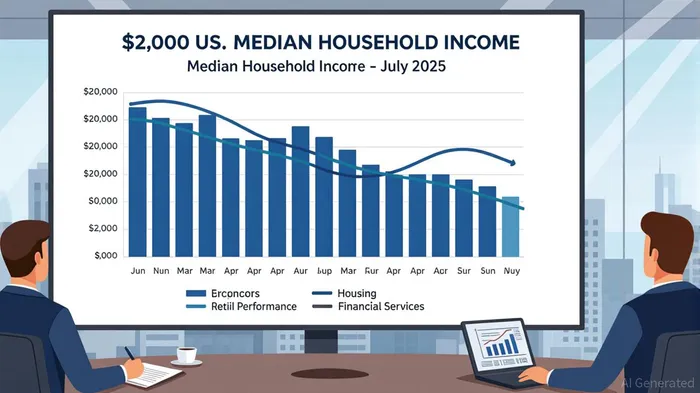
The U.S. economy is at a crossroads in 2025, with median household income signaling a troubling shift in consumer behavior. While June 2025 data from Motio Research showed a modest 0.6% increase to $83,680, July’s figures plunged to $78,171—a nearly $2,000 drop year-over-year [6]. This volatility underscores a fragile labor market and inflationary pressures, forcing investors to recalibrate their strategies. The decline in income is not just a statistical anomaly; it’s a harbinger of sector-specific disruptions in retail, housing, and financial services.
Retail: A K-Shaped Recovery Widens
The retail sector is experiencing a stark bifurcation. High-income households continue to splurge on luxury goods and premium experiences, driving growth in categories like apparel and home goods [5]. Meanwhile, middle- and lower-income consumers are tightening belts, opting for store brands and gift cards to stretch budgets [4]. According to Deloitte, core retail sales (excluding cars, gas, and restaurants) remain resilient due to low unemployment and real wage gains, but volume growth is lagging behind nominal figures [2]. Investors should prioritize retailers with omnichannel agility and value-driven offerings while avoiding mid-tier brands facing margin compression.
Housing: A Frozen Market with Lingering Risks
The housing sector is in a tailspin, with high mortgage rates (6.6%–7%) and rising home prices creating an affordability crisis. J.P. Morgan Research forecasts only a marginal easing to 6.7% by year-end, keeping demand suppressed [1]. Existing home sales have plummeted in early 2025, and the “lock-in effect” means many homeowners are reluctant to sell, fearing refinancing losses [3]. For investors, this means underweighting homebuilders and mortgage lenders but considering defensive plays in construction materials (e.g., lumber, steel) as supply constraints persist [6].
Financial Services: Navigating Credit Strain and Policy Uncertainty
Consumer credit is under stress, with rising delinquencies and a widening gap between high- and low-income borrowers. While low unemployment has cushioned defaults, Morgan StanleyMS-- notes that low-income households are drowning in credit card debt, a trend that could strain banks’ balance sheets [2]. Conversely, financial institutionsFISI-- with robust wealth management divisions may thrive, as high-net-worth clients continue to spend. The Federal Reserve’s anticipated rate cuts by late 2025 could provide relief, but investors should brace for sector volatility until affordability improves [6].
Strategic Rotation and Risk Mitigation
The income decline demands a tactical shift. Overweight sectors showing resilience—luxury retail, essential goods, and construction materials—while hedging against housing and mid-tier retail risks. Diversification into financial services firms with strong capital buffers and low exposure to subprime lending is critical. As the Fed’s policy pivot looms, maintaining liquidity and a short-term horizon will be key to navigating this uneven recovery.
Source:
[1] The Outlook for the U.S. Housing Market in 2025 [https://www.jpmorganJPM--.com/insights/global-research/real-estate/us-housing-market-outlook]
[2] U.S. Consumer Spending Trends to Watch in 2025 [https://www.morganstanley.com/insights/articles/us-consumer-spending-trends-2025]
[3] Is the Housing Market About to Turn? How Housing Can Impact the Economy [https://www.fiduciary-trust.com/insights/is-the-housing-market-about-to-turn-how-housing-can-impact-the-economy/]
[4] While Retail Sales Saw a Strong First Half of 2025, Will ' ... [https://retailwire.com/discussion/retail-sales-first-half-2025/]
[5] An update on US consumer sentiment [https://www.mckinsey.com/industries/consumer-packaged-goods/our-insights/the-state-of-the-us-consumer]
[6] Average Household Income US 2025 (Median Salary) [https://www.demandsage.com/average-us-income/]





Comentarios
Aún no hay comentarios