
The Impact of Declining Consumer Confidence on U.S. Equities and Economic Resilience
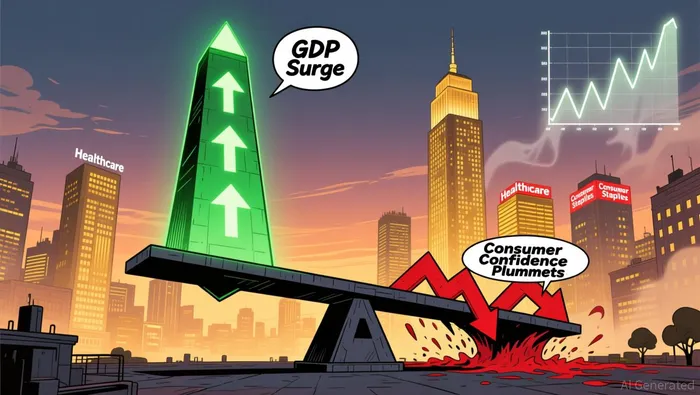
The U.S. economy entered 2026 with a paradox: robust GDP growth in Q3 2025 juxtaposed with a sharp decline in consumer confidence. By December 2025, the Conference Board's U.S. Consumer Confidence Index had fallen to 89.1, its second-lowest level of the year, driven by pessimism about business conditions and employment prospects. This divergence between macroeconomic performance and consumer sentiment raises critical questions about the resilience of equities and the sectors best positioned to navigate prolonged pessimism.
Defensive Sectors: Healthcare and Consumer Staples as Safe Havens
Defensive sectors, particularly healthcare and consumer staples, have emerged as relative safe havens amid economic uncertainty. In Q3 2025, healthcare led the S&P 500 in earnings surprises, with 93% of companies exceeding expectations. Consumer staples followed closely, with an 89% beat rate, underscoring their resilience despite tariffs and inflation. These sectors' outperformance aligns with their role as essential expenditures, even in downturns.
Healthcare's strength is further bolstered by structural tailwinds. The aging population and expansion into lower-acuity care settings, such as ambulatory surgery centers, are expected to drive volume growth in 2026. Additionally, AI-driven cost reductions in drug discovery and regulatory clarity from the One Big Beautiful Bill Act (OBBBA) could enhance margins. However, the sector faces headwinds, including a 5.43% probability of default and workforce shortages.
Consumer staples, while less volatile, have shown weaker performance in 2025, gaining only 1.72% year-to-date. This reflects shifting consumer behaviors and inflationary pressures. Yet, the sector's low volatility and consistent cash flows make it a buffer against macroeconomic turbulence, particularly if inflation moderates.
Cyclical Sectors: Discretionary and Industrials in the Crosshairs
Cyclical sectors, including consumer discretionary and industrials, face heightened risks from declining confidence and labor market fragility. Consumer discretionary underperformed in Q3 2025, with 24% of companies revising earnings forecasts downward. This aligns with broader trends: the Present Situation Index fell by 4.3 points in November 2025, reflecting deteriorating perceptions of the labor market.
Industrials, however, offer a nuanced outlook. While the sector's P/E ratio stood at 27.91 in late 2025, reflecting optimism about AI infrastructure spending and industrial production growth, 2026 projections suggest earnings-driven returns. Analysts anticipate 6.2% earnings growth for the sector in 2026, supported by tax incentives and potential Fed rate cuts. Yet, early 2026 may see sluggish hiring as businesses remain cautious about tariffs and trade policy.
Labor Market and Inflation: A Double-Edged Sword
The labor market's trajectory in 2026 will be pivotal. Unemployment is projected to peak at 4.5% in early 2026, signaling a soft but not collapsing market. While this could limit wage growth and consumer spending, it also creates a balanced environment for hiring in both cyclical and defensive sectors. For example, healthcare's job growth in 2025 accounted for a significant portion of total employment gains, a trend likely to continue if broader economic conditions stabilize.
Inflation, expected to moderate to 2.5% by year-end 2026, will further shape sector dynamics. Defensive sectors like utilities and staples may benefit from stable demand, while cyclical sectors could see improved margins if input costs decline. However, the risk of a recession remains, with consumer expectations for the next six months remaining weak, a level historically associated with rising recession risk.
Valuation Realism: Are Markets Pricing in Pessimism?
Current valuations for defensive and cyclical sectors suggest a mixed outlook. The S&P 500's forward P/E of 22.4 in mid-2025-above both 5- and 10-year averages-reflects optimism about earnings growth but raises concerns about stretched valuations. For healthcare, a forward P/E of 21.8 in 2026 appears reasonable given its structural growth drivers, though regulatory risks persist.
 Consumer discretionary's P/E of 29.21 in late 2025 indicates investor confidence in future earnings, but this may be overbought given the sector's exposure to consumer sentiment. Industrials' valuation, while elevated, is supported by AI-driven productivity gains and potential policy tailwinds as analysts suggest.
Conclusion: Navigating the Divergence
The U.S. equity market in 2026 is caught between a resilient GDP and a fragile consumer. Defensive sectors like healthcare and consumer staples offer stability, while industrials and consumer discretionary face a more uncertain path. Investors must weigh the realism of current valuations against macroeconomic risks, including a potential recession and lingering inflation. As the Federal Reserve adopts a "wait-and-see" approach, the key to navigating this divergence lies in balancing defensive positioning with selective exposure to cyclical sectors poised to benefit from policy-driven recovery.







Comentarios
Aún no hay comentarios