
The Impact of Australia's Under-16 Social Media Ban on Big Tech Compliance Costs and User Growth
Regulatory Landscape and Compliance Challenges
Australia's legislation mandates that platforms like Facebook, TikTok, and Instagram take "reasonable steps" to detect and deactivate underage accounts, with penalties of up to Aus$49.5 million for non-compliance, according to a Yahoo News report. The eSafety Commissioner, tasked with enforcement, has launched public education campaigns to ease the transition for families, but the law's ambiguity-such as the lack of universal age verification requirements-has drawn criticism. YouTube's challenge to the ban, arguing it is not a social media platform, highlights the sector's resistance to broad regulatory definitions, as described in a Malay Mail article.
Globally, similar pressures are emerging. The EU's Digital Services Act (DSA) and France's proposed under-13 ban reflect a principles-based approach emphasizing data privacy and content moderation, while the U.S. favors prescriptive rules, such as Texas's H.B. 20, which restricts viewpoint-based content moderation, noted in a UCLA Law Review article. These divergent strategies create compliance dilemmas for platforms operating across borders. For instance, a post removed under the DSA for violating EU laws could face legal exposure in the U.S. under Section 230 protections, according to a CCIANet analysis.
Compliance Costs and Strategic Divergence
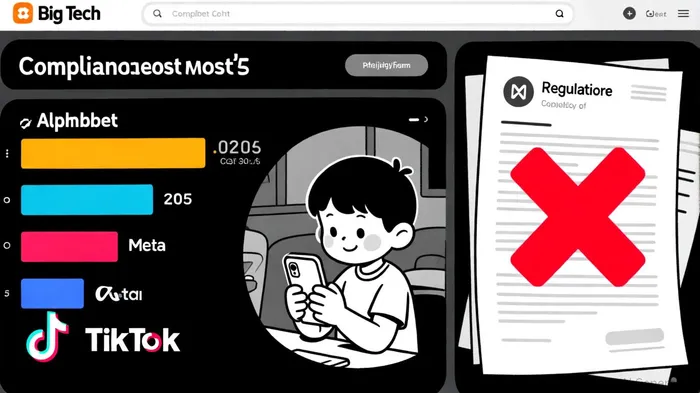
The financial burden of compliance varies significantly. Alphabet's proactive investment of $120 million in AI-based age inference tools has bolstered its regulatory resilience, contributing to a 3% stock rise in 2025, per a DISA analysis. In contrast, the same DISA analysis finds Meta's reactive approach to Instagram's age verification led to a 12% stock decline, underscoring the risks of delayed adaptation.
The EU's extraterritorial regulations, such as GDPR, further amplify costs. U.S. firms face average annual compliance expenses of $430 million per large company, with potential financial exposure ranging from $4.3 billion to $12.5 billion yearly, according to a GRC2020 report. These figures highlight the growing tension between innovation and regulatory compliance, particularly for platforms reliant on global user bases.
User Growth Metrics and Platform Dynamics
Australia's pre-ban user data reveals a highly engaged population: 77.9% of Australians are active on social media, with TikTok users spending an average of 38 hours monthly on the platform, per a Retain Media report. The under-16 ban, however, risks displacing younger users to less regulated spaces, such as private messaging apps or unmonitored platforms. While platforms like MetaMETA-- and TikTok have begun deactivating underage accounts, enforcement remains a phased process, with no immediate data on user growth shifts, as reported in an Economic Times article.
Globally, user growth is increasingly constrained by regulatory headwinds. In the EU, the DSA's content moderation requirements have led to reduced engagement on niche platforms, while U.S. states like Texas have seen a rise in alternative platforms catering to deregulated content, a trend highlighted in a Biometric Update piece. These trends suggest that regulatory fragmentation may fragment user bases, creating opportunities for smaller, agile platforms to capture market share.
Opportunities in Regulatory Resilience
Despite the challenges, regulatory pressures are driving innovation. Platforms investing in privacy-compliant age verification tools, such as Alphabet's AI-based solutions, are positioning themselves as leaders in responsible tech. Additionally, the push for localized compliance strategies-such as tailored content moderation policies-offers opportunities to differentiate in markets with stringent regulations.
The EU's principles-based framework, while costly, also incentivizes long-term innovation. For example, the DSA's emphasis on transparency has spurred the development of open-source moderation tools, which could lower compliance costs for smaller firms, according to a Cullen International report. Similarly, Australia's focus on public education campaigns may set a precedent for collaborative regulatory approaches that balance safety with user empowerment.
Conclusion
Australia's under-16 ban is a microcosm of the broader regulatory challenges facing the global social media sector. While compliance costs and enforcement ambiguities pose risks, they also catalyze innovation in age verification and responsible platform design. For investors, the key lies in identifying firms that can adapt to this evolving landscape-those that treat regulation not as a burden, but as a catalyst for sustainable growth.





Comentarios
Aún no hay comentarios