
Immutable X's 70% September Rally: A Structural Shift in On-Chain Behavior or a Short-Lived Frenzy?
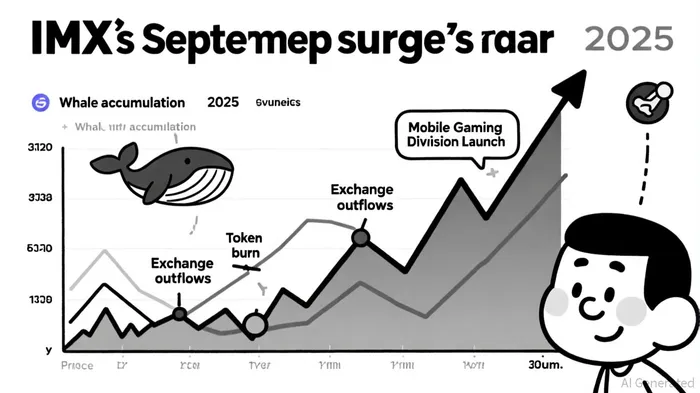
In September 2025, ImmutableIMX-- X's IMXIMX-- token surged by 70% in just two weeks, sparking debates about whether this rally reflects a structural shift in on-chain behavior or a speculative frenzy. To answer this, we must dissect the interplay of on-chain fundamentals, token economics, and strategic developments.
On-Chain Metrics: Accumulation, Outflows, and Transactional Resilience
Immutable X's on-chain data reveals a compelling narrative of accumulation and reduced selling pressure. Large holders (10,000–10 million IMX tokens) increased their holdings, while smaller investors sold off, a pattern often associated with institutional-grade confidence[1]. Whale transactions exceeding $100K and $1 million surged, signaling deep-pocketed participation[1]. Exchange outflows outpaced inflows, with only 7.33% of the IMX supply now on exchanges—the lowest since May 2025[3]. This shift toward private wallets suggests a transition from speculative trading to long-term holding, a hallmark of structural adoption.
Transaction volume on Immutable zkEVM also rose by 5.7% quarter-over-quarter, processing an average of 498,000 daily transactions[5]. While daily active addresses declined by 31.5%, the average transaction fee in IMX increased by 28.8%, indicating higher-value interactions rather than broad user participation[5]. This aligns with Immutable's focus on gaming and NFTs, where high-net-worth users dominate activity.
Token Economics: Deflationary Pressures and Supply Dynamics
Immutable X employs token burning as a core deflationary mechanism, sending tokens to a zero address on EthereumETH-- L1 and a paired Stark key on L2[5]. While specific September 2025 burn volumes remain unreported, the platform's zero-gas-fee model for NFTs and gaming transactions inherently drives IMX utility[3]. Additionally, Immutable Passport holders receive subsidized gasGAS-- fees, further incentivizing token retention[5].
However, a critical supply-side risk emerged on September 5: a 24.5M token unlock (1.3% of total supply) entered circulation[4]. Historical data suggests such unlocks could correlate with 15–25% price dips[1]. Yet, the market's resilience—despite this dilution—points to strong demand fundamentals. The IMX token's utility in staking, governance, and fee payments creates a flywheel effect, where increased adoption drives scarcity[3].
Strategic Catalysts: Mobile Gaming and Industry Partnerships
Immutable's September 19 launch of its Mobile Gaming Division marked a pivotal moment. Targeting the $121 billion mobile gaming market, this initiative aims to onboard mainstream studios and leverage regulatory shifts (e.g., the Epic Games court ruling) to bypass app store fees[1]. The division's focus on gas-free NFTs and creator incentives (e.g., Netmarble's NPC M program) strengthens IMX's utility beyond speculative trading[1].
Partnerships with Ubisoft (Might & Magic Fates) and MEXC further diversified adoption channels. Ubisoft's integration of zkEVM for gas-free trading cards and MEXC's streamlined token transfers expanded Immutable's ecosystem reach[1]. These moves mitigate reliance on volatile NFT markets and position IMX as a foundational asset for web3 gaming.
Industry Benchmarks: Immutable vs. Layer-2 Rivals
Immutable X's performance against peers like Polygon and ArbitrumARB-- highlights its niche strengths. While Polygon dominates in daily active addresses (1.2 million in Q2 2024) and TVL ($4.12 billion in Q3 2025), Immutable leads in NFT sales volume ($22.5M 30-day sales vs. Polygon's $12.1M and BNBBNB-- Chain's $7.6M)[1]. Its 9,000 TPS and $0.001 NFT mint cost make it the most efficient Layer-2 for gaming[2]. However, Immutable's 1.8% market share in blockchain gaming games lags behind BNB Chain (35.5%) and Polygon (12.6%), underscoring competition from rivals with broader developer ecosystems[1].
Is This a Structural Shift or a Frenzy?
The September rally appears to straddle both narratives. Structural factors include:
- Whale accumulation and reduced exchange supply, signaling long-term conviction[1][3].
- Strategic product launches (Mobile Gaming Division) that expand IMX's utility beyond NFTs[1].
- Deflationary mechanisms that align with broader crypto trends, where token burns correlate with price surges (e.g., a 160%–192% rally after a 65M→21M token burn)[4].
Yet short-term risks persist:
- The September 5 token unlock could reintroduce volatility[4].
- Competition from SeiSEI-- and SolanaSOL-- threatens Immutable's gaming market share[1].
- NFT market cycles remain unpredictable, with Q1 2025 sales dropping 1.6% quarter-over-quarter[6].
Conclusion: A Hybrid of Fundamentals and Frenzy
Immutable X's 70% rally is best understood as a hybrid of structural adoption and speculative momentum. On-chain accumulation, strategic product innovation, and deflationary tokenomics lay a foundation for long-term growth. However, the token's susceptibility to supply-side shocks and market cycles means investors should balance optimism with caution. For IMX to sustain its trajectory, the Mobile Gaming Division must deliver tangible user growth, and token burns must outpace unlocks. If these conditions hold, the rally could evolve from a frenzy into a structural shift.






Comentarios
Aún no hay comentarios