
The Imminent Altcoin Rotation as Bitcoin Dominance Stalls
The cryptocurrency market in early 2026 stands at a pivotal inflection point. BitcoinBTC-- dominance, a metric representing Bitcoin's share of the total crypto market capitalization, has stabilized at approximately 59.6% as of late 2025, signaling a maturing market structure. While this figure remains above the 55% threshold historically associated with altcoin outperformance according to analysis, the broader ecosystem is primed for a rotation. Institutional adoption, regulatory clarity, and sector-specific innovations are converging to create a unique environment where altcoins could gain traction in early 2026. This analysis explores the dynamics of capital flow, timing indicators, and strategic opportunities for investors.
Bitcoin Dominance: A Stabilized but Not Immune Landscape
Bitcoin's dominance has held firm despite macroeconomic volatility, with institutional demand acting as a stabilizing force. As of November 2025, Bitcoin's market capitalization of $1.65 trillion accounts for nearly 60% of the global crypto market. This resilience is driven by Bitcoin's role as a hedge against fiat currency risks and its adoption in registered investment vehicles, such as spot ETFs, which have attracted $60.8 billion in institutional capital. However, the Altcoin Season Index-a separate metric measuring market sentiment toward altcoins-currently sits at 35, far below the 75 threshold required for broad-based altcoin outperformance. This suggests that while Bitcoin remains the gravitational center of capital flows, the conditions for a rotation are brewing.
Historical Patterns and Institutional Influence
Historical cycles provide a roadmap for understanding the timing of altcoin rotations. In 2017 and 2021, Bitcoin dominance fell from 86.3% to 38% and 70% to 38%, respectively, triggering explosive altcoin rallies. For example, EthereumETH-- surged 800% in 2021 as DeFi and NFTs gained traction, while SolanaSOL-- rose by 20,000% according to market data. However, 2026's rotation is expected to differ due to institutional participation. Unlike past cycles, where speculative retail-driven flows dominated, 2026's rotation will likely be more measured, with capital flowing into large-cap altcoins aligned with institutional-grade narratives such as real-world asset (RWA) tokenization and decentralized AI.
Institutional infrastructure, including JPMorgan's on-chain funds and platforms like OndoONDO-- Finance and Maple FinanceSYRUP--, is redirecting capital toward yield-generating products. This structural shift reduces the likelihood of a sharp drop in Bitcoin dominance to levels seen in prior cycles. Instead, a gradual decline to 50% or below-triggered by macroeconomic catalysts-could mark the onset of a more selective altcoin season.
Sector-Specific Opportunities in 2026
The 2026 altcoin rotation is expected to be narrative-driven, with capital flowing into sectors that address institutional-grade use cases. Three key areas stand out:
- Real-World Asset (RWA) Tokenization: Platforms like Chainlink (LINK) and Ondo (ONDO) are positioned to benefit from the $25 billion RWA market, which includes tokenized treasuries and private credit. Chainlink's role in bridging blockchain with real-world data and ONDO's institutional-grade access to treasuries make them strong candidates for capital inflows according to market analysis.
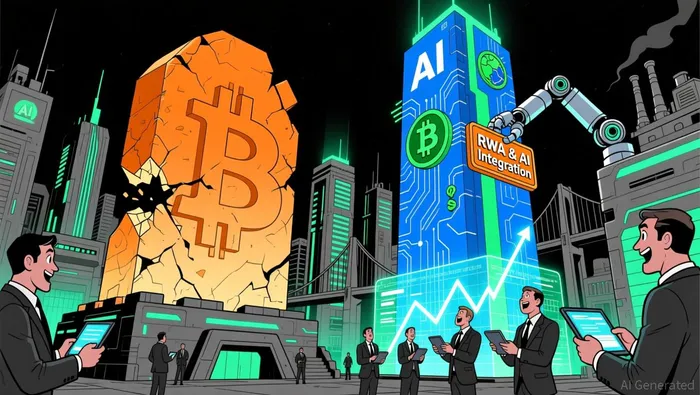
- Decentralized AI Infrastructure: Render (RENDER), which provides GPU resources for decentralized AI training, is gaining traction as institutional demand for AI-driven solutions grows.
- Bitcoin Layer 2 Solutions: Innovations in Bitcoin's scalability, such as the Lightning Network and Ordinals protocol, could drive adoption of Layer 2-focused projects, though specific tokens remain speculative at this stage according to technical analysis.
Emerging projects like Mutuum Finance (MUTM) also show promise, with early development progress and investor interest suggesting a potential 650% price increase in 2026.
Timing the Rotation: Macroeconomic Catalysts
The rotation's timing hinges on macroeconomic developments. The Federal Reserve's January 2026 rate pause-a "Goldilocks" scenario of cautious policy-has created a favorable environment for crypto adoption. This policy stance, combined with the CFTC's planned regulatory framework for digital assets by Q1 2026, is expected to reduce uncertainty and attract institutional capital.
Bitcoin's price consolidation between $120,600 and $129,000 in early 2026 could act as a catalyst for profit-taking capital to flow into altcoins. Historical patterns suggest that a drop in Bitcoin dominance below 50%-potentially occurring in Q2 2026-will signal the start of a multi-stage rotation:
1. Bitcoin Consolidation: Institutional inflows into Bitcoin ETFs stabilize its price.
2. Large-Cap Altcoin Participation: Ethereum and RWA-aligned tokens like LINKLINK-- and ONDO gain traction.
3. Mid/Small-Cap Altcoin Cascade: Capital flows into niche projects like RENDER and MUTM according to market forecasts.
Strategic Investment Considerations
For investors, the key is to balance exposure to Bitcoin's stability with strategic entry into altcoins. Given the current Altcoin Season Index, a staged approach is advisable:
- Q1 2026: Allocate to Bitcoin and Ethereum as macroeconomic clarity emerges.
- Q2 2026: Shift capital into large-cap altcoins as Bitcoin dominance dips below 55%.
- Q3–Q4 2026: Target mid/small-cap altcoins aligned with RWA and AI narratives.
Risk management is critical, as volatility remains a feature of the crypto market. Diversification across sectors and use of stop-loss mechanisms can mitigate downside risks.
Conclusion
The 2026 altcoin rotation is not a binary event but a nuanced process shaped by institutional infrastructure, regulatory progress, and sector-specific innovation. While Bitcoin dominance remains elevated, the convergence of macroeconomic stability and institutional-grade narratives positions altcoins for a measured but significant outperformance. Investors who align their strategies with these dynamics-prioritizing RWA, decentralized AI, and Bitcoin Layer 2 solutions-stand to capitalize on the next phase of crypto's evolution.







Comentarios
Aún no hay comentarios