
U.S. Immigration Policy Shifts and the Tech Sector: Assessing Long-Term Risks to Talent and R&D
The Trump administration's imposition of a $100,000 fee on new H-1B visa applications in September 2025 has ignited significant shareholder backlash and operational uncertainty within the U.S. tech industry. This policy, coupled with intensified ICE enforcement actions, is reshaping the landscape of high-skill labor markets and corporate R&D spending. As companies grapple with the financial and strategic implications of these shifts, the long-term risks to innovation ecosystems and global competitiveness are becoming increasingly pronounced.
Immediate Financial and Operational Impacts
The $100,000 fee has disproportionately affected smaller tech startups, which lack the financial buffers of larger corporations to absorb such costs. According to a report by , this policy is forcing firms to explore alternatives like upskilling U.S. workers, forming partnerships with local educational institutions, and nearshoring talent from countries like Poland. 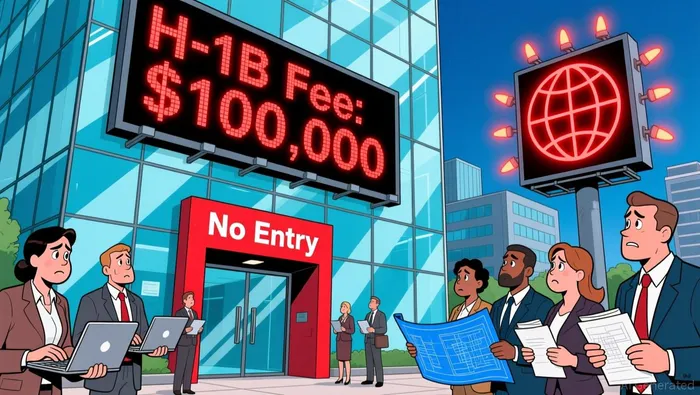 Meanwhile, major tech firms have advised their H-1B visa holders to remain in the U.S. or return immediately, signaling the disruptive impact of the policy. Indian tech firms, including InfosysINFY-- and Tata Consulting Services, have seen immediate stock price declines due to the humanitarian and economic consequences of the fee.
The financial burden extends beyond direct costs. A Bloomberg analysis highlights that the new fee is shifting corporate focus from innovation to administrative compliance, with resources diverted to navigate the complexities of the revised visa process. This reallocation of capital risks stifling long-term R&D investment, particularly in fields like AI and advanced engineering, where access to global talent is critical.
ICE Enforcement and Talent Uncertainty
Complementing the H-1B fee, ICE enforcement trends have introduced further instability. A 2025 policy shift prioritizing a wage-based lottery system for H-1B visas and stricter audits has heightened uncertainty for employers and workers alike. Large-scale raids, such as the Hyundai battery-plant construction site incident in Georgia, have exacerbated labor shortages and compliance costs, with nearly 40% of U.S. workers reporting reduced workplace security. While these actions primarily target low-skill labor, their ripple effects extend to high-skill sectors, where workforce stability is vital for R&D continuity.
For startups, the H-1B visa lottery outcomes have a measurable impact on survival probabilities. A study by the Atlanta Fed notes that winning firms are 3 percentage points more likely to remain operational, underscoring the program's role in sustaining innovation. Conversely, restrictive policies risk exacerbating labor shortages and slowing technological advancement, particularly in STEM fields.
Global Competition and R&D Trends
The U.S. is not the only player in the global race for tech talent. Countries like Canada, the UK, and China are adopting more flexible immigration policies to attract skilled workers. For instance, Canada's Global Talent Stream under the Temporary Foreign Worker Program has streamlined work permits for tech professionals, offering a competitive edge. Meanwhile, China's R&D spending grew by 8.9% in 2023, nearly double the U.S. rate, with its GERD reaching 96% of U.S. levels in PPP-adjusted terms.
The U.S. tech sector's historical reliance on immigrant talent-responsible for 23% of patents and 25% of their economic value-is now under threat. Restrictive policies risk eroding this advantage, as companies increasingly consider offshoring operations to countries with more accommodating immigration systems. For example, the 89-year green card wait time for Indian nationals has prompted firms to explore alternatives in India or Canada.
Long-Term Economic Projections
Long-term projections suggest that restrictive immigration policies could reduce U.S. R&D investment and innovation output. A model by the Richmond Fed estimates that removing immigration barriers could increase firm entry by 65%, leading to higher productivity and economic efficiency. Conversely, a 10% reduction in college-educated immigrants could shrink annual welfare for U.S. natives by $2.9 billion.
Federal R&D spending is also at risk. The ITIF warns that a 20% cut in federal R&D funding could shrink the U.S. economy by $1 trillion over a decade. As China and other competitors ramp up investments in AI, quantum computing, and climate technologies, the U.S. risks losing its innovation edge.
Conclusion
The Trump administration's immigration policies are creating a dual challenge for the U.S. tech sector: immediate financial strain and long-term erosion of competitive advantages. While large corporations may weather the costs, smaller firms and startups face existential risks. Globally, the U.S. is losing ground to nations with more adaptive immigration frameworks, threatening its leadership in R&D and innovation. For investors, the implications are clear: a recalibration of immigration policy is essential to sustain the U.S. tech ecosystem's vitality.





Comentarios
Aún no hay comentarios