
U.S. Immigration Policy Shifts and South Korea's Economic Crossroads: Geopolitical Risks and Investor Sentiment in 2025
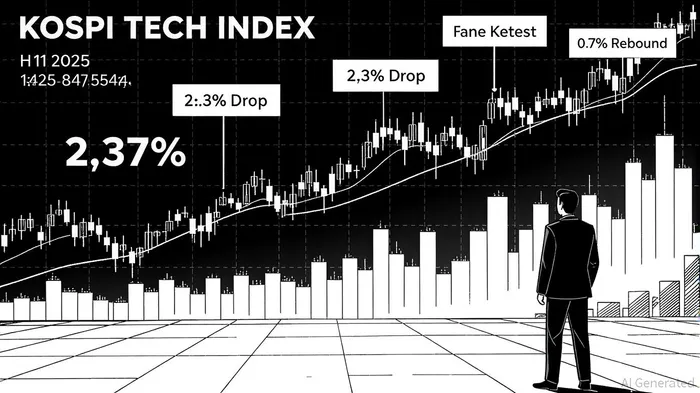
The 2025 U.S. immigration policy overhaul, particularly the tightening of H-1B visaV-- rules and the introduction of median wage requirements, has sent shockwaves through global tech ecosystems. For South Korea, a nation deeply intertwined with U.S. semiconductor supply chains and a key player in the global race for AI talent, these shifts represent both a challenge and an opportunity. This analysis examines how U.S. policy changes are reshaping investor sentiment, geopolitical risk perceptions, and stock market dynamics in South Korea, with a focus on the KOSPI tech index and major firms like Samsung and SK Hynix.
1. U.S. Immigration Policy and the Semiconductor Talent War
The U.S. H-1B visa program, long a lifeline for tech firms, now faces stricter caps and wage mandates. According to a report by BAL.com, South Korea’s new top-tier visa—targeting advanced industries like semiconductors—aims to attract foreign professionals with advanced degrees and work experience, signaling a strategic pivot to counter U.S. restrictions [1]. This move reflects a broader global competition for talent, as U.S. firms may increasingly turn to South Korea to fill gaps left by restricted Indian and Chinese engineers [1].
However, the U.S. policy shift risks destabilizing cross-border collaboration. For instance, the revocation of "validated end-user" (VEU) authorizations for South Korean chipmakers operating in China has already triggered a 4.4% drop in SK Hynix shares and a 2.3% decline in Samsung’s stock [2]. These restrictions, part of a broader U.S. effort to curb China’s access to advanced technology, have forced firms to navigate complex licensing hurdles, raising operational costs and delaying production timelines [2].
2. Geopolitical Risks and Investor Sentiment
The Trump administration’s 2025 trade policies, including 25% tariffs on South Korean goods, have exacerbated investor anxiety. A Q2 2025 market outlook by Trillium Invest notes that the S&P 500 experienced a sharp decline following the "Liberation Day" tariff announcement, with South Korean tech stocks particularly vulnerable due to their export-dependent business models [5]. While a 90-day tariff pause allowed partial recovery, the KOSPI tech index remains volatile, reflecting uncertainty over future U.S. policy shifts [5].
Geopolitical tensions further complicate the landscape. South Korea’s strategic balancing act between U.S. alignment and economic ties with China has led to a recalibration of foreign policy, with investors factoring in risks of U.S. troop reductions or weakened security guarantees [3]. This uncertainty is compounded by the Hyundai-LG battery plant immigration raid in Georgia, which detained 300 South Korean nationals and triggered a 3.77% drop in SK Hynix shares [5]. Such events highlight the fragility of U.S.-South Korea business relationships amid heightened enforcement of immigration laws.
3. KOSPI Tech Index and Stock Performance
Despite these headwinds, South Korea’s tech sector has shown resilience. The KOSPI tech index surged 30% year-to-date in 2025, driven by IPO activity and corporate governance reforms [4]. However, this growth has been uneven. For example, Samsung’s stock rose 0.71% on May 30, 2025, amid hopes for a tariff resolution, only to fall 1.65% after the July 30 tariff reduction [3]. SK Hynix, conversely, saw a 3.8% surge post-tariff cut, reflecting divergent investor perceptions of risk and recovery potential [3].
The U.S. H-1B policy changes, while not directly cited in stock performance data, indirectly influence investor behavior. A JPMorganJPM-- report notes that U.S. immigration restrictions could deter foreign investment in high-skill sectors, potentially affecting South Korea’s ability to attract capital [4]. This is critical for firms like Samsung, which relies on U.S. equipment for its advanced chip manufacturing and faces profit declines due to supply chain disruptions [3].
4. Strategic Implications for Investors
Investors must navigate a dual challenge: the U.S. policy-driven talent and trade shifts, and South Korea’s domestic efforts to modernize its labor market. While the KOSPI tech index has outperformed other Asian markets in 2025, its volatility underscores the need for hedging against geopolitical risks. For instance, the index’s 0.7% rebound in August 2025 followed a temporary easing of U.S. tariffs, illustrating how short-term policy adjustments can drive market sentiment [6].
Long-term strategies should focus on firms with diversified supply chains and strong domestic innovation capabilities. South Korea’s push for regulatory sandboxes and tax incentives in high-tech sectors [2] may mitigate some U.S. policy impacts, but investors must remain vigilant about U.S.-China tensions and the potential for further immigration restrictions.
Source:
[1] South Korea | New top-tier visa announced [https://www.bal.com/immigration-news/south-korea-new-top-tier-visa-announced/]
[2] US makes it harder for SK Hynix, Samsung to make chips in China [https://ca.finance.yahoo.com/news/us-harder-intel-sk-hynix-130540521.html]
[3] Seoul shares snapSNAP-- 6-day winning streak after U.S. tariff deal [https://koreajoongangdaily.joins.com/news/2025-07-31/business/finance/Seoul-shares-snap-6day-winning-streak-after-US-tariff-deal/2366155]
[4] Kospi could soar 50% in 2 years: JPMorgan [https://www.koreaherald.com/article/10530391]
[5] Q2 2025 Economic and Market Outlook [https://www.trilliuminvest.com/newsroom/q2-2025-economic-and-market-outlook]
[6] KOSPI Index Performance: Gains 0.58% to 3089.65 [https://www.ebc.com/forex/kospi-index-performance-gains--to]





Comentarios
Aún no hay comentarios