
U.S. Immigration Policy Shifts and Their Impact on Labor Markets and Investment Opportunities
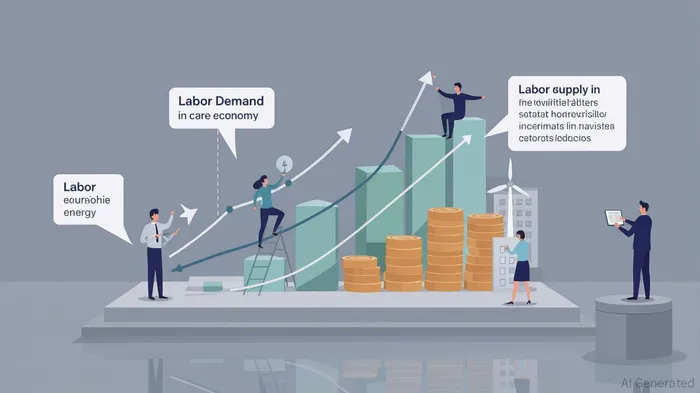
The U.S. immigration landscape remains a critical, yet often underappreciated, determinant of labor market dynamics and investment returns. While recent judicial decisions on unaccompanied migrant children have not been explicitly identified in 2024–2025 [1], broader policy environments and demographic shifts continue to shape labor supply in key sectors. Investors must grapple with how evolving immigration frameworks—whether through enforcement, asylum access, or child-specific protections—interact with structural labor shortages and emerging economic opportunities.
Labor Market Implications: Care Economy and Green Transition
The Future of Jobs Report 2025 underscores a stark reality: care economy roles, including nursing and personal care, are among the fastest-growing occupations, driven by aging populations and rising demand for services [2]. Simultaneously, the renewable energy sector is surging, with wind and solar power installations expanding at unprecedented rates . These trends highlight a dual challenge: filling low-skill, labor-intensive roles in care and high-skill, technical positions in green energy.
Unaccompanied migrant children, often reliant on federal programs for housing and education, represent a demographic that could theoretically bolster the labor supply in care sectors if integrated into training pipelines. However, restrictive policies—such as expedited removals or limited access to legal status—create uncertainty, deterring long-term workforce participation. Conversely, policies that facilitate pathways to legal residency or vocational training could alleviate shortages in these critical areas.
Investment Opportunities in a Policy-Driven Landscape
For investors, the interplay between immigration policy and labor supply offers both risks and opportunities. In the care economy, firms that partner with government agencies to provide job training for immigrant populations may see outsized returns. Similarly, renewable energy firms that address labor bottlenecks—through apprenticeships or immigration-compliant hiring practices—could gain competitive advantages as the sector scales.
The absence of direct judicial rulings on unaccompanied minors in recent years does not negate the indirect influence of policy environments. For instance, the Biden administration's 2023 “Title 42” termination and expanded asylum access likely increased the pool of potential workers in low-wage sectors, indirectly supporting industries reliant on immigrant labor [2]. Such shifts, while not court-mandated, reflect administrative priorities that shape economic outcomes.
Conclusion: Navigating Uncertainty
The lack of recent judicial decisions on unaccompanied migrant children does not render immigration policy irrelevant to investors. Instead, it underscores the need to monitor administrative actions, demographic trends, and sector-specific labor demands. As the care economy and green transition reshape the U.S. economy, immigration policy will remain a pivotal, if indirect, lever in determining labor supply and investment viability.







Comentarios
Aún no hay comentarios