
U.S. Immigration Policy Shifts: Assessing Long-Term Risks for Investors in Diversity Visa-Dependent Sectors
The U.S. Diversity Visa (DV) Program, a cornerstone of legal immigration for underrepresented countries, has faced unprecedented disruption in 2025. Following the suspension of the green card lottery by President Donald Trump after the Brown University and MIT shootings, the program's future remains shrouded in legal and political uncertainty. This abrupt policy shift, coupled with broader enforcement strategies, has sent shockwaves through sectors reliant on immigrant labor, creating a volatile landscape for international investors.
Disruption of Migration Flows and Sectoral Vulnerability
The DV Program, which allocates up to 50,000 green cards annually to applicants from countries with historically low U.S. immigration rates, was suspended in 2025 amid claims of national security risks. Nearly 20 million people applied for the 2025 lottery, with over 131,000 selected, yet the program's halt has left these applicants in limbo. For sectors like construction, healthcare, and hospitality-industries already grappling with labor shortages-the suspension exacerbates existing vulnerabilities.
Data from the Federal Reserve Bank of Minneapolis reveals that declining net immigration accounts for 40–60% of the recent drop in U.S. job growth, particularly in labor-intensive sectors. For example, the construction industry, where one in four laborers are immigrants, reports 92% of contractors struggling to find qualified workers. Similarly, healthcare and home care services face critical staffing gaps, with immigrant workers filling roles that underpin the sector's operational capacity. The DV Program's suspension threatens to deepen these shortages, driving up labor costs and delaying projects.
A 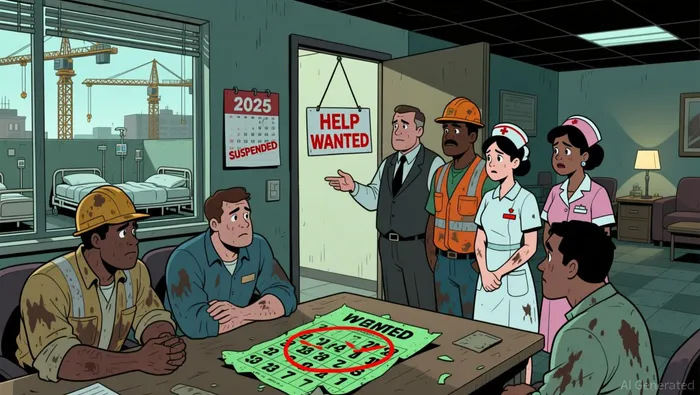 would help visualize the impact of the policy change.
Legal Challenges and Policy Uncertainty
The legality of the 2025 suspension remains contested. While the Trump administration framed the move as a national security measure, critics argue it lacks statutory basis, as the State Department typically administers the program. Legal battles are likely to prolong uncertainty, with courts potentially forcing a reinstatement or validating the suspension. This ambiguity complicates long-term planning for investors, particularly in sectors where immigration policy directly influences labor supply and economic output.
Compounding this, the administration's expansion of travel bans to 32 countries in late 2025 further restricts immigration pathways. These policies, justified as counterterrorism measures, have created a more restrictive environment for legal immigration, including the DV Program. For investors, the risk of sudden policy reversals or prolonged legal disputes necessitates a hedging strategy that accounts for regulatory volatility.
Enforcement Strategy Changes and Sectoral Exposure
Post-2025, U.S. immigration enforcement has shifted toward aggressive deportation policies and expanded border security. Nationwide expedited removals, which allow for rapid deportations of undocumented immigrants with less than two years of U.S. residency, have increased operational risks for industries reliant on immigrant labor. For example, construction firms report that one-third of operations have been disrupted by immigration enforcement activities, leading to project delays and rising costs.
Meanwhile, the Department of State's undisclosed changes to the 2027 DV Program-announced in November 2025-add another layer of unpredictability. While the registration period for DV-2027 remains scheduled from October 1, 2026, to September 30, 2027, the lack of clarity on application process adjustments forces investors to navigate a patchwork of evolving rules.
Investor Risks and Hedging Strategies
For international investors, the DV Program's suspension and broader enforcement shifts highlight three key risks:
1. Labor supply shocks in sectors like agriculture, hospitality, and healthcare, with potential ripple effects on GDP growth and inflation.
2. Processing delays in investor visa programs (e.g., EB-5) due to heightened scrutiny of financial documentation and source-of-funds.
3. Policy volatility creates a regulatory environment where today's rules may be overturned tomorrow.
To mitigate these risks, investors should adopt the following strategies:
- Legal audits ensure all immigration documentation, including source-of-funds and business plans, is meticulously prepared to withstand intensified scrutiny.
- Diversification spreads investments across sectors less reliant on immigrant labor, such as technology or finance, to balance exposure.
- Legal expertise partners with immigration attorneys to navigate policy shifts and explore alternative pathways, such as National Interest Exceptions (NIEs) for restricted countries.
- Scenario planning builds contingency budgets for potential delays in visa processing and labor shortages, particularly in construction and healthcare.
A could provide useful insights into migration-related investment trends.
Conclusion
The 2025 suspension of the DV Program and the broader crackdown on immigration signal a new era of policy-driven volatility for U.S. immigration-dependent economies. For international investors, the stakes are clear: sectors reliant on immigrant labor face heightened risks from labor shortages, legal battles, and enforcement shifts. By proactively hedging against these uncertainties-through diversification, legal preparedness, and strategic planning-investors can navigate the turbulent landscape and safeguard long-term returns.







Comentarios
Aún no hay comentarios