
The Illusion of Predictability: Why Bitcoin Price Forecasts Fail in a Speculative Market
Bitcoin's price has long been a lightning rod for speculation, with analysts, institutions, and retail investors alike offering bold predictions. Yet, as the cryptocurrency's volatility and real-world outcomes demonstrate, these forecasts are inherently unreliable. The root cause lies not in Bitcoin's technical properties but in the psychological and structural dynamics of its market. From herding behavior to institutional manipulation, the forces shaping Bitcoin's price defy traditional analytical frameworks, rendering predictions a precarious exercise in guesswork.
Investor Psychology: The Engine of Volatility
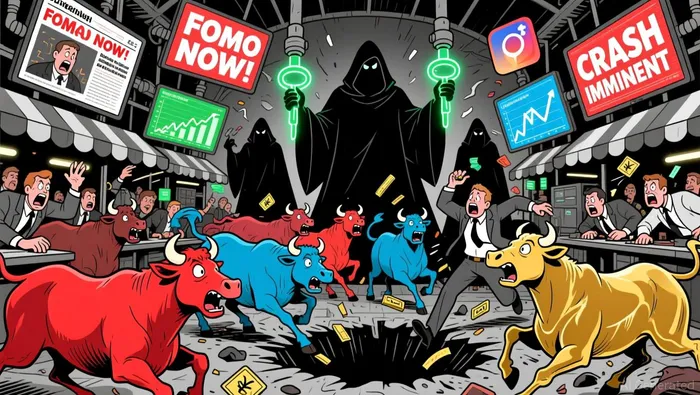
Academic research underscores how investor psychology drives Bitcoin's erratic price swings. Herding behavior, where traders mimic the actions of others rather than relying on fundamentals, is rampant in crypto markets. Social media amplifies this effect, turning viral trends into speculative frenzies according to a 2022 study. For instance, the 2025 BitcoinBTC-- crash was partly fueled by a "liquidity vacuum" as traders rushed to sell after the Federal Reserve delayed rate cuts according to Forbes analysis. This herd mentality is compounded by behavioral biases such as the disposition effect-traders holding onto losing positions while selling winners too early as research shows. Such irrationality creates a feedback loop: panic selling during downturns and euphoric buying during rallies, distorting price signals.
Institutional investors and "whales" exacerbate these dynamics. Studies show that institutional activity accounts for a disproportionate share of Bitcoin's volatility according to a 2023 paper. These actors, with their vast capital and advanced analytics, can manipulate sentiment and liquidity, creating artificial price movements. For example, JPMorgan's recent $170,000 price target for Bitcoin is based on a gold-based risk-capital model as reported by CoinDesk, yet this approach ignores the behavioral factors that have historically derailed similar predictions.
The Flawed Logic of Predictive Models
JPMorgan's bullish forecasts highlight a broader issue: the overreliance on simplistic models that conflate correlation with causation. The bank's argument that Bitcoin should trade at a 1.8x risk-capital premium to gold as reported by Yahoo Finance assumes a stable relationship between the two assets, ignoring the unique speculative nature of crypto markets. This approach mirrors the flawed logic of pre-2008 housing bubble models, which similarly underestimated behavioral and systemic risks.
The 2025 Bitcoin crash laid bare these shortcomings. Despite JPMorgan's assertion that $94,000 was a "floor" price based on production costs according to Forbes reporting, the asset plummeted below $90,000 as macroeconomic shifts and ETF outflows triggered a sell-off as reported by Yahoo Finance. Such outcomes reveal the limits of analytical rigor in a market where fundamentals are often secondary to sentiment.
Real-World Consequences: From Individual Tragedies to Institutional Fiascos
The human cost of speculative misjudgment is stark. James Howells, a UK resident, accidentally discarded a hard drive containing 7,500–8,000 BTC (worth $937 million to $1 billion) in 2025 according to 247WallSt reporting. His story is emblematic of how individual errors-often driven by overconfidence or poor risk management-can lead to catastrophic losses. Similarly, Stefan Thomas, a German programmer, lost 7,002 BTC ($875 million) due to a forgotten password according to 247WallSt reporting. These cases illustrate the personal toll of treating Bitcoin as a speculative gamble rather than a long-term investment.
Institutional failures are equally instructive. Sequans Communications, a French semiconductor firm, saw its stock drop 83% after a controversial Bitcoin strategy failed to offset poor operational performance according to Chainalysis. Meanwhile, Ming Shing Group's $483 million Bitcoin purchase plan triggered a 78% stock plunge as investors questioned its viability according to Chainalysis reporting. These examples underscore how speculative bets can distract from core business fundamentals, creating value destruction rather than growth.
The Path Forward: Embracing Uncertainty
Bitcoin's price will always be a function of its speculative nature. While institutional adoption and macroeconomic factors will influence its trajectory, the interplay of investor psychology and market structure ensures that predictions remain unreliable. For investors, the lesson is clear: treat Bitcoin not as a predictable asset but as a high-risk, high-uncertainty proposition. As the 2025 crash demonstrated, even the most sophisticated models cannot account for the chaos of human behavior according to Forbes analysis.
In the end, Bitcoin's value lies not in its price tag but in its role as a mirror for the irrational exuberance and fear that define speculative markets. Until investors recognize this, forecasts will remain as fleeting as the trends that drive them.







Comentarios
Aún no hay comentarios