
Illicit Crypto Holdings Surpassing $75B and Bitcoin's Dominance: Assessing the Risks and Opportunities in a Fragmented Crypto Regulatory Landscape
The global cryptocurrency ecosystem in 2025 is defined by two paradoxical forces: the staggering scale of illicit activity and the maturation of institutional adoption. According to Chainalysis' 2025 report, $75 billion in illicit crypto holdings now reside on blockchains, split between criminal-linked wallets ($15 billion) and downstream wallets tied to illicit activity ($60 billion) (Chainalysis' 2025 report). Meanwhile, Bitcoin's market dominance has surged to 64% in Q3 2025, driven by ETF inflows and macroeconomic tailwinds, as shown in the CoinbaseCOIN-- and Glassnode Q3 chart (Coinbase and Glassnode Q3 chart). This duality-between criminal capital and institutional legitimacy-creates a volatile yet fertile ground for investors navigating a fragmented regulatory landscape.
The $75B Illicit Crypto Conundrum
The $75 billion figure represents a 359% increase in criminal-linked wallets over five years, with darknet markets accounting for $46.2 billion alone, Chainalysis reports. These funds, often derived from stolen assets and ransomware attacks, remain largely unseized due to the pseudonymous nature of blockchain. However, governments are increasingly prioritizing enforcement. Chainalysis estimates that coordinated efforts could recover a significant portion of these funds, particularly as advanced analytics tools improve traceability (see the CoinLedger analysis on trends and statistics for 2025: CoinLedger research). For instance, the DPRK's $1.5 billion hack of ByBit in 2025-the largest single crypto theft-has spurred global interest in cross-border seizure frameworks, according to the Chainalysis mid-year update (Chainalysis mid-year update).
Yet, the presence of such vast illicit holdings also signals systemic vulnerabilities. Cybercriminals are adapting to regulatory scrutiny by leveraging stablecoins and decentralized finance (DeFi) protocols to launder funds, as outlined in the Atlantic Council analysis on 2025 policy divergences (Atlantic Council policy landscape). TRM Labs, in its 2025 report, notes a 24% decline in illicit volume from 2023 to 2024, but this may reflect improved detection rather than reduced activity (TRM Labs report). Investors must weigh the risk of regulatory crackdowns against the potential for asset recovery programs, which could inject liquidity into markets.
Bitcoin's Resilient Dominance
Bitcoin's 64% market dominance in Q3 2025 underscores its role as the de facto store of value in a fragmented crypto landscape, as the Coinbase and Glassnode Q3 chart shows. Institutional adoption, fueled by ETF approvals and macroeconomic uncertainty, has driven inflows into Bitcoin-backed products. EthereumETH--, while showing signs of rotation, remains a secondary asset class, with its ETFs gaining traction but trailing Bitcoin's institutional embrace, according to the same Coinbase and Glassnode analysis.
The rise of stablecoins-surpassing $230 billion in total supply and $4 trillion in monthly volumes-has further entrenched Bitcoin's dominance by providing a bridge to fiat markets. However, this growth is not without risks. The U.S. and EU have divergent approaches to stablecoin regulation, with the former favoring innovation and the latter imposing strict reserve requirements under MiCA, as discussed in PwC's 2025 global regulation review (PwC 2025 regulation review). Such fragmentation could delay the integration of stablecoins into global financial systems, limiting Bitcoin's utility as a transactional asset.
Navigating a Fractured Regulatory Environment
The regulatory landscape in 2025 is marked by stark contrasts:
- The U.S. has embraced a pro-crypto stance under the Trump administration, banning CBDCs and promoting a BitcoinBTC-- strategic reserve (Forbes coverage of U.S. developments). Congress has also passed the STABLE and GENIUS Acts to regulate stablecoins, signaling a balance between innovation and oversight (Crypto.com explainer).
- The EU enforces the Markets in Crypto-Assets (MiCA) framework, which mandates stringent compliance for crypto platforms but has slowed the adoption of decentralized technologies, per the Atlantic Council analysis. Divergence among member states-such as the Czech Republic's openness to Bitcoin reserves versus Germany's caution-creates regulatory arbitrage opportunities (see CoinRank's national policy outlook: CoinRank policy outlook).
- China maintains a hardline ban on crypto activities, prioritizing its digital yuan (e-CNY) and blockchain research (see China regulation statistics: CoinLaw China stats). Despite this, Hong Kong's licensed exchanges offer a glimpse of how mainland China might eventually liberalize (analysis on China's 2025 stance: Rue.ee China overview).
These divergent policies create both risks and opportunities. For example, the U.S.'s investor-friendly approach has attracted capital to crypto ETFs and ETPs, while the EU's cautious stance has pushed innovation to jurisdictions like Singapore and South Korea, as noted in PwC's 2025 review. Conversely, China's crackdowns have introduced volatility, particularly for Bitcoin, which remains sensitive to regulatory shifts in the world's second-largest economy (detailed in an analysis of China's regulations and impact: China regulation impact).
Strategic Implications for Investors
The interplay between illicit holdings, Bitcoin's dominance, and regulatory fragmentation demands a nuanced strategy:
1. Risk Mitigation: Investors should prioritize jurisdictions with clear regulatory frameworks, such as the U.S. and Singapore, while avoiding regions with sudden policy shifts like China.
2. Opportunities in Enforcement: Governments' efforts to seize illicit crypto could unlock new liquidity pools, particularly if recovered assets are auctioned or integrated into financial systems.
3. Diversification: While Bitcoin remains the dominant asset, Ethereum's ecosystem and stablecoins offer complementary exposure to institutional adoption and cross-border transactions.
In conclusion, the $75 billion in illicit crypto holdings and Bitcoin's 64% dominance highlight a market at a crossroads. Regulatory fragmentation introduces complexity, but it also creates avenues for strategic investment in regions where innovation and oversight align. As the crypto landscape evolves, the ability to navigate these dual forces will define long-term success.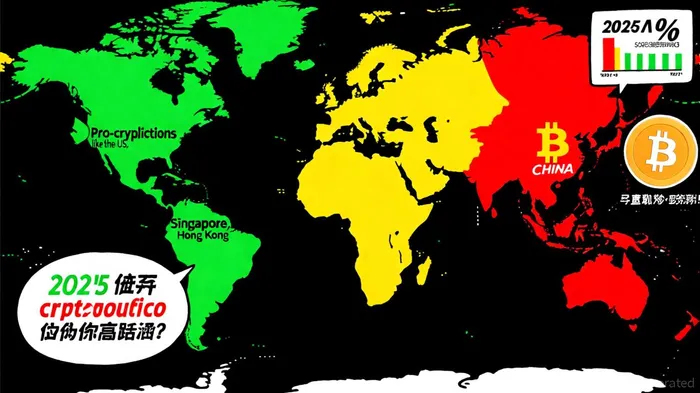





Comentarios
Aún no hay comentarios