
Why IJR May Be a Better Bet Than Russell 2000 for Small-Cap Exposure
When it comes to accessing the small-cap equity market, investors often default to the Russell 2000, the most popular U.S. small-cap index. But in today's environment—where liquidity, quality, and cost efficiency matter more than ever—the iShares Core S&P Small-Cap ETF (IJR) deserves a closer look. According to Morningstar's analysis, IJR's index construction and performance efficiency give it a clear edge over the Russell 2000, making it a superior vehicle for capturing the small-cap premium[1].
The Index Construction Edge: Quality Over Quantity
The S&P SmallCap 600 Index, which IJRIJR-- tracks, is not just a smaller version of the Russell 2000. It's a more disciplined benchmark. For starters, the S&P index requires constituents to be profitable over the past four quarters, a filter the Russell 2000 lacks[1]. This profitability screen ensures that IJR avoids the “junk” stocks that often plague the Russell 2000, which includes companies with negative earnings or thin trading volumes. MorningstarMORN-- notes that this quality bias translates into higher exposure to the “quality factor,” a key driver of long-term risk-adjusted returns[2].
Moreover, the S&P SmallCap 600 employs buffering rules to reduce unnecessary turnover. Unlike the Russell 2000's rigid, mechanical reconstitution process—which triggers concentrated trading activity on a single date—IJR's index methodology smooths out transitions, minimizing price distortions and transaction costs[1]. This is critical in small-cap markets, where liquidity is often scarce. As a result, IJR's portfolio efficiency outshines the Russell 2000's, particularly at the lower end of the market-cap spectrum[3].
Performance Efficiency: Lower Costs, Higher Returns
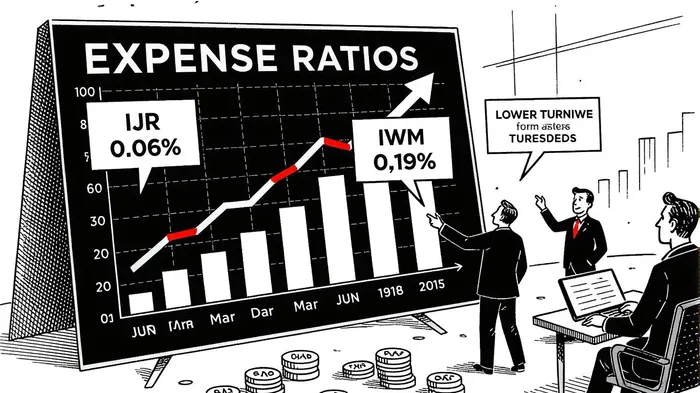
Costs matter. Over time, even small differences in expense ratios can erode returns. IJR's 0.06% expense ratio is significantly lower than the iShares Russell 2000 ETF's (IWM) 0.19%[4]. Data from Yahoo Finance shows that IJR has outperformed IWMIWM-- in recent periods, with a 7.08% return year-to-date as of July 2025 compared to IWM's 1.15%[5]. While past performance isn't a guarantee of future results, the combination of lower fees and a higher-quality portfolio gives IJR a structural advantage.
The Russell 2000's popularity also works against it. Its rules-based construction attracts heavy inflows and outflows during reconstitution, creating liquidity challenges. For example, when a stock is added to the index, sudden demand can inflate its price, while removals can lead to sharp declines. IJR's more curated approach avoids these extremes, offering a smoother ride for investors[1].
Risk-Adjusted Returns: A Gold Standard
Morningstar's Analyst Rating of Gold for IJR underscores its ability to deliver superior risk-adjusted returns over a full market cycle[2]. The S&P SmallCap 600's focus on profitability and liquidity reduces exposure to volatile, unprofitable names—a common issue in the Russell 2000. This is reflected in IJR's lower standard deviation (21.69%) compared to IWM's 22.98%[5]. While both ETFs have similar betas, IJR's tighter risk control makes it a more attractive option for investors seeking small-cap growth without unnecessary volatility[5].
Conclusion: A Smarter Small-Cap Play
The Russell 2000 may be the default choice for small-cap exposure, but IJR's index construction and performance efficiency make it a better bet for most investors. By prioritizing quality, reducing turnover, and keeping costs low, IJR offers a more refined way to access the small-cap premium. In a market where every basis point counts, this edge could mean the difference between outperforming and underperforming.





Comentarios
Aún no hay comentarios