
Is G-III Apparel Group Overvalued or Undervalued Amid Strategic Shifts and Mixed Financial Signals?
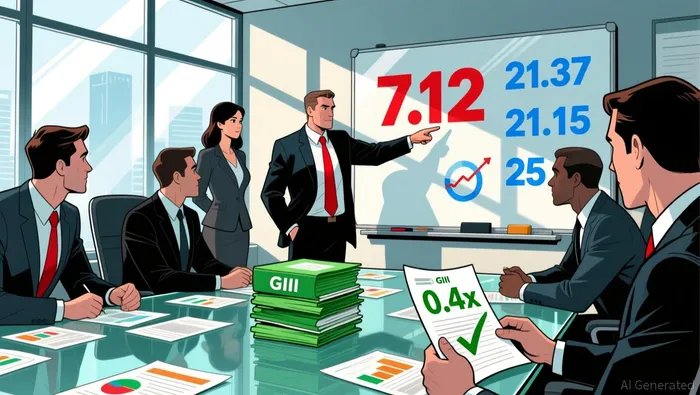
The apparel industry in 2025 is marked by stark valuation disparities, with G-III Apparel GroupGIII-- (GIII) standing out as a case study in dislocation. While the trailing price-to-earnings (P/E) ratio of 7.12 as of December 2025 lags far behind the industry average of 21.37 for apparel manufacturing as reported by industry data, its strategic initiatives and financial performance suggest a nuanced picture. This analysis explores whether G-IIIGIII-- is undervalued or overvalued, weighing its valuation gap against the risks and opportunities tied to its evolving business model.
Valuation Dislocation: A Tale of Two Metrics
G-III's P/E ratio has historically traded in a narrow band, dipping to 5.84 in July 2025 before stabilizing at 7.12 by year-end. This contrasts sharply with peers like Ralph Lauren (P/E 25.15) and Guess (P/E 10.30) as of the latest market data, as well as the broader industry average. The company's market capitalization of $1.28 billion-coupled with fiscal 2025 revenue of $3.18 billion as reported in the earnings release-suggests a price-to-sales ratio of approximately 0.4, another metric that underlines its relative cheapness.
This dislocation may reflect skepticism about G-III's reliance on licensed brands, such as Tommy Hilfiger and Calvin Klein, which face expiration risks. For instance, the expiration of Phillips-Van Heusen (PVH) licenses is projected to create a $400 million revenue headwind by fiscal 2027. However, the company's pivot to owned brands-DKNY, Donna Karan, and Karl Lagerfeld-has shown promise. These labels collectively drove double-digit growth in 2025, with the Donna Karan relaunch alone signaling "significant sales potential" as stated in the official announcement.
Strategic Execution: A Double-Edged Sword
G-III's 2025 strategic initiatives aim to mitigate reliance on licensed brands while expanding its global footprint. The acquisition of a 19% stake in Madrid-based All We Wear Group (AWWG) is a key move, granting access to the Iberian market and India. Additionally, the company secured a global apparel license for Converse, targeting the active lifestyle segment-a sector with higher growth potential.
Digital transformation is another pillar. G-III has upgraded e-commerce platforms for DKNY and Karl Lagerfeld, aiming to strengthen omnichannel engagement. These efforts align with broader industry trends, where digital sales now account for 25% of revenue for leading apparel firms. However, execution risks persist. For example, the success of the Converse line hinges on brand synergy and distribution efficiency, areas where G-III has limited prior experience.
Financial discipline remains a strength. The company's net cash position and disciplined inventory management provide flexibility to fund strategic initiatives. Share repurchases and a raised fiscal 2025 earnings guidance further underscore confidence in its model. Yet, the PVH headwind looms large. While owned brands are growing, they remain insufficient to fully offset the projected revenue loss, raising questions about long-term sustainability.
Mixed Financial Signals: Opportunity or Warning?
G-III's third-quarter fiscal 2026 results, released in late 2025, exceeded expectations with improved sales and margins. This outperformance, coupled with a robust balance sheet, could justify a re-rating. However, the company's P/E ratio remains below its 12-month average of 6.87, suggesting lingering doubts. Analysts have maintained a "Market Perform" rating, with a $31.36 price target as of December 2025, implying a potential 30% upside from its December 2025 valuation.
The apparel industry's broader valuation trends add complexity. While manufacturing firms trade at a 21.37 P/E as reported by industry benchmarks, G-III's focus on both manufacturing and retail (via owned brands) complicates direct comparisons. Its lower P/E may reflect a hybrid valuation, discounted for the risks of transitioning from licensed to owned brands.
Conclusion: A Calculated Bet
G-III Apparel Group appears undervalued relative to its peers and the industry average, but this dislocation is not without justification. The company's strategic shifts-expanding owned brands, securing new licenses, and investing in digital infrastructure-position it to mitigate the PVH headwind and tap into growth segments. However, execution risks, particularly in global expansion and brand integration, could delay or derail these efforts.
For investors, the key question is whether G-III can scale its owned brands quickly enough to offset declining licensed revenue. If successful, the current valuation offers a compelling entry point. If not, the dislocation may persist. Given the company's financial strength and strategic clarity, the former outcome seems more likely, albeit with a timeline that demands patience.





Comentarios
Aún no hay comentarios