
IEA's 2050 Oil Demand Projections and Implications for Energy Transition: How Conservative Assumptions and Geopolitical Pressures Distort Energy Investment Strategies
The Shifting Landscape of Oil Demand
The IEA's updated scenario attributes the delayed peak in oil demand to a confluence of factors: energy security concerns, the resurgence of liquefied natural gas (LNG) plant licenses, coal plant installations in Asia, and a slowdown in electric vehicle (EV) adoption, Seeking Alpha reports. India, for instance, is emerging as a key driver of oil consumption under current trends, while the U.S. retains its dominance in conventional oil and gas despite its earlier leadership in the energy transition, Seeking Alpha notes. These developments highlight a troubling disconnect between the IEA's conservative assumptions and the accelerating technological and economic forces reshaping the energy sector.
Critics argue that the IEA's reliance on existing policies-rather than aspirational climate goals-understates the potential for clean energy adoption. For example, the agency recently slashed its 2025–30 forecasts for U.S. wind and solar growth by nearly 60% and 40%, respectively, citing policy uncertainty, tax credit expirations, and slower permitting under the Trump administration, TradingView reports. Such adjustments reflect a broader trend: geopolitical and regulatory headwinds are distorting market signals, leading to underinvestment in renewables and overreliance on fossil fuels.
Conservative Assumptions and Policy Inertia
The IEA's Current Policy Scenario has faced sharp critiques for its failure to account for the urgency of decarbonization. As stated by Reuters, the agency's latest outlook predicts continued growth in oil and gas demand until 2050, a projection that U.S. Energy Secretary Chris Wright has called "nonsensical," Reuters reports. This disconnect is exacerbated by the IEA's abandonment of its previous "Pledges Scenario," which incorporated climate commitments but lacked granular country-specific plans, Reuters notes. The result is a framework that underestimates the scale of investment required to meet rising global power demands, particularly as AI-driven data centers and electrification reshape energy consumption patterns, Carbon Credits reports.
Investors are increasingly aware of this misalignment. Duke Energy, for instance, has announced a $95–105 billion investment plan to modernize its grid and expand clean energy capacity-a move that contrasts sharply with the IEA's conservative assumptions, Simply Wall St notes. Yet, such forward-looking strategies remain the exception rather than the norm. The broader financial ecosystem continues to grapple with the IEA's delayed peak oil forecasts, which may inadvertently discourage capital from flowing into renewables by perpetuating the perception that fossil fuels will remain economically viable for decades.
Geopolitical Pressures and Market Realities
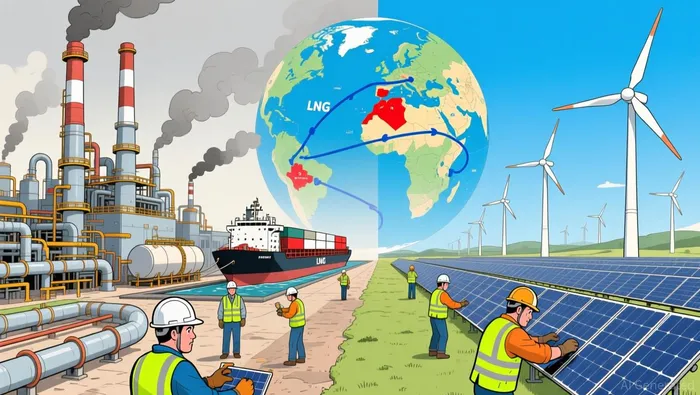
Geopolitical tensions further complicate the energy transition. The IEA's emphasis on LNG as a bridge fuel-projecting a 50% increase in supply by 2030-reflects a pragmatic response to energy security concerns, Reuters reports. However, this focus risks locking in long-term fossil fuel infrastructure, particularly in Asia, where coal plant installations are on the rise, Seeking Alpha notes. Meanwhile, the slowdown in EV adoption, driven by supply chain bottlenecks and policy rollbacks, has delayed the projected decline in oil demand, Seeking Alpha notes. These dynamics create a self-reinforcing cycle: conservative projections justify continued investment in oil and gas, which in turn delays the systemic shifts needed to achieve net-zero targets.
The Investment Dilemma
The IEA's Current Policy Scenario thus presents a paradox for investors. On one hand, global clean energy investment is projected to reach $2.2 trillion in 2025-double the amount allocated to oil, gas, and coal, IEA World Energy Investment 2025 reports. On the other, the agency's conservative assumptions may misalign incentives by underestimating the pace of technological disruption and regulatory change. For instance, Crusoe Energy's $600 million raise to develop AI-powered clean energy data centers demonstrates how innovation can address rising power demands, Carbon Credits notes. Yet, such initiatives remain niche without broader alignment between policy, market signals, and investor strategies.
Conclusion: A Call for Strategic Diversification
The IEA's 2050 projections serve as a cautionary tale for investors. While the agency's focus on energy security and geopolitical realities is pragmatic, its conservative assumptions risk distorting long-term investment strategies. The clean energy transition is not a distant inevitability but an urgent necessity-one that requires immediate action to close the investment gap. Investors must prioritize diversification into resilient, low-carbon technologies, leveraging both market fundamentals and policy shifts to future-proof their portfolios. As the energy landscape evolves, those who align with the IEA's outdated assumptions may find themselves left behind in a rapidly decarbonizing world.





Comentarios
Aún no hay comentarios