
Identifying Tesla's Mispricing Opportunity in a Shifting EV Landscape: A Value Investor's Perspective for 2026
The electric vehicle (EV) market in 2026 is at a crossroads, marked by a structural "demand vacuum" driven by regulatory rollbacks, waning consumer incentives, and a strategic retreat by legacy automakers. Amid this turbulence, Tesla's stock valuation has become a battleground of competing narratives: some analysts warn of overvaluation and deteriorating fundamentals, while others project a path to a $3 trillion market cap. For value-oriented investors, this divergence raises a critical question: does Tesla's current stock price reflect a mispricing opportunity, or is it a cautionary tale of speculative overreach?
Structural Shifts and the EV Demand Vacuum
The U.S. EV market is undergoing a profound transformation. According to a report by Shasta Unfiltered, the Trump administration's policy changes-including weakened , the revocation of California's , and the expiration of federal EV tax credits-have . EV sales for 2025. By Q4 2025, EVs accounted for just 5.7% of new vehicle sales, a stark drop from earlier projections. This "demand vacuum" has forced automakers like Ford and GM to pivot toward hybrid models, which offer higher profitability and align with relaxed regulatory standards. Meanwhile, Tesla's carbon credit revenue stream-a key profit driver-has also diminished, compounding its challenges.
Yet, within this vacuum lies a paradox: Tesla's reduced competition could strengthen its market dominance. As legacy automakers retreat, Tesla's brand equity, manufacturing efficiency, and AI-driven infrastructure (e.g., Supercharging network) position it to capture a larger share of the remaining EV demand. However, this advantage is tempered by intensifying competition from Chinese automakers like BYD, .
Valuation Divergence: Overvaluation or Undervalued Potential?
Tesla's stock valuation in 2026 is a subject of fierce debate. On one hand, has labeled TeslaTSLA-- a "Strong Sell," citing deteriorating fundamentals and a 33.1% year-over-year decline in earnings per share. Yahoo Finance's valuation check further notes a modest overvaluation, with a fair value estimate . On the other hand, bullish analysts like argue that Tesla's pivot to high-margin software and services-such as Full Self-Driving (FSD) monetization and robotaxi development- could unlock a multi-trillion-dollar valuation by 2035.
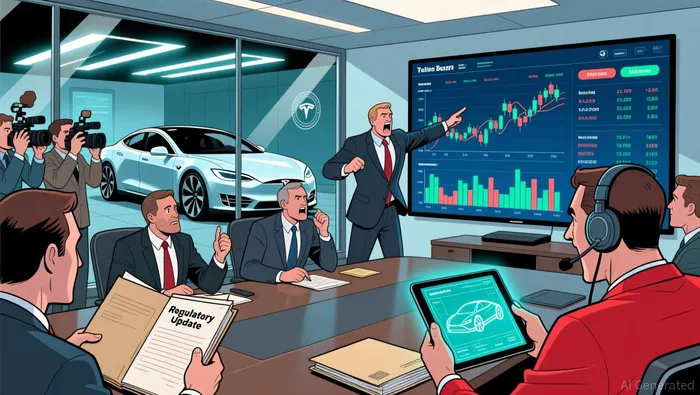 This divergence reflects a critical disconnect between Tesla's current financial performance and its long-term growth potential. While , the company's strategic shift toward software-as-a-service (SaaS) and energy solutions introduces a new revenue paradigm. SimplyWall St highlights that Tesla's energy business and AI-driven ventures could justify a premium valuation if FSD gains regulatory approval and robotaxi adoption accelerates.
Strategic Entry Point for Value Investors?
For value investors, the key lies in reconciling Tesla's near-term challenges with its structural advantages. The "demand vacuum" has created a scenario where Tesla's intrinsic value may be underappreciated by short-term bearishness. Consider the following:
1. Cost-Cutting and Margin Resilience: Tesla's recent restructuring efforts, including plant optimizations and AI-driven manufacturing, aim to restore profit margins amid declining vehicle sales.
2. Product Roadmap Catalystscould reignite demand, particularly in price-sensitive markets.
3. Regulatory Hurdles as a Binary Event: FSD's approval (or rejection) in 2026 could act as a catalyst, either unlocking a new revenue stream or forcing a reevaluation of Tesla's software ambitions.
However, risks remain. The loss of U.S. policy tailwinds and BYD's market-share gains underscore the fragility of Tesla's dominance. Additionally, the EV sector's broader slump-projected to recover in 2027 as affordable models proliferate-suggests patience may be required.
Conclusion: A High-Conviction Bet with Caveats
Tesla's 2026 valuation presents a classic case of market dislocation. While its stock appears overvalued based on traditional financial metrics, its strategic pivot to software, AI, and energy solutions introduces a non-linear growth trajectory. For value investors with a long-term horizon, Tesla's current price may represent a mispricing opportunity-if the company can navigate regulatory hurdles, prove the viability of its lower-priced models, and maintain its technological edge.
That said, this is not a risk-free bet. The EV sector's structural shifts and Tesla's competitive challenges demand rigorous due diligence. Investors must weigh the potential for a multi-trillion-dollar re-rating against the likelihood of further near-term volatility. In a market defined by disruption, Tesla's story in 2026 will hinge on its ability to redefine what it means to be an "electric vehicle company".





Comentarios
Aún no hay comentarios