
Icahn Partners' Strategic Entry into Monro, Inc.: A Value-Investment Opportunity at $17.48?
Short-Term Catalysts: Earnings Volatility and Institutional Confidence
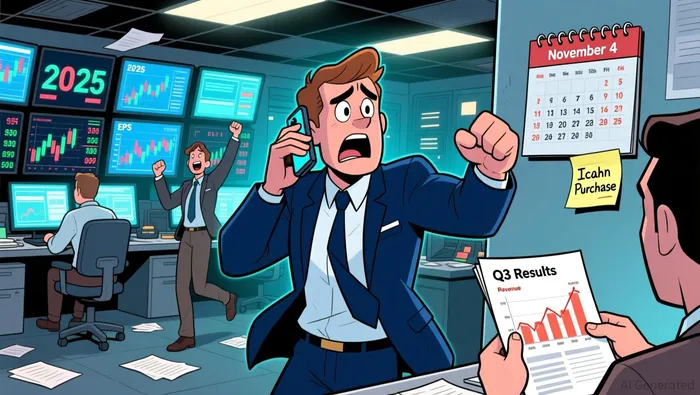
Monro's third-quarter 2025 results revealed a dichotomy. While the company exceeded earnings per share (EPS) expectations with a non-GAAP profit of $0.21 per share-16.7% above forecasts-revenue fell short at $288.9 million, down 4.1% year-on-year, according to Monro's Q3 2025 Earnings. This underperformance, coupled with a 15.5% post-earnings stock price decline to $15.27, as noted in a look back at Monro's Q3 earnings, created a valuation gap that Icahn Partners appears to be exploiting. The Icahn Group's purchase of 639,473 shares at $15.19 per share on November 4, as reported in Icahn buys $9.7M in Monro stock, suggests a belief in near-term undervaluation, particularly as the stock rebounded post-transaction, reflecting renewed institutional confidence, as noted in a look back at Monro's Q3 earnings.
A key short-term catalyst lies in Monro's operational restructuring. The company has closed 156 stores since 2022, streamlining its footprint to 1,116 locations, according to Monro's Q3 2025 Earnings. While this has reduced top-line revenue, it has stabilized operating margins at 4.4%, according to Monro's Q3 2025 Earnings, a critical metric for a defensive play in a sector sensitive to consumer spending. Analysts remain focused on Monro's ability to leverage digital marketing and vendor partnerships to offset declining foot traffic, as discussed in analyst questions from Monro's Q3 earnings call.
Long-Term Value: Strategic Initiatives and Industry Positioning
Monro's long-term appeal hinges on its strategic investments in technician training, workplace safety, and performance-based compensation programs. These initiatives align with broader industry trends toward skilled labor retention and service quality differentiation. Additionally, the company's 2025 ESG report underscores sustainability efforts, including energy-efficient store retrofits and supply chain decarbonization, which could attract ESG-focused capital in a sector increasingly scrutinized for environmental impact.
However, the auto parts industry's defensive positioning is not without risks. Monro's same-store sales growth of 1.1% year-on-year in Q3 2025, according to Monro's Q3 2025 Earnings, contrasts with a 5.8% decline in the prior-year period, indicating uneven consumer demand. Macroeconomic headwinds, such as inflation-driven repair cost inflation and shifting vehicle ownership patterns, remain unresolved challenges, as discussed in analyst questions from Monro's Q3 earnings call. For Icahn Partners, the bet is that Monro's operational discipline and store-closure strategy will eventually translate into margin expansion and earnings visibility.
Industry Trends and Competitive Dynamics
The auto parts sector is undergoing structural shifts. Digitalization, including AI-driven diagnostics and e-commerce integration, is reshaping customer expectations. Monro's recent focus on digital marketing and customer segmentation positions it to compete with national chains like AutoZone and O'Reilly, which have deeper digital ecosystems. Yet, Monro's regional footprint and localized service model offer a counterbalance, particularly in markets where personalized service remains a differentiator.
A critical question is whether Monro can replicate the success of peers in leveraging vendor support. For instance, partnerships with OEMs for warranty-covered repairs could stabilize revenue streams. Analysts note that Monro's vendor relationships remain a "double-edged sword," offering cost advantages but also exposing the company to margin compression during supplier price hikes, as discussed in analyst questions from Monro's Q3 earnings call.
Valuation at $17.48: A Balancing Act
At $17.48, Monro's valuation appears anchored to its earnings potential rather than revenue growth. The stock trades at a price-to-earnings (P/E) ratio of approximately 82x based on its Q3 2025 EPS of $0.21, a premium to the S&P 500's 22x multiple, according to Monro's Q3 2025 Earnings. This premium reflects both optimism about Monro's operational turnaround and skepticism about its ability to sustain profitability. For Icahn Partners, the purchase price of $15.19 represents a 15% discount to the $17.48 level, suggesting a belief in further upside if earnings stabilize.
Yet, the $17.48 price tag also implies a premium to intrinsic value metrics. Using a discounted cash flow (DCF) model with a 10% discount rate, Monro's fair value estimate hovers around $16.50, assuming a 5% annual EPS growth rate and stable operating margins, according to Monro's Q3 2025 Earnings. This suggests that the current price may already incorporate some optimism about the company's turnaround, leaving limited room for error.
Conclusion: A Calculated Bet in a Cyclical Sector
Icahn Partners' investment in Monro reflects a classic value-investment thesis: buying into a company with strong operational fundamentals but temporarily depressed sentiment. The auto parts sector's defensive characteristics-driven by inelastic demand for vehicle maintenance-make it an attractive haven in a volatile market. However, Monro's long-term success depends on executing its store-closure strategy, improving same-store sales, and navigating macroeconomic risks.
For investors, the $17.48 price point represents a crossroads. It offers exposure to a company with a proven ability to exceed earnings expectations but also demands patience as Monro grapples with structural challenges. Icahn's track record of identifying undervalued assets in cyclical industries adds credibility to the investment, but the path to value realization remains contingent on execution.





Comentarios
Aún no hay comentarios