
IBM's Quantum Breakthroughs and Roadmap to Dominance
The Nighthawk and Loon: Building Blocks of Quantum Supremacy
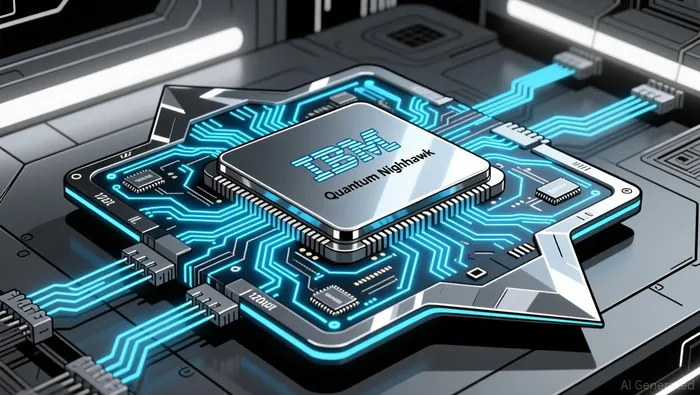
IBM's Quantum Nighthawk processor, unveiled in 2025, is a marvel of engineering. With 120 qubits and 218 next-generation tunable couplers, it delivers a 30% increase in circuit complexity compared to its predecessors while maintaining low error rates. By the end of 2025, Nighthawk is expected to support circuits requiring up to 5,000 two-qubit gates-a critical threshold for practical quantum applications. Future iterations, leveraging long-range couplers, could scale to 15,000 gates by 2028, enabling complex simulations in chemistry, finance, and materials science, as the Quantum Insider reported.
Complementing this is the Quantum Loon, an experimental processor designed to test the foundations of fault-tolerant quantum computing. Loon introduces multiple low-loss routing layers and demonstrates real-time quantum error decoding using qLDPC codes, reducing decoding time to under 480 nanoseconds, as the Quantum Insider reported. These advancements are not just incremental; they address the existential challenge of error correction, a barrier to large-scale quantum adoption.
300 mm Wafer Fabrication: Accelerating the Quantum Timeline
IBM's shift to 300 mm wafer fabrication is a game-changer. By scaling up production, the company has slashed R&D timelines, enabling faster iteration of qubit designs and improving connectivity, density, and performance, as the Quantum Insider reported. This move mirrors the semiconductor industry's transition to larger wafers in the 2000s, which drove down costs and boosted yields. For quantum computing, it means IBM can now produce and test processors at a pace that outstrips competitors like IonQ and D-Wave, who remain reliant on smaller-scale fabrication, as the Bitget reported.
Error Correction and the Path to Fault Tolerance
Quantum error correction (QEC) is the linchpin of IBM's long-term strategy. The company's recent milestone in real-time QEC using qLDPC codes-a type of low-density parity-check code-demonstrates its ability to decode errors in under half a microsecond, as the Quantum Insider reported. This is critical for fault-tolerant systems, where error rates must be suppressed to near-zero levels. By 2029, IBM aims to build a fault-tolerant quantum computer, a goal that would cement its dominance in the field, as the Newsable reported.
Market Dynamics: A $20.2 Billion Opportunity by 2030
The global quantum computing market is projected to grow from $3.52 billion in 2025 to $20.2 billion by 2030, at a compound annual growth rate (CAGR) of 41.8%, as the Yahoo Finance reported. This surge is driven by demand for quantum solutions in drug discovery, financial modeling, and logistics optimization-sectors where classical systems hit insurmountable limits. IBM's Quantum Computing as a Service (QCaaS) model, integrated with cloud platforms like IBM Cloud, is uniquely positioned to capture this growth.
Competitors like IonQ and D-Wave are making strides, but IBM's focus on fault tolerance and ecosystem building gives it a structural advantage. IonQ's ambition to reach 2 million physical qubits by 2030 is admirable, but without robust error correction, its roadmap remains speculative, as the Bitget reported. D-Wave, despite recent revenue boosts, lacks the software and algorithmic depth to challenge IBM's holistic approach, as the Bitget reported.
Strategic Partnerships and R&D: Fueling the Quantum Ecosystem
IBM's $7.48 billion R&D spend in 2024 (up from $6.78 billion in 2023) underscores its commitment to quantum leadership, as the Statista reported. This investment is amplified by strategic partnerships:
- IBM and AMD are co-developing quantum-centric supercomputing architectures, blending quantum processors with high-performance computing and AI infrastructure, as the IBM Newsroom reported.
- The University of Chicago collaboration supports quantum software startups through IBM's Duality accelerator program, fostering a pipeline of innovation, as the University of Chicago reported.
These partnerships are not just technical-they're ecosystem-building. By integrating quantum with AI and cloud, IBM is creating a self-sustaining infrastructure that mirrors its success in hybrid cloud and AI.
The Investment Case: A Long-Term Play on Infrastructure Dominance
For investors, IBM's quantum strategy is a masterclass in long-term positioning. The company is investing heavily in hardware, software, and partnerships while navigating the technical hurdles that plague the industry. Its roadmap-quantum advantage by 2026, fault tolerance by 2029-is ambitious but achievable, given its R&D scale and execution track record.
The risks are real: error rates, qubit instability, and talent shortages remain challenges, as the Yahoo Finance reported. But IBM's diversified approach-combining hardware innovation, cloud accessibility, and ecosystem development-mitigates these risks. As the quantum market matures, IBM's first-mover advantage and infrastructure-centric model will likely translate into outsized returns for shareholders.
Conclusion
Quantum computing is the next infrastructure revolution, and IBM is its most formidable architect. From the Nighthawk's 120-qubit marvel to the Loon's fault-tolerant experiments, from 300 mm wafer fabrication to real-time error correction, IBM is laying the groundwork for a future where quantum dominance is not just possible-it's inevitable. For investors with a 10-year horizon, this is a stock that transcends the hype cycle and enters the realm of foundational innovation.





Comentarios
Aún no hay comentarios