
The Hyundai Visa Scandal: Implications for Foreign Direct Investment in the U.S. and South Korea’s Export-Driven Sectors
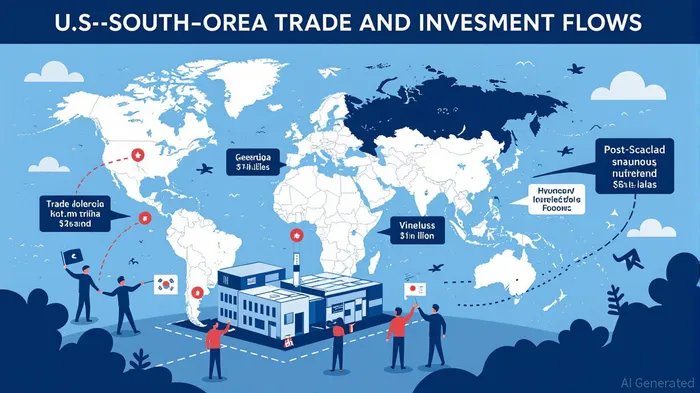
The 2025 Hyundai VisaV-- Scandal—marked by a historic ICE raid at a Hyundai-LG battery plant in Georgia—has become a flashpoint in the evolving dynamics of foreign direct investment (FDI) between the U.S. and South Korea. The operation, which detained 475 individuals, including over 300 South Korean nationals, exposed vulnerabilities in corporate compliance frameworks and raised urgent questions about the viability of U.S. immigration policies for multinational manufacturing ventures. This analysis examines how the scandal is reshaping FDI flows, corporate strategies, and investor confidence in key industries like electric vehicle (EV) manufacturing.
The Scandal and Its Immediate Fallout
The September 2025 raid, described as the largest single-site immigration enforcement action in U.S. history, targeted alleged visa violations at a $7.6 billion joint venture between Hyundai and LG Energy Solution. Most detained workers were South Koreans on short-term visas (e.g., B-1 business visas) who were reportedly engaged in tasks like equipment installation, which some argue exceeded the scope of their permits [1]. The U.S. government defended the operation as part of its broader immigration enforcement agenda under President Donald Trump, while South Korea condemned it as a disruption to its export-driven economy and a breach of trust in bilateral trade agreements [2].
The incident forced a temporary halt in construction at the Georgia plant and triggered a diplomatic crisis. South Korea chartered a flight to repatriate detained workers, while Hyundai emphasized that the detained individuals were subcontractors, not direct employees, underscoring the risks of fragmented supply chains in cross-border projects [3].
Implications for FDI and Corporate Compliance
The scandal has exposed critical gaps in how South Korean firms navigate U.S. immigration and labor laws. According to a report by The Autopian, the raid highlighted the reliance of EV manufacturers on short-term visas for technical expertise, a practice that is increasingly vulnerable to enforcement actions [4]. South Korean companies, including Hyundai and LG, have since frozen nonessential travel to the U.S. and initiated internal compliance reviews to avoid future violations [5].
For U.S. policymakers, the incident underscores a paradox: while the Trump administration seeks to attract foreign investment in strategic industries like EVs, its strict immigration policies risk deterring such projects. Data from the Department of Homeland Security indicates that over 140 trillion won ($101 billion) in South Korean investments across multiple U.S. states could face delays or cost overruns without clearer bilateral agreements on skilled labor mobility [6].
Investor Confidence and Reshoring Trends
The scandal has also shaken investor confidence in U.S. manufacturing. A Bloomberg analysis notes that South Korean firms are now prioritizing diversification, with increased investments in Central Europe (e.g., Hungary and Poland) to mitigate risks associated with U.S. policy volatility [7]. This shift aligns with broader reshoring trends, as companies seek to localize production and reduce dependency on politically sensitive regions.
Labor costs and visa compliance have further complicated the equation. While the U.S. offers a flexible regulatory environment, its higher wages and enforcement risks contrast with South Korea’s skilled but rigid workforce. A 2024 U.S. Department of State report highlights that South Korea’s investment climate has improved through regulatory reforms, yet challenges like inconsistent visa interpretations persist [8].
Strategic Recommendations for Firms
To navigate this evolving landscape, firms must adopt proactive strategies:
1. Strengthen Subcontractor Vetting: Companies should implement rigorous compliance checks for third-party labor providers, including E-Verify systems and regular audits.
2. Diversify Supply Chains: Reducing reliance on a single country or visa category can mitigate risks. Hyundai’s pivot to Central Europe exemplifies this approach.
3. Engage in Policy Dialogue: Firms should collaborate with governments to advocate for clearer visa frameworks, such as expanding H-1B or L-1 visas for technical workers.
4. Invest in Domestic Talent: Long-term solutions require partnerships with U.S. educational institutions to address skill shortages in EV manufacturing.
Conclusion
The Hyundai Visa Scandal is a watershed moment for FDI in the U.S. and South Korea’s export sectors. While the U.S. remains a critical market for EV innovation, its immigration enforcement policies must align with the needs of global manufacturers to sustain investment. For South Korean firms, the path forward lies in balancing compliance rigor with strategic diversification, ensuring resilience in an era of geopolitical and regulatory uncertainty.
Source:
[1] Hyundai factory raid in Georgia leads to detention of hundreds of South Korean engineers and technicians, [https://m.economictimes.com/news/international/business/hyundai-factory-raid-in-georgia-leads-to-detention-of-hundreds-of-south-korean-engineers/articleshow/123776878.cms]
[2] South Korean workers arrested in ICE raid at Georgia Hyundai plant, [https://nypost.com/2025/09/07/us-news/south-korea-and-us-reach-deal-for-release-of-workers-detained-during-hyundai-plant-raid-in-georgia/]
[3] ICE Raids Hyundai Georgia Metaplant, 450 Workers Detained as Battery Site Halted, [https://www.visaverge.com/news/ice-raids-hyundai-georgia-metaplant-450-workers-detained-as-battery-site-halted/]
[4] What The Hyundai Immigration Raid Says About America's Immigration Enforcement, [https://www.theautopian.com/hyundai-immigration-raid-explained/comment-page-1/]
[5] News Focus: U.S. raid at Hyundai-LG site triggers turmoil in South Korea-U.S. EV investments, [https://en.yna.co.kr/view/AEN20250908006100320?section=national/diplomacy]
[6] Hyundai Visa Scandal and FDI Risks in U.S. Manufacturing, [https://www.zinkpot.com/?news=economy-fdi-at-an-all-time-low-reasons-for-downfall-and-why-experts-predict-a-turnaround-soon&page=news]
[7] Central Europe-East Asia EV Nexus: Tracking South Korean Investments, [https://www.researchgate.net/publication/395012289_Central_Europe-East_Asia_EV_nexus_Tracking_Chinese_South_Korean_and_Japanese_electric_vehicle_and_battery_investment_in_the_V4_countries]
[8] 2024 Investment Climate Statements: South Korea, [https://www.state.gov/reports/2024-investment-climate-statements/south-korea]







Comentarios
Aún no hay comentarios