
Hyundai's Strategic Leadership and Innovation Momentum: Investment Implications of Claudia Marquez's Recognition as a Top Corporate Entrepreneur
In 2025, Claudia Marquez's appointment as Chief Operating Officer (COO) of Hyundai Motor America marked a pivotal shift in the automaker's U.S. strategy. Her recognition as a Top Corporate Entrepreneur Gold Award recipient by Negocios y Ejecutiva magazines underscores her role in steering Hyundai toward customer-centric growth and operational excellence. For investors, Marquez's leadership offers a lens through which to assess Hyundai's evolving position in the electric vehicle (EV) and luxury markets, where competition is intensifying and innovation is paramount.
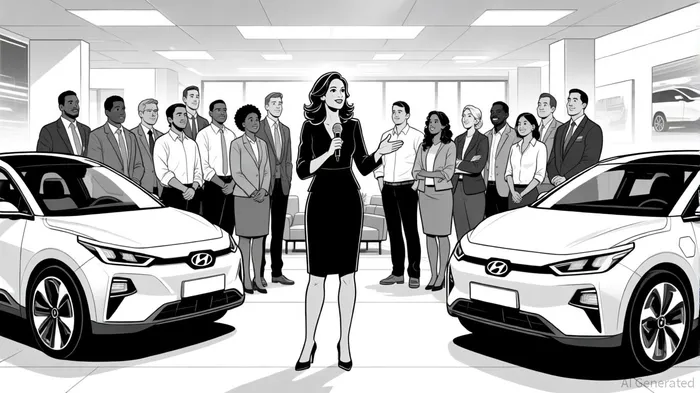
Strategic Pillars: Customer-Centric Growth and Operational Resilience
Marquez's approach to leadership is anchored in three pillars: customer-centric growth, people and culture, and operational excellence. Since her appointment, she has prioritized optimizing dealer performance and enhancing customer experiences, leveraging data-driven decision-making to align with Hyundai's broader goals of inclusivity and innovation, as reported in a PR Newswire release. Her tenure at Genesis Motor North America, where she expanded the luxury brand's retail network to over 60 facilities and drove record sales, demonstrates her ability to scale brands while maintaining profitability, per the Genesis appointment release.
This strategy has translated into tangible results for Hyundai Motor America. In 2025, the company reported its best first-half sales in history, with 439,280 units sold-a 10% year-over-year increase-while surpassing 17 million total U.S. sales since 1986, according to the June and Q2 2025 sales announcement. Her emphasis on electrification further strengthens this momentum: the Ioniq 5's price reduction by $9,800 for 2026 models and the launch of the Ioniq 9 reflect Hyundai's commitment to affordability and product diversity, critical factors in a price-sensitive EV market, as noted in the September 2025 sales release.
Financial Performance: Balancing Growth and Profitability
Hyundai's Q2 2025 financial results highlight both the opportunities and challenges under Marquez's leadership. The company achieved a record quarterly revenue of KRW 48.29 trillion, a 7.3% increase year-over-year, driven by strong North American and Korean sales and rising demand for electrified vehicles, according to Hyundai's Q2 business results. However, operating profit declined by 15.8% to KRW 3.6 trillion, attributed to higher incentives and global trade pressures, including tariffs, as noted in the same Q2 business results.
This duality-robust revenue growth paired with margin compression-reflects the broader automotive industry's struggle to balance aggressive EV adoption with profitability. Marquez's focus on operational efficiency, such as U.S. manufacturing investments in Georgia and cost reductions in battery production, positions Hyundai to mitigate these pressures. For instance, the Ioniq 5's 151% year-over-year retail sales increase in September 2025 demonstrates the effectiveness of her pricing and product strategies, as highlighted in the Hyundai release.
Competitive Landscape: Navigating the EV and Luxury Segments
Hyundai's EV strategy under Marquez faces stiff competition from TeslaTSLA-- and BYD, two dominant forces reshaping the luxury and mass-market EV sectors. Tesla, led by Elon Musk, continues to leverage its vertical integration, Supercharger network, and Full Self-Driving (FSD) software to maintain its premium brand image. Meanwhile, BYD's cost-efficient production model and in-house battery technology (e.g., LFP blade batteries) enable it to offer competitive pricing and rapid international expansion, according to a Tesla vs BYD analysis.
In the luxury segment, Hyundai's Genesis brand, under Marquez's prior leadership, has carved out a niche with models like the G90 and GV80, achieving a 57% sales increase in 2025 compared to 2024, per a Car and Driver list. This contrasts with Tesla's Model 3, which, despite its technological edge, faces growing competition from Hyundai's Ioniq 6 and BYD's Seal. The Ioniq 6's 800V architecture and 18-minute 10–80% charge time position it as a viable alternative to the Model 3, particularly for buyers prioritizing charging efficiency over raw performance, as shown in a MotorTrend comparison.
Investment Implications: Innovation vs. Market Volatility
For investors, Marquez's leadership presents both opportunities and risks. Her emphasis on electrification and U.S. manufacturing aligns with long-term trends in sustainability and domestic supply chain resilience. Hyundai's investment in Georgia, for example, not only supports local job creation but also reduces exposure to global trade disruptions, as noted in the Hyundai September 2025 sales release. Additionally, her focus on diversity and inclusive leadership-evidenced by her advocacy for Hispanic executives-strengthens Hyundai's brand equity in key U.S. demographics, a critical factor in an era where corporate social responsibility influences consumer loyalty, as reported in the PR Newswire release.
However, Hyundai's operating profit decline in Q2 2025 highlights vulnerabilities in its business model. Rising incentives to boost EV adoption, coupled with global tariff pressures, could erode margins if not managed carefully. Investors must also consider the competitive intensity in the EV sector: Tesla's recent 40.9% decline in EU registrations and BYD's ambition to surpass Tesla in European market share by 2030 signal a dynamic and unpredictable landscape, as discussed in the Tesla vs BYD analysis.
Conclusion: A Strategic Leader in a Transformative Era
Claudia Marquez's recognition as a top corporate entrepreneur is more than a personal accolade-it reflects Hyundai's strategic pivot toward innovation, inclusivity, and customer-centricity. Her leadership has positioned the automaker to capitalize on EV growth while navigating the challenges of margin pressures and competitive rivalry. For investors, the key takeaway is clear: Hyundai's success in the coming years will hinge on its ability to balance aggressive innovation with operational discipline, a challenge Marquez appears well-equipped to address.





Comentarios
Aún no hay comentarios