
Hyundai's Strategic US Expansion and Hybrid EV Momentum: A Blueprint for Outperformance in a Protectionist Era
The global automotive industry is undergoing a seismic shift, driven by protectionist policies, supply chain reconfigurations, and surging demand for electrified vehicles. Amid this transformation, Hyundai Motor Group is emerging as a standout performer in the United States—a market that has long been a battleground for global automakers. Through a $21 billion investment in localized production, advanced hybrid and EV technologies, and a strategic alignment with U.S. economic and environmental priorities, Hyundai is positioning itself to outperform rivals in a post-pandemic landscape defined by geopolitical volatility and shifting consumer preferences.
Localized Production: A Shield Against Global Volatility
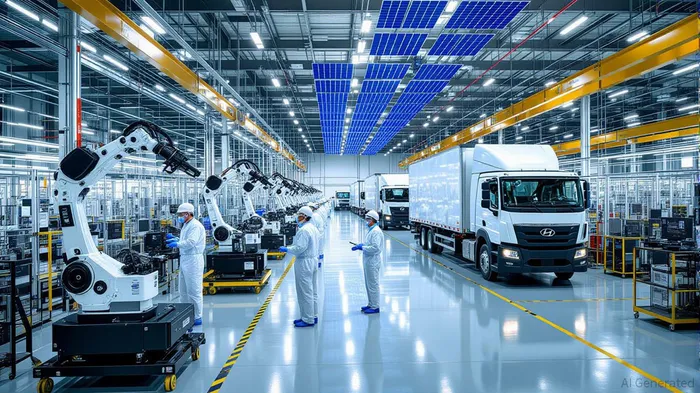
Hyundai's U.S. expansion is anchored by a bold commitment to localize supply chains and reduce dependence on international markets. At the heart of this strategy is the Hyundai Motor Group Metaplant America (HMGMA) in Georgia—a $12.6 billion project that will produce 500,000 electric and hybrid vehicles annually by 2030. This facility, the largest economic development in Georgia's history, integrates cutting-edge AI-driven production systems, robotics, and hydrogen-powered logistics, ensuring efficiency and sustainability. By co-locating EV battery production and steel manufacturing—such as Hyundai Steel's new Electric Arc Furnace (EAF) mill in Louisiana—the company minimizes exposure to tariffs and supply chain bottlenecks.
The Louisiana steel mill, producing 2.7 million tons of low-carbon steel annually from local scrap, is a masterstroke. It not only secures a stable, cost-effective material supply for U.S. and Mexican plants but also aligns with the Biden administration's Inflation Reduction Act (IRA), which offers tax credits for domestic clean energy production. This vertical integration—spanning steel, battery components, and vehicle assembly—creates a self-sufficient ecosystem that insulates Hyundai from the fragility of global trade networks.
High-Margin Hybrid Momentum: Capturing the Transition Market
While battery-electric vehicles (BEVs) dominate headlines, Hyundai's focus on hybrids has proven to be a more lucrative and pragmatic strategy. In 2025, U.S. hybrid sales surged 3% year-over-year, with models like the Elantra N and Santa Fe HEV setting records (up 33% and 39%, respectively). Hybrid and electrified vehicles now account for 22% of U.S. light-duty vehicle sales, up from 18% in early 2024—a trend Hyundai is exploiting with a 14-model hybrid lineup by 2030.
The company's next-generation TMED-II hybrid system, featuring smart regenerative braking and Vehicle-to-Load (V2L) technology, enhances fuel efficiency and customer value. This has translated into robust profitability: Q1 2025 operating profit hit KRW 3.63 trillion ($2.9 billion), driven by a 38.4% year-on-year increase in electrified vehicle sales. Crucially, hybrids offer a bridge between internal combustion engines and full electrification—a sweet spot in a U.S. market where range anxiety and charging infrastructure gaps persist.
EREV Innovation: Bridging the EV Gap
Hyundai is also pioneering Extended-Range Electric Vehicles (EREVs), a category poised to disrupt the market. By 2026, the company will launch EREV models with a 900-km range, combining EV performance with the flexibility of refueling. This addresses consumer hesitancy while leveraging existing ICE technology to reduce battery costs—a key margin booster. EREVs could capture a significant share of the U.S. market, where BEV adoption has plateaued despite aggressive government incentives.
Strategic Resilience and Financial Heft
Hyundai's $95.6 billion investment plan through 2033—$54.5 billion in R&D, $51.6 billion in capital expenditures—underscores its long-term vision. The company is also optimizing dealer networks, enhancing inventory management, and prioritizing customer-centric design, as evidenced by its J.D. Power rankings and IIHS safety accolades. These efforts reinforce brand loyalty and pricing power, critical in a market where margins are under pressure.
Investment Implications
For investors, Hyundai's dual focus on localized production and high-margin hybrids presents a compelling case. The company is not only insulating itself from protectionist policies but also capturing the transition market—a segment likely to dominate the next decade. With a target of 1.33 million hybrid sales globally by 2028 and 690,000 in North America alone, Hyundai is well-positioned to outperform peers reliant on BEVs or traditional ICE vehicles.
However, risks remain. Battery costs and supply chain dynamics could shift, and U.S. political winds might turn against foreign automakers. Yet Hyundai's diversified strategy—spanning steel, EVs, hybrids, and EREVs—offers resilience. For long-term investors, this is a company building not just cars, but a sustainable competitive advantage in an uncertain world.
In a post-pandemic auto market where agility and adaptability are paramountPARA--, Hyundai's strategic foresight is paying dividends. As the U.S. leans into protectionism and green energy, this South Korean giant is proving that innovation, localization, and hybrid momentum can drive both profit and purpose.







Comentarios
Aún no hay comentarios