
Hyundai's Starter Motor Recall and Its Implications for Auto Sector Safety Investments
The automotive industry is no stranger to product recalls, but the scale and frequency of recent incidents-particularly Hyundai's 2025 starter motor and ABS module recalls-underscore a critical juncture for investor risk assessment and strategic opportunity identification. These events, while immediate in their operational and reputational impacts, also illuminate broader trends in supply chain resilience and safety innovation. For investors, the challenge lies in balancing short-term volatility with long-term gains in an industry grappling with technological disruption and global uncertainty.
The Recall Landscape: Scope and Immediate Risks
Hyundai's 2025 recalls highlight systemic vulnerabilities in automotive manufacturing. The first, involving 135,386 Santa Fe vehicles, stems from improperly installed starter motor assemblies that risk electrical shorts during crashes, according to a Reuters report. The second, a July 2025 recall of 65,000 vehicles, addresses a faulty ABS module prone to moisture-induced corrosion and spontaneous combustion, according to a CarsTimes report. Together, these recalls affect nearly 200,000 units in the U.S. alone, with Hyundai advising owners to park vehicles outdoors until repairs are completed.
While specific financial costs for the starter motor recall remain undisclosed, historical data suggests such incidents typically incur hundreds of millions in expenses. For context, the 2023 recall of 800,000 Hyundai-Kia vehicles for similar electrical issues cost the company $450 million in direct costs, according to a ConsumerAffairs article. Reputational damage further compounds these expenses, as consumer trust erodes and resale values dip. According to Kelley Blue Book, post-recall depreciation for affected models can range between 5% and 15%, depending on repair complexity and public perception.
Supply Chain Resilience: A Post-Recall Imperative
The recalls have accelerated Hyundai's strategic pivot toward supply chain localization and technological integration. In response to 2025's trade policy uncertainties and production bottlenecks, the company announced a $21 billion investment in U.S. operations, including a $5.8 billion steel plant in Louisiana to reduce reliance on imported materials, according to Hyundai's announcement. This move aligns with broader industry trends: 78% of automakers now prioritize regional production hubs to mitigate geopolitical risks, per a Sphera report.
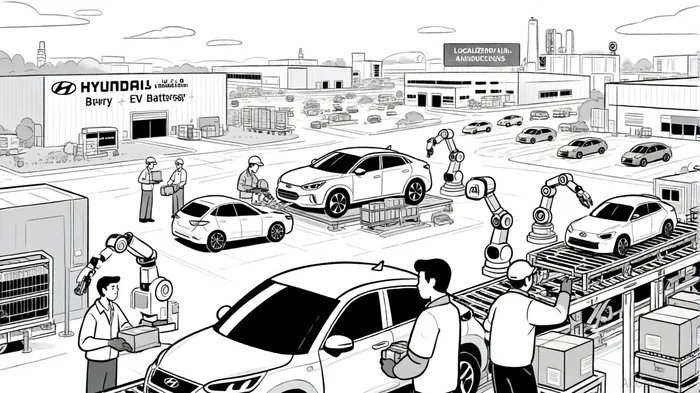
Hyundai's strategy also emphasizes vertical integration and AI-driven logistics. By retooling Georgia and Alabama plants for EV battery production and leveraging real-time data analytics, the company aims to shorten lead times and enhance quality control, according to a Supply Chain Digital article. Such investments, however, require sustained capital outlays. For instance, Hyundai's $16.6 billion 2024 EV supply chain boost included $8.18 billion for production line retooling-a costly but necessary step to meet decarbonization targets, per an Archyde report.
Investor Risks and Opportunities
For investors, the interplay between recall-related costs and supply chain modernization presents a dual-edged scenario. On one hand, frequent recalls signal operational inefficiencies and regulatory scrutiny, which can depress short-term earnings. Hyundai's revised 2025 operating profit margin forecast (6–7%, down from 7–8%) reflects these pressures, driven by tariff-driven production cost hikes and recall expenses, according to a ForvisMazars outlook. On the other, proactive supply chain investments position Hyundai to capitalize on long-term trends such as EV adoption and U.S. tax incentives for localized manufacturing, according to a SupplyChain360 analysis.
The key for investors lies in assessing whether Hyundai's expenditures translate into sustainable competitive advantages. For example, its Louisiana steel plant not only insulates it from trade disruptions but also aligns with the Inflation Reduction Act's domestic content requirements, potentially unlocking billions in tax credits. Similarly, AI-enhanced quality control systems could reduce future recall risks, improving margins over time.
Conclusion: Navigating Uncertainty with Strategic Clarity
Hyundai's 2025 recalls are a microcosm of the automotive sector's broader challenges: balancing innovation with safety, and global efficiency with localized resilience. For investors, the path forward hinges on two questions: Can Hyundai's supply chain overhauls offset the financial drag of recalls? And will these investments enable the company to outperform in an EV-dominated future?
The answers lie in Hyundai's ability to execute its $21 billion transformation while maintaining operational discipline. If successful, the company could emerge as a leader in resilient, tech-driven automotive manufacturing-a compelling proposition for long-term investors. Conversely, missteps in execution or cost overruns could amplify existing risks. In this high-stakes environment, vigilance and adaptability will be paramount.







Comentarios
Aún no hay comentarios