
Hyundai's September Sales Surge: A Glimpse Into EV Market Momentum
The electric vehicle (EV) market is entering a pivotal phase, and Hyundai's September 2025 sales performance offers a compelling case study in strategic execution and market responsiveness. With total sales of 71,003 units in the month-a 14% year-over-year increase-Hyundai not only outperformed its 2024 figures but also signaled its growing influence in a sector dominated by TeslaTSLA-- and General MotorsGM--, as shown by Hyundai's reported September sales. This surge, driven by robust demand for the IONIQ 5 and hybrid models, reflects a broader alignment between the company's long-term vision and evolving consumer preferences. For investors, the question is whether this momentum translates into sustainable value creation or is merely a short-term spike tied to expiring tax incentives.
Strategic Execution: Production, Partnerships, and R&D
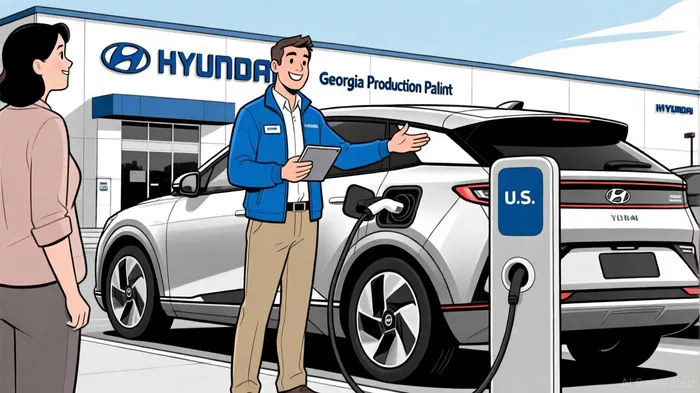
Hyundai's success in September 2025 is underpinned by a multi-pronged strategy that combines aggressive production scaling, strategic alliances, and heavy R&D investment. The company's $2.7 billion investment in its U.S. plant, HMGMA, is a cornerstone of this approach, aiming to boost capacity to 500,000 units by 2028 while creating 3,000 jobs, according to Hyundai's 2030 vision. This domestic production capability not only reduces costs but also qualifies the IONIQ 5 for federal tax credits, a critical factor as the 2025 expiration date loomed, as discussed in a MotorTrend interview. By localizing production, Hyundai has mitigated supply chain risks and positioned itself to capitalize on U.S. policy incentives-a move that mirrors Tesla's early dominance but with a more diversified regional footprint.
Equally significant is Hyundai's collaboration ecosystem. Partnerships with Waymo for autonomous technology testing, Amazon Autos for digital retail integration, and Boston Dynamics for robotics-driven manufacturing efficiency highlight a commitment to innovation beyond vehicle design, as outlined in Hyundai's 2030 vision. These alliances address both operational excellence and customer experience, two areas where traditional automakers have historically lagged. Meanwhile, the company's $77.3 billion investment in R&D and capital expenditures between 2026 and 2030 underscores its ambition to lead in battery technology, software-defined factories, and Extended Range EVs (EREVs), a point reinforced by a Cox Automotive forecast. By 2027, Hyundai aims to launch EREVs with over 600 miles of range, a response to consumer concerns about charging infrastructure that could differentiate its offerings in a crowded market.
Market Positioning: Navigating Competition and Shareholder Value
Despite Hyundai's gains, the U.S. EV market remains highly competitive. Tesla's dominance-44.7% market share in Q2 2025-continues to pose a challenge, while GM's 12.9% share in the first half of 2025 reflects its aggressive push with the Chevrolet Equinox EV. Hyundai and Kia's combined 7.6% share in H1 2025, though down from 11% in 2024, masks a nuanced reality: the company is capturing market share in hybrid and plug-in hybrid segments, where demand is stabilizing as pure EV adoption faces affordability hurdles, according to an Autoblog report. This hybrid pivot is strategic, as it allows Hyundai to maintain growth even as EV tax credits phase out.
For shareholders, the key metric is whether these strategies translate into profitability. Hyundai's 2030 roadmap-targeting 5.55 million global sales, with 60% electrified-provides a clear growth trajectory, but execution risks remain. The company's pledge to deliver a 35% shareholder return through dividends and buybacks by 2027, detailed in Hyundai's 2030 vision, hinges on its ability to scale production without sacrificing margins. Early indicators are positive: Q3 2025 saw a 13% year-over-year increase in U.S. sales, with electrified models accounting for 36.4% of global EV sales in the second quarter, per the Autoblog report. However, investors must monitor how Hyundai balances its $56 billion investment in R&D and production with near-term profitability, particularly as rivals like Tesla and GMGM-- ramp up their own EV and battery initiatives.
Broader Industry Trends and Investment Implications
Hyundai's September performance is emblematic of a maturing EV market. The 72% year-over-year surge in electrified vehicle sales reported in the MotorTrend interview aligns with Cox Automotive's forecast of 410,000 U.S. EV sales in Q3 2025-a 21.1% annual increase. Yet, this growth is not uniform. While new EV sales face headwinds from expiring incentives and high interest rates, the used EV market is booming, suggesting a shift in consumer behavior toward affordability and practicality noted in the MotorTrend discussion. Hyundai's hybrid and EREV strategies are well-positioned to address these dynamics, offering a bridge between traditional internal combustion engines and fully electric vehicles.
For long-term investors, the critical question is whether Hyundai can sustain its innovation pace while scaling profitably. The company's regional production strategy-targeting India, China, and Europe with tailored models like the IONIQ 3 and Elexio-is part of Hyundai's 2030 vision. However, geopolitical risks, such as trade tensions and supply chain disruptions, could impact these plans. Additionally, the success of EREVs by 2027 will depend on consumer acceptance of extended-range technology, which remains untested at scale.
Conclusion: A Calculated Bet on the Future
Hyundai's September sales surge is more than a quarterly anomaly-it is a testament to the company's strategic agility in a rapidly evolving market. By combining localized production, hybrid innovation, and forward-looking partnerships, Hyundai is carving out a niche that balances growth with profitability. While challenges from Tesla and GM persist, the company's 2030 roadmap and shareholder return targets provide a clear framework for value creation. For investors, the key takeaway is that Hyundai's EV transition is not just about capturing market share but about redefining what electrification means in a post-subsidy era. The coming years will test this vision, but the September 2025 figures suggest that the company is well-prepared for the journey.







Comentarios
Aún no hay comentarios