
Hyundai's Resilient US EV Push Amid Supply Chain and Geopolitical Risks
Navigating Supply Chain Risks: Local Production and Pricing Agility
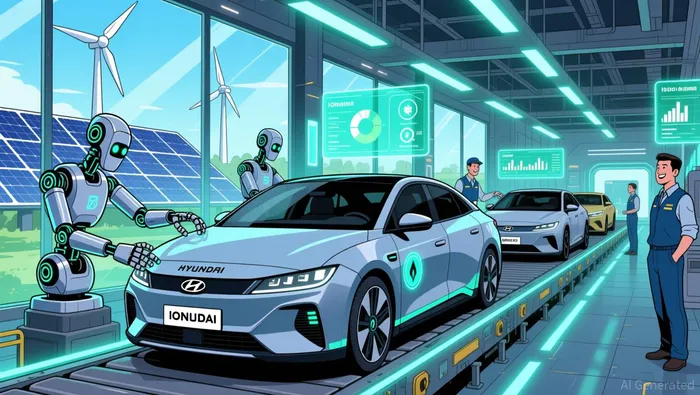
Hyundai's U.S. supply chain has faced intense scrutiny, including a high-profile lawsuit alleging the use of prison labor and child labor in its Southern operations. While such controversies threaten reputational and regulatory stability, the company has responded with a dual strategy of localized manufacturing and aggressive pricing adjustments. By ramping up production at the Hyundai Motor Group Metaplant America in Georgia, Hyundai has reduced reliance on global supply chains, with EV output of the IONIQ 5 and IONIQ 9 surging to meet demand. This shift not only mitigates logistical bottlenecks but also aligns with U.S. consumer preferences for domestically produced goods.
 Simultaneously, Hyundai has leveraged pricing flexibility to maintain competitiveness. , , . These moves underscore Hyundai's ability to adapt to market dynamics while preserving profit margins-a critical trait in an industry where cost volatility remains a persistent challenge.
Geopolitical Risk Mitigation: Partnerships and Infrastructure Investments
Geopolitical risks, from trade tensions to resource scarcity, demand a diversified strategy. Hyundai's partnerships with tech giants like Amazon and Waymo illustrate its proactive approach. Collaborations with Amazon have enhanced dealer engagement and logistics efficiency, while joint testing with Waymo on autonomous electric platforms positions Hyundai at the forefront of mobility innovation. These alliances not only diversify risk but also open new revenue streams in the evolving EV ecosystem.
Infrastructure investments further solidify Hyundai's resilience. , reducing dependency on imported materials. Such vertical integration insulates Hyundai from global supply shocks and aligns with U.S. policy priorities, including the 's emphasis on domestic content. By 2030, the company aims to produce 80% of U.S. sales locally, a target that harmonizes with both regulatory expectations and consumer demand for sustainability.
Policy Alignment and Strategic Recalibration: Flexibility in a Shifting Landscape
Hyundai's strategic recalibration in 2025 reflects a pragmatic response to evolving market conditions. At its CEO Investor Day, the company abandoned its 2030 EV sales target of 2 million units, pivoting instead to a broader portfolio of eco-friendly vehicles, including hybrids and extended-range electrics. This shift, driven by factors like the expiration of U.S. tax credits and battery supply chain instability, highlights Hyundai's agility in navigating policy uncertainties.
. , Hyundai is future-proofing its U.S. operations. Additionally, its focus on luxury and performance segments, such as the Genesis GV60 Magma and N performance brand, taps into high-growth niches while reinforcing brand equity.
Long-Term Value Creation: A Blueprint for the EV Transition
Hyundai's strategy transcends short-term survival, embedding long-term value creation into its DNA. The development of next-generation platforms like the 'eM' architecture standardizes components, reducing R&D costs and accelerating time-to-market. Meanwhile, initiatives like , its high-speed charging network, address infrastructure gaps that could stifle EV adoption. These efforts position Hyundai not just as a manufacturer but as a systemic enabler of the EV transition.
Moreover, the company's global ambition-to become the world's third-largest EV manufacturer by 2030-rests on a 31-model EV roadmap and a $24 trillion investment in Korea's domestic EV industry. This dual focus on global scale and regional customization ensures Hyundai can capitalize on both U.S. and international markets.
Conclusion
Hyundai's U.S. EV strategy exemplifies strategic resilience: it balances localized production with global supply chain diversification, leverages partnerships to mitigate geopolitical risks, and adapts to policy shifts with flexible electrification pathways. While challenges like the recent labor lawsuit highlight the fragility of even the most robust strategies, Hyundai's proactive investments and agile recalibrations demonstrate a commitment to long-term value creation. For investors, the company's ability to navigate turbulence while maintaining growth trajectories makes it a compelling player in the EV transition.







Comentarios
Aún no hay comentarios