
Hyundai Motor Group's Strategic Expansion in Southeast Asia: Innovation Labs in Singapore as a Catalyst for EV and Smart Mobility Leadership
In the race to dominate the next era of mobility, Hyundai Motor Group has positioned itself as a formidable contender by anchoring its Southeast Asian expansion in Singapore-a hub of technological innovation and strategic connectivity. The Hyundai Motor Group Innovation Center Singapore (HMGICS), launched in 2023, is not merely a production facility but a blueprint for the future of smart urban mobility. By integrating advanced manufacturing, customer-centric design, and open innovation, HMGICS is poised to redefine Hyundai's competitive edge in the electric vehicle (EV) and smart mobility sectors, particularly in Southeast Asia, a region projected to become a critical growth engine for the global automotive industry, according to Hyundai's Strategy 2025 roadmap.
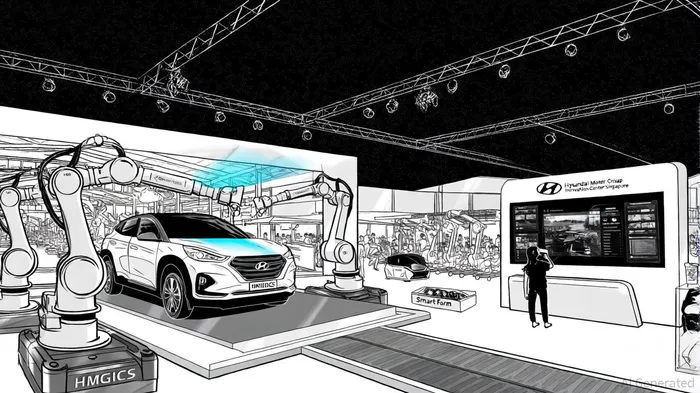
HMGICS: A Technological and Production Powerhouse
Hyundai's Singapore facility exemplifies the company's commitment to reimagining manufacturing. Equipped with cell-based production systems and 5G-powered digital twins, HMGICS enables real-time collaboration across global operations, reducing development cycles and costs, as noted in the HMGICS announcement. This agility is critical in an industry where rapid iteration and scalability are paramount. The center already produces the IONIQ 5 and IONIQ 6, but its true value lies in its flexibility: it can pivot to manufacture purpose-built vehicles (PBVs), robotaxis, and even advanced air mobility (AAM) solutions, aligning with Hyundai's 2025 vision to become a "smart mobility solution provider," according to a Hyundai Singapore story.
The integration of robotics, AI, and automation at HMGICS is not just about efficiency- it's about setting a new standard for human-centric innovation. For instance, the center's Smart Farm, which uses autonomous vehicles for local food production, demonstrates how mobility solutions can extend beyond transportation to address urban sustainability challenges, according to a HYUNDAI press release. Such initiatives underscore Hyundai's ability to diversify its value proposition, a key differentiator in markets where consumer expectations are evolving rapidly.
Strategic Partnerships and an Open Innovation Ecosystem
Hyundai's success in Southeast Asia hinges on its ability to collaborate with local stakeholders. HMGICS has forged partnerships with Singaporean businesses and academic institutions, creating an open innovation ecosystem that accelerates R&D and fosters shared growth, as Hyundai's Strategy 2025 roadmap describes. This approach is particularly effective in Southeast Asia, where regulatory environments and consumer preferences vary widely across countries. By co-developing solutions tailored to regional needs-such as hydrogen-powered public transport or compact EVs for dense urban areas-Hyundai can scale its offerings more effectively than rivals relying on one-size-fits-all strategies.
A compelling example is the center's collaboration with SG Enable and the Singapore Association of the Visually Handicapped to develop an end-to-end navigation solution for persons with visual impairments. This project not only enhances Hyundai's brand equity but also aligns with its sustainability goals, a growing priority for investors and regulators alike.
Customer-Centric Innovation and Market Penetration
Hyundai's investment in customer experience is another pillar of its Southeast Asian strategy. HMGICS offers immersive experiences like VR factory tours and test drives on a Skytrack, creating emotional connections with consumers in a region where brand loyalty is often shaped by personal engagement. These initiatives are not mere marketing gimmicks; they are part of a broader effort to transition from a vehicle manufacturer to a mobility service provider. By integrating connected vehicle platforms and personalized mobility solutions, Hyundai aims to capture recurring revenue streams, a critical factor in an industry shifting toward subscription-based models.
Moreover, the center's focus on inclusive mobility-such as the aforementioned navigation project-positions Hyundai as a socially responsible actor in markets where corporate citizenship is increasingly tied to market access. This is particularly relevant in Southeast Asia, where governments are incentivizing green technologies and penalizing carbon-intensive industries.
Broader Implications for Southeast Asia and Global Markets
Hyundai's Singapore-based innovations are not isolated experiments. The technologies and processes developed at HMGICS are being applied to future smart factories in Ulsan and Georgia, ensuring that the company's global production network benefits from localized breakthroughs, as described in the HMGICS announcement. This "test-and-scale" model reduces risk and accelerates deployment, a strategic advantage in a sector where first-mover benefits are significant.
Southeast Asia itself is a linchpin in Hyundai's global ambitions. The region's young, tech-savvy population and rapidly urbanizing cities present a fertile ground for EVs and smart mobility solutions. Hyundai's 2025 target of selling 670,000 EVs annually, including 560,000 battery electric vehicles (BEVs) and 110,000 fuel-cell electric vehicles (FCEVs), is ambitious but achievable given its localized production capabilities and partnerships, according to Hyundai's Strategy 2025 roadmap. Furthermore, the company's exploration of hydrogen fuel cells and urban air mobility (UAM) aligns with Southeast Asia's infrastructure gaps and environmental challenges, offering tailored solutions that competitors may struggle to replicate.
Conclusion
Hyundai Motor Group's innovation labs in Singapore are more than a regional outpost-they are a microcosm of the company's broader strategy to lead the transition to smart mobility. By leveraging cutting-edge technology, fostering open innovation, and prioritizing customer and community engagement, HMGICS is positioning Hyundai to dominate Southeast Asia's EV market while setting a template for global expansion. For investors, the company's ability to translate these innovations into scalable, profitable solutions represents a compelling opportunity in an industry undergoing its most profound transformation since the advent of the assembly line.







Comentarios
Aún no hay comentarios