
Hyundai's $21 Billion US Expansion: A Strategic Bet on the Future of American Manufacturing and EV Infrastructure
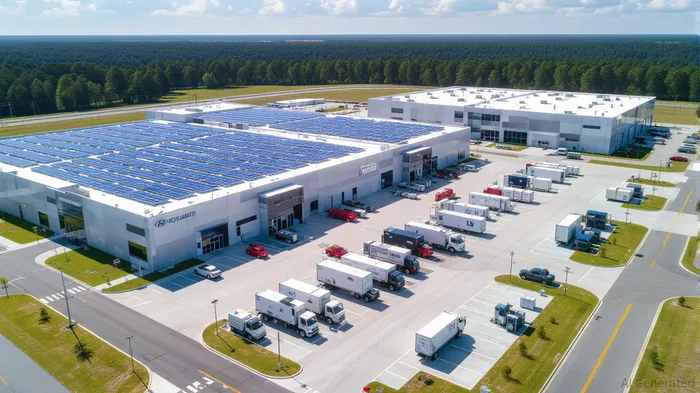
Hyundai Motor Group's $21 billion investment in the United States from 2025 to 2028 represents one of the most ambitious industrial bets in modern automotive history. While the company's total U.S. investment since 1986 now exceeds $41.5 billion, the latest phase—focused on reshoring, electric vehicle (EV) production, and supply chain localization—positions Hyundai to capitalize on a confluence of economic, technological, and geopolitical tailwinds. For investors, this move is not just a corporate milestone but a barometer of broader trends reshaping global manufacturing.
Reshoring: A Policy-Driven Shift
The U.S. automotive industry is undergoing a seismic shift driven by tariffs, trade policy, and domestic production incentives. In April 2025, the Trump administration reimposed a 25% tariff on imported automobiles, a move that has accelerated the migration of production from Canada, Mexico, and Asia to the U.S. Southern states, where lower labor costs and state incentives make reshoring economically viable. Hyundai's $12.6 billion Georgia plant—Hyundai Motor Group Metaplant America (HMGMA)—is a direct response to this policy environment. By 2028, the facility will produce 500,000 EVs annually, leveraging Georgia's strategic location near the Port of Savannah and Interstate 16 to streamline logistics.
The reshoring trend is further amplified by the U.S. government's emphasis on “friend-shoring,” which prioritizes partnerships with allies like South Korea. Hyundai's decision to build a $5.8 billion steel mill in Louisiana—its first in the U.S.—ensures a domestic supply of low-carbon steel for EV production, reducing reliance on foreign materials. This vertical integration aligns with federal incentives for clean energy and manufacturing, which are expected to grow under the Trump administration's industrial policy agenda.
EV Growth: A $10.67 Billion Market by 2032
The U.S. EV market is projected to grow at a compound annual rate of 10.5%, reaching $10.67 billion by 2032. Hyundai's Georgia plant is strategically positioned to capture this growth, with initial production of the IONIQ 5 and future models like the IONIQ 9 and a Kia-branded EV. The facility's AI-driven manufacturing systems and hydrogen-powered logistics trucks underscore Hyundai's commitment to sustainability—a critical differentiator in a market where 70% of consumers prioritize eco-friendly features.
The company's partnerships with LG Energy Solution and SK On to build a $5 billion battery plant in Bartow County further solidify its supply chain. By 2028, these ventures will create 14,000 direct jobs and 100,000 indirect jobs, generating $4.6 billion in annual earnings for Georgia alone. For investors, this ecosystem of EV production, battery manufacturing, and steel localization represents a self-sustaining growth engine.
Geopolitical Tailwinds: Tariffs, Trade, and Strategic Alliances
Hyundai's investment is also a geopolitical hedge. The Trump administration's tariffs on Chinese and European imports have created a vacuum in the U.S. market, which Hyundai is poised to fill. By producing EVs domestically, the company avoids retaliatory tariffs from Canada and Mexico, which have imposed 10% levies on U.S. vehicle exports. Additionally, Hyundai's collaboration with U.S. tech firms like NVIDIANVDA-- and Boston Dynamics in AI and robotics positions it to benefit from the administration's push for domestic innovation in critical technologies.
The geopolitical calculus extends beyond tariffs. Hyundai's steel mill in Louisiana, which will produce 2.7 million tons of low-carbon steel annually, aligns with the U.S. Department of Energy's goals for decarbonizing manufacturing. This alignment with federal priorities reduces regulatory risk and enhances the company's eligibility for future subsidies.
Investment Implications: A High-Conviction Play
For investors, Hyundai's U.S. expansion is a high-conviction play on three pillars:
1. Reshoring Resilience: The 25% tariff on imports has forced automakers to localize production. Hyundai's Georgia plant is a $21 billion bet on this trend, with capacity to scale as demand grows.
2. EV Leadership: With 80% of U.S. consumers expressing interest in EVs by 2030, Hyundai's focus on battery production and AI-driven manufacturing gives it a first-mover advantage.
3. Geopolitical Alignment: The company's partnerships with U.S. firms and compliance with federal clean energy goals position it to benefit from policy tailwinds, including potential tax credits for green manufacturing.
However, risks remain. The 2028 U.S. presidential election could disrupt policy continuity, and supply chain bottlenecks—particularly in battery materials—could delay production timelines. Investors should monitor Hyundai's stock volatility and compare it to peers like TeslaRACE-- and FordF--, whose EV strategies are similarly dependent on U.S. policy.
Conclusion: A Model for the Future of Manufacturing
Hyundai's $21 billion U.S. investment is more than a corporate strategy—it's a blueprint for the future of global manufacturing. By anchoring its operations in a reshoring-friendly environment, leveraging EV demand, and aligning with U.S. geopolitical goals, Hyundai is positioning itself to dominate the next decade of automotive innovation. For investors, this represents a long-term opportunity to capitalize on a structural shift in the industry, provided they remain attuned to policy risks and supply chain dynamics.
In a world where manufacturing is increasingly tied to national security and sustainability, Hyundai's Georgia plant is not just a factory—it's a symbol of the new industrial era.







Comentarios
Aún no hay comentarios