
Hyster-Yale’s Strategic Pivot: Betting on Batteries Over Fuel Cells in a Shifting Industrial Landscape
Hyster-Yale Materials Handling (HYMH) has embarked on a bold strategic realignment, recalibrating its business to prioritize near-term profitability and long-term growth. The move, announced in April 2025, reflects a clear shift toward battery-driven solutions and energy management systems, while scaling back its ambitious but struggling fuel cell program. For investors, this restructuring presents both opportunities and challenges, as the company bets on electrification trends to drive its next phase of expansion.
The realignment centers on three core initiatives: expanding battery technology, downsizing the fuel cell program, and optimizing costs to fuel future growth. Let’s dissect the implications.
Battery Expansion: The Engine of Future Growth
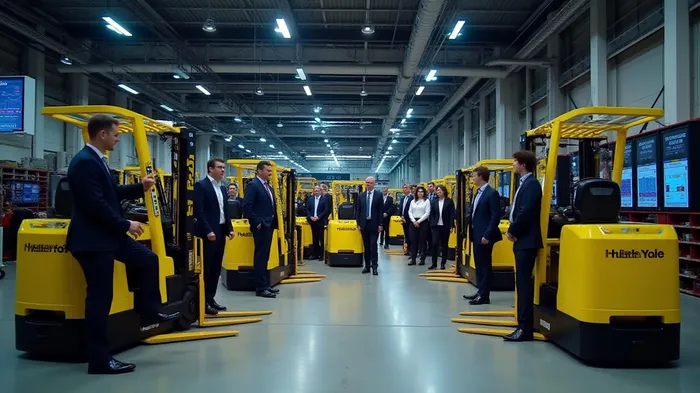
The Billerica facility, now fully integrated into HYMH, will spearhead the development of lithium-ion battery modules, chargers, and energy management systems. These efforts are critical to supporting next-generation electric forklifts, which are expected to see sales growth of 20–30% year-over-year starting in 2025. A key innovation is the mobile, modular hybrid electric charging platform—HydroCharge™—which combines HYMH’s battery tech with Nuvera’s fuel cell expertise.
The HydroCharge™ platform targets off-grid power applications, such as ports and large warehouses, where reliable energy is a bottleneck. While initial sales are expected in late 2025, the long-term potential is significant. Analysts estimate the global market for industrial energy management solutions could reach $12 billion by 2030, driven by decarbonization mandates and automation trends.
Fuel Cells: A Necessary Retreat
The downsizing of the fuel cell program underscores a pragmatic reassessment of market realities. After years of underwhelming adoption due to high costs, hydrogen supply constraints, and geopolitical uncertainties, HYMH has narrowed its focus to completing a 125KW fuel cell for port equipment—a higher-margin, niche application.
The write-downs and restructuring costs—$15–$18 million in Q2 2025—are painful but strategic. As one executive noted, “The fuel cell business wasn’t scaling fast enough to meet profitability targets, and the capital could be better deployed elsewhere.” This shift aligns with broader industry trends: while hydrogen remains a long-term solution, batteries are the near-term winner in industrial mobility.
Financial Implications: Costs Now, Profits Later
The restructuring will deliver $25–$35 million in annualized cost savings by 2027, including reduced capital intensity and optimized supply chains. However, investors must navigate short-term headwinds.
HYMH’s Q4 2024 results provide a baseline: $4.3 billion in revenue (+5% YoY) and a 28% surge in adjusted operating profit to $267 million, driven by pricing discipline and higher-value sales in the Americas. Yet challenges persist: EMEA and JAPIC regions faced margin pressure, while Nuvera’s fuel cell division contributed minimal revenue and a loss.
The near-term outlook includes lower production levels in early 2025, as the company retools its operations. However, management projects a modest global lift truck market recovery in 2025, particularly in EMEA and JAPIC, which could offset some of the transition costs.
Risks and Rewards: Navigating Uncertainty
HYMH’s strategy is not without risks. Supply chain bottlenecks, currency volatility, and geopolitical tensions—such as trade policies or conflicts—could disrupt execution. Additionally, the success of HydroCharge™ hinges on customer adoption, which remains unproven at scale.
Yet the company’s focus on modular, scalable products—like its new counterbalanced forklift models—positions it to capitalize on rising demand for warehouse automation and energy-efficient equipment. By 2027, the savings from restructuring and top-line growth from batteries and HydroCharge™ could deliver a $30–$40 million annual boost, even in cyclical downturns.
Conclusion: A Strategic Rebirth, But Patience is Advisable
Hyster-Yale’s realignment is a calculated pivot toward the industrial electrification megatrend. The move to prioritize batteries over fuel cells aligns with market realities and customer needs, while cost discipline and operational optimization aim to deliver sustainable returns.
For investors, the near-term pain—including restructuring charges and margin pressures—must be weighed against the long-term potential. If HYMH executes on its $30–$40 million annual savings target and captures even a fraction of the $12 billion energy management market, the stock could outperform peers.
Yet caution is warranted. The company’s success depends on overcoming execution risks and securing early HydroCharge™ wins. As the old adage goes: “In the long run, we’re all dead.” But for Hyster-Yale, this realignment is a clear step toward a future where batteries, not fuel cells, power its growth.
Data points referenced include Hyster-Yale’s Q4 2024 financials, market growth projections from industry analysts, and restructuring cost estimates provided in the company’s announcement.







Comentarios
Aún no hay comentarios