
Hyster-Yale Materials Handling: Navigating a Slowdown with Innovation and Resilience
The global materials handling equipment market is in a delicate balancing act. While the industry is projected to grow at a 6.2% CAGR through 2034, driven by e-commerce and automation, Hyster-Yale Materials HandlingHY-- (HY) faces a challenging Q2 2025 outlook. With Q1 2025 revenues down 14% year-over-year and a backlog of $1.9 billion, the company must prove its ability to adapt in a slowing market. But what sets HY apart is not just its product portfolio—it's the strategic depth of its innovation and operational resilience. Let's dissect whether these strengths justify a buy thesis despite near-term headwinds.
The Revenue Conundrum: A Tale of Two Markets
Hyster-Yale's Q1 2025 results highlight the duality of its challenges. While Americas and EMEA bookings surged 48% sequentially, global revenue fell to $910 million, down 14% year-over-year. The decline stems from weaker demand for high-margin internal combustion engine (ICE) trucks and lingering tariff pressures. Analysts project Q2 revenue of $936.9 million, a modest sequential uptick but still below 2024 levels.
The company's guidance for 2025—lower revenues and profits compared to 2024—reflects broader macroeconomic pressures. Yet, HY's leadership isn't retreating; it's pivoting. The key lies in its strategic realignment of the Nuvera fuel cell division and aggressive cost-cutting measures.
Strategic Realignments: Sacrifices for Long-Term Gains
Hyster-Yale's Nuvera division, once a sprawling hydrogen fuel cell venture, is now a streamlined energy solutions unit. The company is shifting focus to lithium-ion batteries, modular charging platforms, and HydroCharge™ systems. While this realignment will cost $15–$18 million in Q2 2025 (via severance and impairment charges), the long-term payoff is clear:
- Cost Savings: $15–$20 million in annualized savings starting in 2025.
- Synergy Potential: Integration of battery tech with lift truck production, reducing reliance on third-party suppliers.
- Market Positioning: A first-mover advantage in off-grid power solutions, a niche with high growth potential.
These moves are part of a broader $30–$40 million annual savings program by 2027, driven by manufacturing footprint optimization and working capital efficiency. While short-term pain is inevitable, the roadmap to 7% operating profit margins (a target for the Lift Truck and Bolzoni businesses) is achievable.
Innovation as a Defense Against Commodity Competition
HY's competitors—KUKA, Kion Group, and Daifuku—are all investing in automation and electrification. But Hyster-Yale's approach is distinct: modular, scalable lift trucks and a hybrid energy ecosystem. Its new product line, designed to meet the demands of e-commerce and warehouse automation, is already boosting Q1 bookings by 13% year-over-year.
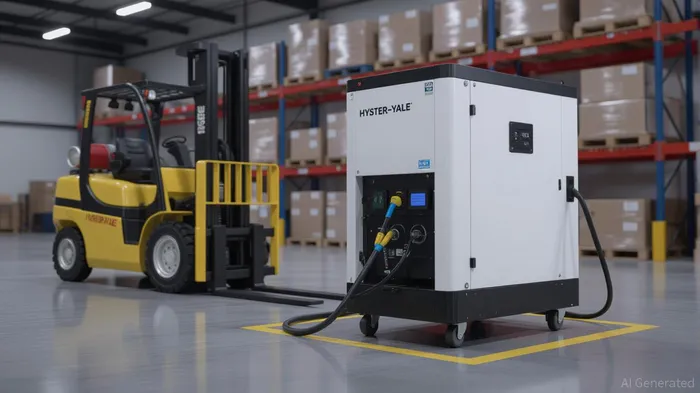
The company's focus on electrification aligns with a $252.53 billion market expected to grow to $390.88 billion by 2032. By 2026, HY aims to leverage its energy solutions to capture a larger share of the electric forklift truck segment, which is projected to grow at a 12% CAGR.
Tariffs and Pricing Power: Navigating the Storm
Tariffs remain a wildcard. HY has already implemented price increases in Q1 2025 and plans further adjustments to offset costs. While this may temporarily dampen demand, the company's disciplined pricing strategy and cost discipline—evidenced by a $69 million inventory reduction in Q1—position it to weather trade volatility better than peers.
The Investment Thesis: Buy for the Long Game
Hyster-Yale's Q2 2025 earnings may disappoint, but the company's strategic playbook is robust:
1. Short-Term Pain, Long-Term Gain: $30–$40 million in annual savings by 2027 will stabilize margins.
2. Energy Solutions: A $15–$20 million head start in battery and charging tech could redefine its profit pool.
3. Market Share Gains: Strong Q1 bookings and product innovation suggest a rebound in 2026.
While HY's stock has underperformed the S&P 500 Industrial Machinery Index over the past year (trading at $40.23 vs. an average price target of $56), the valuation reflects near-term risks rather than long-term potential. For investors with a 3–5 year horizon, HY's focus on electrification, automation, and cost efficiency offers a compelling case.
Final Verdict: Hyster-YaleHY-- is not a short-term play. But for those who can stomach the volatility and see value in its strategic reinvention, the company's innovation engine and operational resilience make it a high-conviction buy. The market's next inflection pointIPCX-- may come when its energy solutions and modular trucks gain traction in 2026.





Comentarios
Aún no hay comentarios