
Hyroad Energy's Strategic Acquisition of Nikola Assets: A Catalyst for Dominance in the Hydrogen Trucking-as-a-Service Market
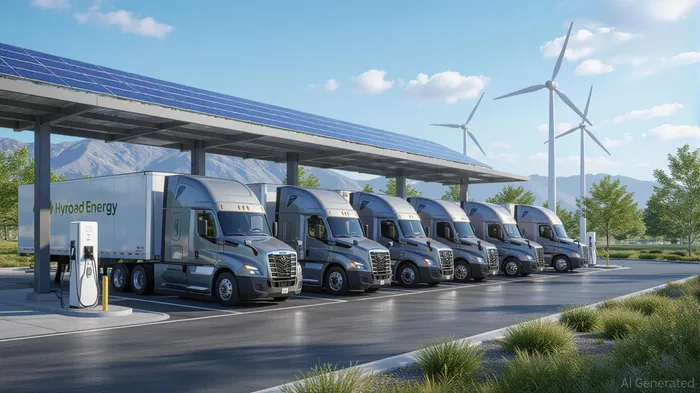
In 2025, the hydrogen trucking-as-a-service (TaaS) market is undergoing a seismic shift, driven by regulatory urgency, ESG imperatives, and the urgent need for scalable decarbonization solutions. At the forefront of this transformation is Hyroad Energy, a company that has redefined the economics of zero-emission freight through its innovative pay-per-mile model. The recent acquisition of Nikola Corporation's hydrogen assets—a $3.85 million deal for $114 million in rolling stock, software, and intellectual property—positions Hyroad as a dominant force in a sector poised for explosive growth.
A Strategic Move to Scale Zero-Emission Solutions
Hyroad's acquisition of Nikola's 113 hydrogen fuel-cell trucks, including 103 new tractors and 10 demonstration units, is more than a transaction; it is a masterstroke in accelerating the company's TaaS model. By integrating Nikola's operational infrastructure, software platforms861226--, and raw material inventory, Hyroad now controls a fleet capable of immediate deployment in California, a state that mandates 75% of Class 8 truck sales to be zero-emission by 2035. The acquisition also includes Nikola's hydrogen refueling infrastructure and maintenance systems, enabling Hyroad to offer a seamless, end-to-end solution for fleet operators.
The pay-per-mile model, which eliminates upfront capital costs for customers, aligns perfectly with the financial constraints of fleet operators transitioning to zero-emission technologies. With hydrogen trucks costing upwards of $750,000 per unit, Hyroad's approach removes a critical barrier to adoption. By 2025, the Port of Los Angeles alone has allocated $50 million in incentives through its Clean Truck Fund, covering up to 90% of hydrogen truck costs. Hyroad's acquisition ensures it can capitalize on these subsidies while scaling its operations to meet the 546-zero-emission truck demand already in motion.
Regulatory Tailwinds and ESG Alignment
California's Advanced Clean Trucks (ACT) regulation is a linchpin for Hyroad's strategy. The state's aggressive timeline for decarbonizing freight—coupled with federal incentives like the $50 million EnergIIZE program—creates a regulatory tailwind that Hyroad is uniquely positioned to exploit. The company's focus on hydrogen over battery-electric alternatives is also strategic: hydrogen's energy density and refueling speed make it ideal for long-haul and heavy-duty applications, where battery-electric trucks face range and charging limitations.
From an ESG perspective, the acquisition aligns with global investor priorities. The European Union's 2030 target of 10 million metric tons of renewable hydrogen production and the U.S. Department of Energy's $62 million in hydrogen safety and permitting grants underscore the sector's importance in decarbonizing hard-to-abate industries. Hyroad's TaaS model not only reduces carbon footprints but also addresses the technical and financial risks associated with hydrogen infrastructure, making it a compelling ESG investment.
Market Potential and Competitive Edge
The hydrogen trucking market is projected to grow at a compound annual rate of 25% through 2030, driven by regulatory mandates and corporate net-zero commitments. Hyroad's acquisition accelerates its ability to capture this growth. By leveraging Nikola's intellectual property and expanding its maintenance facilities, the company can offer a service that is both scalable and resilient.
Competitors in the space, such as Hydrogenious LOHC Technologies and Hystar, are focused on hydrogen storage and production, but Hyroad's end-to-end TaaS model differentiates it. The company's ability to integrate refueling, maintenance, and software analytics into a single platform creates a sticky customer relationship, ensuring long-term revenue streams.
Investment Implications
For investors, Hyroad's acquisition represents a rare confluence of regulatory momentum, ESG alignment, and operational scalability. The company's pay-per-mile model reduces customer risk, while its strategic focus on California—a market that accounts for 40% of U.S. freight emissions—positions it to dominate a critical segment of the hydrogen economy.
However, risks remain. Hydrogen infrastructure is still nascent, and the cost of green hydrogen production must decline to sustain long-term profitability. That said, Hyroad's acquisition of Nikola's assets provides a critical head start in building the infrastructure and customer base needed to overcome these challenges.
Conclusion
Hyroad Energy's acquisition of Nikola's assets is a defining moment in the hydrogen trucking-as-a-service market. By combining Nikola's technology with its own TaaS model, Hyroad is not just adapting to the zero-emission transition—it is leading it. For investors seeking exposure to a sector at the intersection of regulatory inevitability and ESG-driven growth, Hyroad offers a compelling case. The company's ability to scale quickly, reduce customer risk, and align with global decarbonization goals makes it a standout in a market that is only beginning to realize its potential.
As the world races to meet climate targets, Hyroad Energy is proving that the future of freight is not just zero-emission—it's hydrogen-powered, and it's here.







Comentarios
Aún no hay comentarios