
Hyperscale Data's Strategic Expansion in Michigan for NVIDIA Blackwell AI Infrastructure: A High-Growth Play in the AI Revolution
The global AI revolution is accelerating, and data centers are becoming the new oil fields of the digital age. As enterprises and governments race to deploy AI at scale, the demand for high-performance computing infrastructure is surging. Hyperscale DataGPUS--, Inc. (HSD) is positioning itself at the forefront of this transformation with its strategic expansion in Michigan, leveraging NVIDIA's Blackwell AI architecture to create a dual-use facility that combines BitcoinBTC-- mining with next-generation AI workloads. This move aligns with a market poised for explosive growth, where AI data center investments are projected to exceed $200 billion annually by 2030, driven by a 33% year-over-year expansion in capacity[1].
The Michigan Campus: A Dual-Use Powerhouse
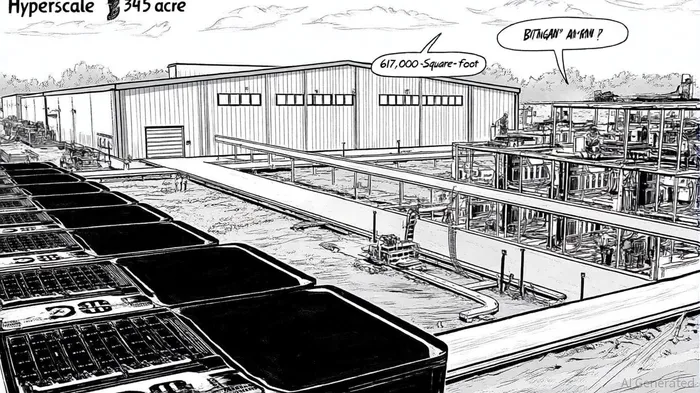
Hyperscale Data's Michigan facility, spanning 34.5 acres and featuring a 617,000-square-foot data center, is undergoing a phased buildout to increase power capacity from 28 megawatts (MW) to 340 MW by the third quarter of 2029[2]. This expansion will enable the company to maintain its Bitcoin mining operations while deploying NVIDIANVDA-- Blackwell servers, which offer 25x higher token throughput and 20x lower cost per inference compared to Hopper GPUs[3]. The dual-use model is a strategic differentiator, allowing HSD to hedge against market volatility in the cryptocurrency sector while capitalizing on the AI boom.
The company has already initiated construction and equipment procurement, with 16 existing NVIDIA GPU servers remaining operational during the transition[4]. CEO William Horne emphasized the site's unique advantages, including its scale, location, and technical expertise, which position it to deliver secure, scalable compute power for both AI and blockchain systems[4]. By 2027, HSD aims to reach 70 MW of power capacity, with a mid-term goal of adding 40 MW by Q2 2027[2].
NVIDIA Blackwell: The Engine of AI's Next Frontier
NVIDIA's Blackwell architecture is redefining the AI landscape. In Q1 2026, Blackwell accounted for nearly 70% of NVIDIA's data center segment compute revenues, driven by its deployment in hyperscaler environments at a rate of 72,000 GPUs per week[3]. The Blackwell Ultra variant, unveiled at GTC 2025, further enhances performance with FP4 precision math, 288 GB of HBM3e/HBM4 memory, and ConnectX-8 networking, making it ideal for large language model (LLM) training and real-time inference[5].
Hyperscale Data's partnership with NVIDIA is not just a technological upgrade—it's a strategic alignment with a market leader. NVIDIA's data center revenue hit $115.2 billion in FY2025, with a 93% year-over-year growth in Q4 alone[3]. The company's Instant AI Factory service, powered by Blackwell-based DGX SuperPODs, is also disrupting traditional infrastructure models by enabling enterprises to rent compute power on demand[5]. For HSD, this means access to cutting-edge technology and a scalable platform to meet the surging demand for AI training and inference.
Financial Strength and Strategic Flexibility
Hyperscale Data's financial discipline further strengthens its investment case. The company recently reduced its debt by over $20 million, bolstering its balance sheet ahead of the Michigan expansion[2]. To fund the 340 MW buildout, HSD filed a shelf registration for up to $125 million, though it is not immediately seeking capital, signaling confidence in its operational cash flow[2]. This flexibility is critical in a sector where power and cooling costs can account for 60% of total expenses[6].
The Michigan facility's power agreements with local utilities and natural gas providers ensure a reliable 300 MW supply, with an additional 40 MW from gas-powered generators[2]. This infrastructure resilience is a key selling point for hyperscalers and cloud providers, who require uninterrupted uptime for mission-critical AI workloads.
Market Validation and Long-Term Outlook
The AI data center market is expected to grow at a compound annual rate of 30.3% from 2025 to 2028[3], driven by demand from hyperscalers and enterprises. Hyperscale Data's Michigan project is well-positioned to capture this growth, particularly as AI factories—automated, high-density compute clusters—become the standard for training and inference[5].
Moreover, HSD's dual-use model offers a hedge against sector-specific risks. While Bitcoin mining remains a volatile revenue stream, the AI infrastructure segment is experiencing a structural shift. For example, Oracle's $300 billion five-year compute power agreement with OpenAI underscores the long-term value of AI infrastructure[7]. Hyperscale Data's ability to pivot between use cases—mining during low-demand periods and AI workloads during peak demand—creates a resilient revenue model.
Conclusion: A Near-Term High-Growth Play
Hyperscale Data's Michigan expansion represents a compelling investment opportunity in the AI revolution. By combining NVIDIA's Blackwell architecture with a dual-use model, the company is addressing both the immediate and long-term needs of the AI and blockchain ecosystems. With a clear path to 340 MW of power capacity, a debt-reduced balance sheet, and strategic partnerships with industry leaders, HSD is well-positioned to capitalize on the $200 billion AI data center market. As the world transitions to AI-driven economies, Hyperscale Data's Michigan campus is not just a data center—it's a cornerstone of the next industrial revolution.







Comentarios
Aún no hay comentarios