
Hyperliquid's Volatility: A Buying Opportunity or a Warning Sign?
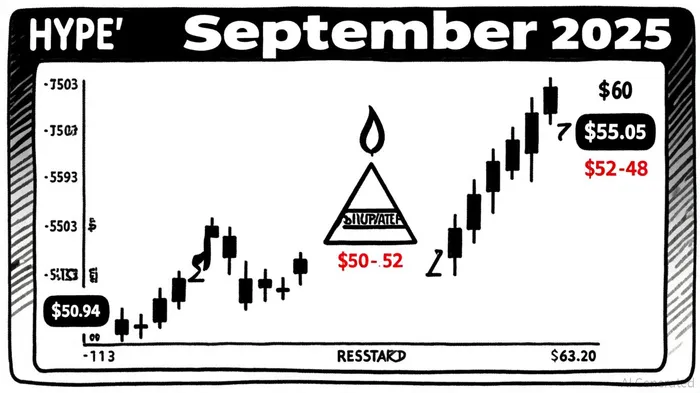
Hyperliquid (HYPE) has become one of the most polarizing assets in the crypto space in 2025. With a 34.41% gain over the past 30 days and a price of $57.80—22.47% above its predicted level for September 23, 2025—the token has defied bearish expectations. But is this volatility a sign of a speculative frenzy, or does it reflect a fundamentally strong ecosystem? Let's dissect the data.
Market Sentiment: Bullish Momentum, But Caution Lingers
The Fear & Greed Index for HYPE sits at 52, a neutral reading in the broader crypto market, yet 88% of technical indicators signal bullish bias[1]. This divergence suggests retail and institutional players are increasingly confident in Hyperliquid's long-term narrative. The token's price has held above key support levels ($52.44, $50.98) despite a 5.03% pullback from its 30-day high[2], indicating robust demand.
However, short-term caution is warranted. On the 4-hour chart, the MACD histogram is fading, signaling consolidation ahead of a potential breakout[1]. If bulls fail to push above $59.13 resistance, a retest of $52 support could trigger profit-taking. Yet, the ascending triangle pattern—formed by a horizontal resistance at $52–$55 and a rising trendline—suggests a high probability of a bullish breakout[4].
On-Chain Behavior: A DeFi Powerhouse Gaining Steam
Hyperliquid's on-chain metrics tell a story of rapid adoption. As of September 2025, the platform's TVL has surged to $5 billion, with weekly inflows averaging $58 million[2]. Open interest hit $15 billion, outpacing centralized exchanges like ByBit and OKX[2]. This growth is driven by Hyperliquid's unique architecture: HyperBFT for consensus, HyperCore for high-speed execution, and HyperEVM for EVM compatibility[6].
The platform's deflationary model further strengthens its case. By burning 97% of trading fees and repurchasing over 28.5 million HYPE tokens ($1.3 billion market value), the protocol has created a self-sustaining value accrual mechanism[3]. This contrasts sharply with traditional DeFi projects, where token supply often dilutes over time.
Institutional Adoption: A Game-Changer
Hyperliquid's institutional adoption is accelerating. Lion Group's $600 million reallocation to HYPE and Arthur Hayes' $9 million position[4] signal growing confidence in its utility as a DeFi infrastructure asset. BitGo's custodial support for HyperEVM/HYPE[2] adds another layer of institutional credibility, addressing security concerns for large investors.
Circle's stake in Hyperliquid also reinforces its role as a stablecoin-driven derivatives hub[2]. With USDH (a proposed stablecoin) and beHYPE (a liquid staking token) in the pipeline, the ecosystem is poised to capture a larger share of the $10 trillion derivatives market[5].
Risk Factors: Volatility as a Double-Edged Sword
Critics argue that HYPE's 5.94% 24-hour gain[1] and 50% weekly surge[2] reflect speculative hype. Whale activity—such as a $3.98 million purchase at $36—suggests continued confidence[3], but sharp corrections (e.g., a drop to $39 or $35[1]) remain possible if macroeconomic conditions deteriorate.
However, the platform's dominance in decentralized perpetual trading (73% market share[2]) and its ability to rival centralized exchanges in liquidity and speed[6] mitigate these risks. The proposed USDH stablecoin could further stabilize the ecosystem by attracting yield-seeking capital.
Conclusion: A High-Conviction Play
Hyperliquid's volatility is neither a red flag nor a green light—it's a reflection of its disruptive potential. The combination of bullish technical patterns, robust on-chain growth, and institutional adoption creates a compelling case for long-term investors. While short-term consolidation is likely, the fundamentals suggest HYPE is undervalued relative to its projected $80 price target by year-end[1].
For those willing to navigate the noise, Hyperliquid represents a rare intersection of innovation and execution in the DeFi space. As the platform continues to scale its TVL, open interest, and institutional partnerships, volatility may prove to be a feature, not a bug.







Comentarios
Aún no hay comentarios