
Hyperliquid's Structural Vulnerabilities and the Rise of Aster in the Perp DEX Arms Race
The decentralized exchange (DEX) landscape for perpetual derivatives has entered a hyper-competitive phase in 2025, with Hyperliquid and Aster locked in a high-stakes battle for market share. While Hyperliquid retains a commanding 48.7% of the sector's $1.8 trillion in trading volume, its structural vulnerabilities are increasingly exposed by Aster's agile, multi-chain strategy. This analysis unpacks the risks inherent to Hyperliquid's architecture and how Aster's innovations are reshaping the competitive dynamics of the PerpPERP-- DEX space.
Hyperliquid's Dominance and Its Hidden Weaknesses
Hyperliquid's success stems from its custom-built Layer 1 (L1) blockchain, optimized for high-frequency trading with sub-second finality and zero gas fees. This architecture enabled it to process 200,000 orders per second, securing a 70% market share earlier in 2025[1]. However, this vertical integration creates a critical dependency: the entire platform's liquidity and user base are confined to a single chain.
This single-chain model exposes Hyperliquid to systemic risks. A recent incident highlighted this vulnerability when a whale manipulated the XPL market, triggering a $130 million loss in open interest[1]. Such events erode user trust and underscore the fragility of centralized liquidity pools. Furthermore, Hyperliquid's reliance on a proprietary L1 limits its ability to tap into cross-chain liquidity, a growing trend in DeFi as users seek interoperability[2].
Aster's Multi-Chain Gambit and Strategic Counterpunches
Aster, by contrast, has adopted a decentralized, multi-chain approach, operating on BNBBNB-- Chain, EthereumETH--, SolanaSOL--, and ArbitrumARB--. This strategy allows it to aggregate liquidity across fragmented ecosystems while mitigating single points of failure. According to a report by Dropstab, Aster's “hidden order” system—designed to prevent front-running and liquidation manipulation—has been a key differentiator, earning endorsements from figures like Binance's Changpeng Zhao[3].
Aster's rapid rise is also fueled by aggressive tokenomics. Its native token, ASTRASTR--, has a capped supply of 8 billion, with 53.5% allocated to airdrops and community rewards[1]. This contrasts with Hyperliquid's HYPE token, which relies on a buyback model where 97% of trading fees are used to repurchase tokens. While this creates a deflationary mechanism, it also ties HYPE's value directly to Hyperliquid's trading volume, making it susceptible to market cycles[2].
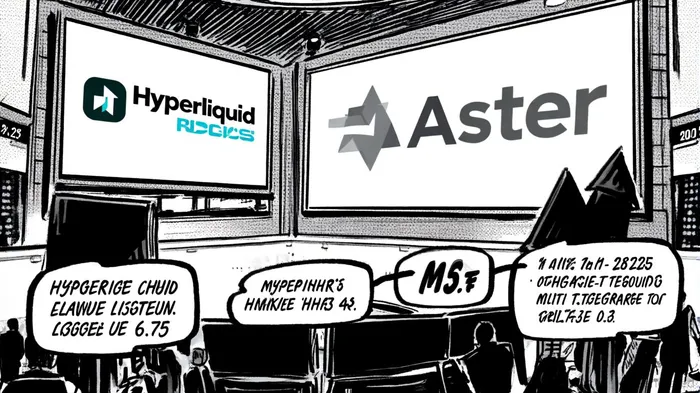
The rivalry has escalated into a war of leverage. Hyperliquid recently listed ASTR with 3x leverage, while Aster retaliated by offering HYPE perpetuals with 300x leverage[3]. These moves reflect a broader trend: platforms are now competing not just on infrastructure but on liquidity incentives and user acquisition tactics.
Structural Risks and the Path Forward
Hyperliquid's primary risk lies in its inability to adapt to cross-chain demands. While its L1 architecture excels in speed, it lacks the interoperability of platforms like Aster, which can integrate with yield protocols such as PendlePENDLE-- and Venus[2]. This limits Hyperliquid's ability to diversify revenue streams or offer users access to real-world assets (RWAs), a growing segment in DeFi[5].
Aster, meanwhile, faces operational complexity from its multi-chain model. Cross-chain bridges remain a security concern, and managing liquidity across four chains requires robust governance. However, its open-interest figure of $3.72 million (compared to Hyperliquid's $15 billion) suggests there is still room for growth[1].
Implications for Investors
For investors, the key takeaway is that Hyperliquid's dominance is not guaranteed. While its execution speed and user experience remain unmatched, its structural rigidity could be exploited by more flexible competitors. Aster's focus on decentralization and cross-chain liquidity positions it to capture a broader audience, particularly as retail traders seek platforms with lower barriers to entry.
However, the risks are not one-sided. Aster's reliance on airdrops and high-leverage token listings could lead to volatility, especially if regulatory scrutiny intensifies. Both platforms must balance innovation with security to sustain long-term growth.
Conclusion
The Perp DEX war of 2025 is a microcosm of DeFi's broader evolution: speed versus scalability, centralization versus decentralization. Hyperliquid's structural risks—single-chain dependency, liquidity concentration, and governance vulnerabilities—make it a prime target for platforms like Aster, which prioritize adaptability. As the sector matures, investors must weigh these trade-offs carefully. The winner may not be the fastest or the most capitalized, but the one that best navigates the tension between innovation and resilience.






Comentarios
Aún no hay comentarios