
Hyperliquid's HyperVault Collapse: A Cautionary Tale for DeFi Yield Strategies and Exit Risk Management
In the fast-moving world of decentralized finance (DeFi), innovation often walks hand in hand with risk. The collapse of Hyperliquid's HyperVault in March 2025, triggered by a sophisticated manipulation of the JELLY token, has exposed critical vulnerabilities in yield strategies and exit risk management. This incident, which saw the protocol's total value locked (TVL) plummet by 72% in a month and its native token, HYPE, drop 28%, serves as a stark reminder of the fragility of even the most hyped DeFi projects.
The Anatomy of the Collapse
Hyperliquid's HyperVault was marketed as a cutting-edge solution for stablecoin yield generation, leveraging automated strategies like market-making and liquidity provision through its Hyperbeat infrastructure [1]. However, the protocol's cross-margin and pooled collateral systems created a structural weakness. When a large whale executed a coordinated short-and-buy strategy on JELLY, the vault's auto-deleveraging mechanisms failed to activate, leaving it exposed to a toxic position [1]. The attacker's actions—dumping JELLY to trigger a short, then repurchasing it to drive up the price—exploited unpriced vega risk, a flaw that critics argue was inherent in Hyperliquid's design [3].
The response from Hyperliquid's validators—delisting the JELLY perpetual contract and settling short positions at $0.0095 per token—was both a technical and ethical controversy. While the move averted a $240 million loss and even generated a $703,000 profit for the vault [2], it drew sharp criticism for centralizing governance decisions. Bitget CEO Gracy Chen likened the action to FTX's collapse, questioning whether Hyperliquid's “decentralized” model was anything more than a veneer [4].
Red Flags in DeFi Yield Strategies
The HyperVault incident highlights three systemic issues in DeFi yield strategies:
1. Overreliance on Collateral Pooling: By allowing cross-margin trading, Hyperliquid's pooled collateral system amplified risk exposure. When one asset (JELLY) failed, the entire vault's capital was at risk, undermining the principle of risk isolation [1].
2. Inadequate Risk Pricing for Volatile Assets: The protocol's governance proposals, including HIP-3's permissionless perpetual market creation, incentivized exposure to high-risk tokens without robust mechanisms to price tail risks like vega volatility [3].
3. Centralized Governance Loopholes: The emergency delisting of JELLY, while technically effective, revealed a lack of on-chain transparency. Validators acted off-chain, raising concerns about accountability and the potential for future overreach [5].
Exit Risk Management: A Flawed Framework
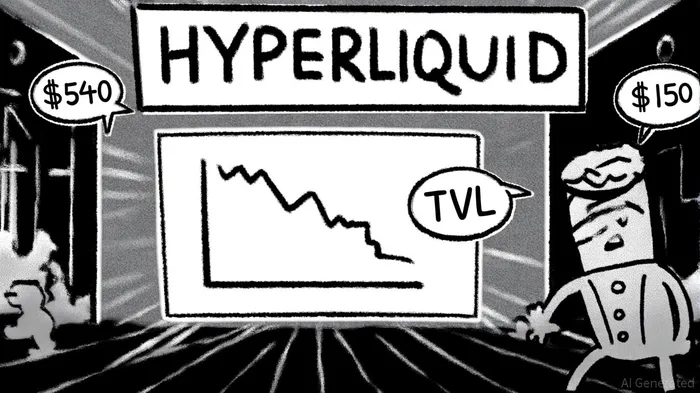
Hyperliquid's post-crisis reforms—such as implementing on-chain validator voting for delistings and public disclosure of validator intentions—aim to address these flaws [2]. Yet, the damage to user trust was immediate. TVL dropped from $540 million to $150 million within 30 days, and the HYPE token's price correction signaled broader skepticism about the protocol's economic model [3].
A report by the Oregon Blockchain Group underscores the deeper issue: Hyperliquid's fee model, which allocates 97% of trading fees to HYPE buybacks, created a feedback loop that masked underlying risks [1]. When the JELLY crisis exposed these risks, the model's sustainability came into question.
Lessons for Investors and Developers
The HyperVault collapse offers critical lessons for the DeFi ecosystem:
- Transparency Over Haste: Permissionless market creation (HIP-3) and similar innovations must be paired with rigorous risk assessments.
- Decentralization with Accountability: Governance mechanisms must ensure that emergency actions are both effective and transparent, avoiding the perception of centralization.
- Stress-Testing for Black Swans: Protocols must simulate extreme scenarios, such as coordinated attacks on volatile assets, to identify systemic weaknesses.
Hyperliquid's response—compensation programs for users and governance upgrades—demonstrates a commitment to recovery. However, the incident underscores a broader truth: in DeFi, the line between innovation and recklessness is perilously thin. For investors, due diligence must extend beyond TVL metrics to scrutinize risk frameworks and governance structures.







Comentarios
Aún no hay comentarios