
Hyperliquid's HYPE Token: Navigating Vesting Overhangs and Price Stability Risks in a High-Stakes Market
The HYPE Token's High-Stakes Balancing Act
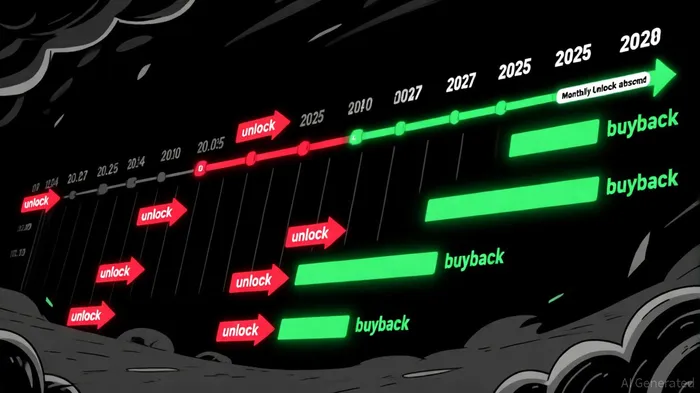
Hyperliquid's HYPE token has surged to an all-time high of $50, driven by aggressive buybacks and a robust trading volume. Yet, beneath the surface, a ticking clock looms: 23.8% of the team's token allocation—worth approximately $11.9 billion—begins unlocking on November 29, 2025, with monthly releases of $500 million at current prices[1]. This vesting schedule, spanning 24 months, poses a critical question: Can Hyperliquid's buyback program and market dynamics absorb such a massive influx of sellable tokens without triggering a collapse in price?
Vesting Overhangs: A Double-Edged Sword
Vesting schedules are a double-edged sword in crypto. On one hand, they align incentives by locking stakeholders into long-term success. On the other, poorly structured unlocks can create massive selling pressure, as seen in projects like Celsius and TerraLUNA--. Hyperliquid's cliff vesting model—where tokens unlock in full after a 12-month cliff—aims to mitigate early dumping. However, the sheer scale of the November 2025 unlock is unprecedented.
According to data from DefiLlama, only 17% of the monthly unlocks are estimated to be absorbed by buybacks, leaving $415 million in potential sellable tokens per month[3]. This creates a precarious equilibrium: If core contributors or whales offload even a fraction of their unlocked tokens, the market could face a liquidity crisis.
Buybacks as a Counterweight: Can They Sustain the Hype?
Hyperliquid's buyback program is its most potent weapon against this overhang. The platform reinvests 97% of protocol fees into HYPE token repurchases, creating a flywheel effect where higher trading volume funds more buybacks[2]. By mid-2025, the Autonomous Fund (AF) had already accumulated $1 billion in HYPE tokens, with recent activity including a $31 million buyback in July 2025 and a $2 million single-day purchase[5].
However, critics argue that even these aggressive buybacks may not outpace the unlock rate. For context, Ethereum's team vesting is spread over years with smaller monthly unlocks, while Binance's token burn strategy focuses on reducing supply gradually[6]. Hyperliquid's approach, while bold, hinges on sustained fee revenue and a market willing to absorb the increased supply.
Whale Activity and Short Positions: A Harbinger of Volatility
The market's anxiety is already palpable. A $122 million HYPE withdrawal by a whale wallet (0x316f) in late 2025 has amplified fears of a sell-off[1]. Compounding this, institutional players like Abraxas Capital have opened $3 million short positions, betting on a price drop[2]. Such activity suggests that even before the first unlock, the market is pricing in potential instability.
Historical precedents reinforce these concerns. Linear vesting models, where tokens unlock incrementally, often lead to steady sell pressure. Hyperliquid's cliff vesting avoids this but risks a sudden liquidity shock when 23.8% of the supply becomes tradable in a single month[3].
Mitigating the Risk: Community-Driven Tokenomics
Hyperliquid's tokenomics strategy leans heavily on community incentives. 70% of the total supply is allocated to community rewards and grants, reducing reliance on venture capital or private investors[3]. This decentralized approach aims to prevent insider dominance and foster organic demand. Additionally, the airdrop of $310 million in HYPE tokens to 90,000 users has broadened ownership, diluting the influence of any single whale[3].
Yet, these measures are not foolproof. If the November 2025 unlock coincides with a broader market downturn or reduced trading volume, the buyback program's effectiveness could wane. The key will be whether Hyperliquid can maintain its $50 price level through strategic liquidity management and continued product innovation.
Conclusion: A High-Risk, High-Reward Proposition
Hyperliquid's HYPE token is a case study in the tension between innovation and volatility. While its buyback program and community-driven tokenomics offer a compelling narrative, the $500 million monthly unlock remains a significant overhang. Investors must weigh the platform's ability to sustain fee growth against the risk of a liquidity crunch.
For now, the market is watching November 2025 closely. If Hyperliquid can navigate this unlock without a price collapse, the token could cement itself as a DeFi leader. But if the sell pressure overwhelms the buyback machine, the HYPE could quickly become a cautionary tale.







Comentarios
Aún no hay comentarios