
Hyperliquid (HYPE) Price Prediction and Growth Potential: On-Chain Innovation and DeFi Tailwinds
The DeFi landscape in 2025 is defined by a confluence of technological breakthroughs and macroeconomic shifts, creating fertile ground for platforms like Hyperliquid to redefine decentralized trading. Hyperliquid, a Layer-1 blockchain built for high-speed perpetual trading, has emerged as a pivotal player in this evolution. By combining the efficiency of centralized exchanges with the transparency of decentralized infrastructure, Hyperliquid has notNOT-- only captured market share but also catalyzed a new era of on-chain innovation. This analysis explores Hyperliquid's (HYPE) price trajectory and growth potential, contextualized by its technical advancements and the broader DeFi tailwinds propelling the sector.
On-Chain Innovation: Hyperliquid's Competitive Edge
Hyperliquid's HyperCore blockchain, underpinned by its HyperBFT consensus mechanism, has redefined the performance benchmarks for decentralized exchanges. With sub-second finality and the capacity to process 200,000 orders per second, HyperCore bridges the gap between centralized and decentralized ecosystems, offering traders the speed of platforms like Binance while retaining on-chain transparency [1]. This architectural leap has been critical in attracting both retail and institutional participants, as evidenced by the platform's $320 billion in perpetuals trading volume and $86.6 million in protocol revenue in July 2025 [2].
The platform's Hyper Improvement Proposals (HIPs) further underscore its innovation-driven ethos. HIP-1 and HIP-2 democratized market creation by enabling permissionless deployment of spot and perpetual assets, allowing builders to capture up to 50% of trading fees. This model has accelerated liquidity provision and asset diversification, with HIP-3 extending the framework to traditional assets like equities and commodities [1]. Such flexibility positions Hyperliquid as a universal trading hub, capable of competing with both centralized exchanges and niche DeFi protocols.
Financial Resilience and Tokenomics
Hyperliquid's financial model is equally compelling. The Assistance Fund, which allocates 97% of trading fees to buy back $HYPE tokens, creates a deflationary flywheel. As of June 30, 2025, the platform's Total Value Locked (TVL) reached $3.5 billion, with weekly trading volumes averaging $47 billion—a testament to its network effects [3]. This revenue-driven buyback mechanism not only stabilizes token supply but also aligns long-term incentives between the protocol and its stakeholders.
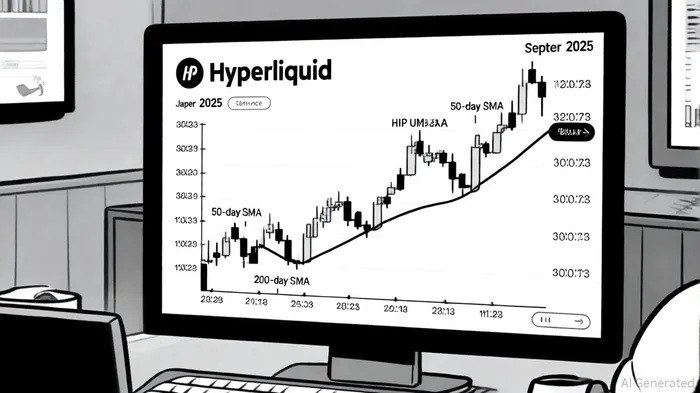
Technically, HYPE is in a consolidation phase, trading at $44.07 as of August 31, 2025. Key indicators suggest an imminent breakout: the RSI is balanced at 52, the 50-day SMA remains above the 200-day SMA, and a recent MACD bullish crossover signals upward momentum [4]. These signals, combined with the platform's fee-driven token buybacks, position HYPE as a strong candidate for sustained growth in Q4 2025 and beyond.
DeFi Tailwinds: AI, Regulation, and Institutional Adoption
Hyperliquid's growth is further amplified by broader DeFi tailwinds. The integration of AI into DeFi protocols is reshaping risk management and liquidity routing, with 86% of employers anticipating transformative impacts by 2030 [5]. Hyperliquid's on-chain data transparency and programmable markets make it an ideal infrastructure layer for AI-driven trading algorithms, enhancing its appeal to next-generation financial applications.
Regulatory clarity is another catalyst. The U.S. GENIUS Act (2025) and the EU's MiCA framework have provided stablecoin issuers with a legal foundation, fostering institutional trust in decentralized systems [5]. Hyperliquid's focus on traditional asset tokenization aligns with these regulatory shifts, enabling it to tap into cross-border markets previously inaccessible to DeFi.
Institutional adoption is also accelerating. With 273 public companies now holding BitcoinBTC-- and rising interest in EthereumETH-- restaking protocols, institutional capital is increasingly allocating to DeFi infrastructure [6]. Hyperliquid's high-performance architecture and fee-driven model make it a natural beneficiary of this trend, particularly as macroeconomic fragmentation drives demand for decentralized alternatives to traditional finance.
Price Prediction and Strategic Outlook
Combining technical and fundamental analysis, HYPE appears poised for a bullish breakout. Assuming continued execution on HIP upgrades and sustained trading volume growth, the token could test resistance levels at $55–$60 by year-end 2025. A successful breakout would likely trigger a retest of the $70–$80 range in early 2026, supported by the platform's TVL expansion and AI-driven liquidity innovations.
Conclusion
Hyperliquid's on-chain innovations, coupled with favorable DeFi tailwinds, position it as a cornerstone of the decentralized trading ecosystem. As AI, regulation, and institutional demand converge, HYPE's technical and financial architecture offers a compelling value proposition. For investors, the combination of sub-second finality, permissionless market creation, and fee-driven tokenomics makes Hyperliquid a strategic bet on the future of DeFi.






Comentarios
Aún no hay comentarios