
Hyperliquid's HIP-3: A Catalyst for Institutional-Grade DeFi Growth
Hyperliquid's HIP-3 upgrade, activated on October 13, 2025, marks a pivotal moment in decentralized finance (DeFi). By enabling permissionless deployment of perpetual futures markets, the protocol transforms from a decentralized exchange into a modular financial infrastructure layer. This innovation introduces a novel economic model where deployers stake 1 million HYPE tokens (~$40–50 million at current prices) to launch markets, aligning their interests with protocol safety and market quality, according to an Oak Research report. The strategic implications of this shift are profound, particularly for institutional adoption and the broader democratization of derivatives trading.
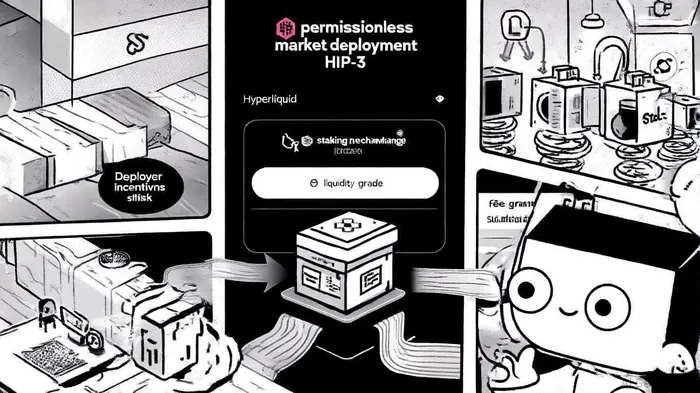
Permissionless Market Creation and On-Chain Governance
HIP-3 eliminates centralized gatekeeping by allowing anyone to deploy perpetual futures markets on HyperCore, Hyperliquid's core infrastructure. Deployers define critical parameters such as oracles, leverage limits, and fee structures, while retaining up to 50% of trading fees, according to a Chainsight analysis. This model fosters innovation by enabling niche and institutional-grade assets-such as equities, commodities, and prediction markets-to be traded on-chain, as an Analytics Insight article explains. For example, protocols like Ventuals have already leveraged HIP-3 to create pre-IPO markets for private companies, demonstrating the protocol's versatility, as Chainsight notes.
The staking requirement acts as a quality control mechanism, ensuring deployers have skin in the game. Validator slashing and open interest caps further mitigate systemic risks, such as market manipulation or excessive leverage, as described in a Medium case study. This balance between decentralization and security is critical for attracting institutional participants, who demand robust risk frameworks. As Oak Research notes, HIP-3's integration with HyperEVM and CoreWriter enhances composability and transparency, enabling smart contracts to interact directly with HyperCore for actions like order submission and staking management.
Institutional Adoption and Risk Management
Institutional adoption of HIP-3 hinges on its ability to replicate the depth and customization of traditional markets. Hyperliquid's infrastructure supports high-performance, low-latency trading with zero gas costs, addressing a key limitation of existing decentralized exchanges, as Analytics Insight reported. Deployers can design markets with tailored risk parameters, attracting professional liquidity providers and market makers. For instance, Kinetiq's "exchange-as-a-service" infrastructure helps teams meet the 1 million HYPE staking requirement, lowering barriers to entry while maintaining institutional-grade standards, per Chainsight.
Risk management is further strengthened by HIP-3's economic incentives. Deployers must maintain oracle integrity and liquidity, with slashing mechanisms penalizing malicious behavior, as the Medium case study describes. Additionally, the 7-day unstaking period for validators provides a buffer to address operational risks. As noted in a Blocmates analysis, these safeguards align with Hyperliquid's vision of becoming the "AWS of liquidity," where infrastructure is accessible yet secure.
Economic Model and Network Effects
HIP-3's fee-sharing model drives a flywheel effect: deployers compete to offer favorable terms, attracting traders and liquidity, which in turn generates higher protocol revenues. Hyperliquid's stable take-rate of 2.25–2.71 basis points and $13.16 billion in daily trading volume (as of Q3 2025) underscore its appeal to institutional actors, a point highlighted in the Medium case study. Deployers can also create incentive programs to bootstrap markets, fostering a self-sustaining ecosystem, as Chainsight describes.
The token economics of HIP-3 further reinforce this dynamic. Staking 1 million HYPE tokens locks a significant portion of the circulating supply, creating buy-side pressure and aligning token holder interests with long-term growth, a dynamic explored in the Blocmates article. Liquid staking pools and fee revenue sharing provide additional avenues for HYPE holders to participate in the network's expansion.
Conclusion
Hyperliquid's HIP-3 represents a paradigm shift in DeFi, bridging the gap between decentralized infrastructure and institutional-grade markets. By democratizing market creation and embedding robust risk management tools, the protocol positions itself as a scalable solution for the next phase of on-chain finance. As more deployers launch specialized markets-ranging from commodities to prediction derivatives-Hyperliquid's network effects will likely accelerate, cementing its role as a foundational layer for global derivatives trading.







Comentarios
Aún no hay comentarios