
Hypercharge's $4 Million Brokered LIFE Offering: A Strategic Move in the EV Charging Boom
The renewable energy sector is undergoing a seismic shift in 2025, driven by the urgent need to decarbonize transportation and meet surging demand for clean infrastructure. According to the IEA executive summary, global renewable power capacity is projected to double by 2030, with solar photovoltaics (PV) accounting for nearly 80% of this growth. Within this landscape, electric vehicle (EV) charging solutions have emerged as a critical frontier. Hypercharge Networks Corp., a Vancouver-based leader in smart EV infrastructure, is leveraging this momentum through a $4 million brokered LIFE (Listed Issuer Financing Exemption) offering announced on October 9, 2025 in a GlobeNewswire release. This move not only underscores the company's strategic vision but also reflects broader trends in private equity's growing influence over clean energy scaling.
Hypercharge's Strategic Fundraising and Operational Momentum
Hypercharge's $4 million offering, priced at $0.10 per unit (comprising one common share and one-half warrant), is a "best efforts" private placement led by FMI Securities Inc. The proceeds will fund general working capital and corporate purposes, aligning with the company's recent operational strides. In Q2 2025, Hypercharge delivered a record 615 EV charging ports-a 116% year-over-year increase-and expanded its footprint to eight Canadian provinces and thirteen U.S. states, including new markets like Washington DC and North Carolina, according to its Q2 results. A major order for 76 DC fast-charging ports from a Western Canadian energy infrastructure provider further validates its value proposition.
The offering's timing is strategic. With the global EV market projected to grow at a 15% CAGR through 2030, per the Deloitte outlook, Hypercharge's focus on scalable, fleet-friendly solutions positions it to capitalize on corporate sustainability mandates and government incentives. For instance, the U.S. Inflation Reduction Act (IRA) has unlocked $1.2 trillion in clean energy investments, creating fertile ground for companies like Hypercharge to secure partnerships and scale deployments, as noted in an Impact Investor list.
Private Equity's Role in Reshaping Renewable Energy
Hypercharge's fundraising also mirrors a broader shift in private equity (PE) strategies. In 2025, PE firms are not merely financing solar panels or wind turbines-they are acquiring the land beneath them. As reported by Forbes, firms like BrookfieldBN-- and KKRKKR-- are securing prime locations with high solar insolation and wind potential, effectively controlling where clean energy is generated. This trend has transformed renewable energy from a public infrastructure challenge into a private asset class.
Hypercharge's offering, while smaller in scale, fits into this ecosystem. By raising capital through a LIFE exemption-a Canadian regulatory shortcut for listed companies-it avoids the costly and time-consuming process of a traditional IPO. This agility is critical in a sector where speed to market often determines success. The company's focus on working capital aligns with PE-backed strategies that prioritize rapid deployment and operational efficiency. For example, TPG's $2.34 billion acquisition of Altus Power in 2025 highlights the sector's appetite for companies with scalable infrastructure models, as Forbes notes.
Risks and Opportunities in a Competitive Landscape
Despite the optimism, challenges persist. BloombergNEF reports that asset finance for utility-scale solar and onshore wind declined by 13% in H1 2025, with small-scale solar capturing most financing (a shift that reflects investor caution toward large, capital-intensive projects and a preference for modular, demand-driven solutions-areas where Hypercharge's DC fast-charging ports excel). BloombergNEF also highlighted concerns about rising costs and delayed community projects tied to private-equity land acquisitions. Hypercharge's focus on partnerships with established energy providers, however, mitigates these risks by leveraging existing infrastructure and regulatory expertise.
Conclusion: A Strategic Bet on the EV Transition
Hypercharge's $4 million offering is more than a financing event-it is a calculated step in a sector poised for exponential growth. By aligning its capital needs with the IRA's incentives, corporate decarbonization goals, and PE-driven infrastructure strategies, the company is well-positioned to capture a significant share of the EV charging market. For investors, this represents an opportunity to participate in a sector where policy, technology, and capital are converging to redefine energy systems. As Deloitte notes, data centers and AI industries alone will require an additional 44 GW of renewable energy by 2030. Hypercharge's ability to scale its network-evidenced by its Q3 2025 revenue of $3.4 million, according to the company financials-suggests it is not just riding the wave but helping to shape it.```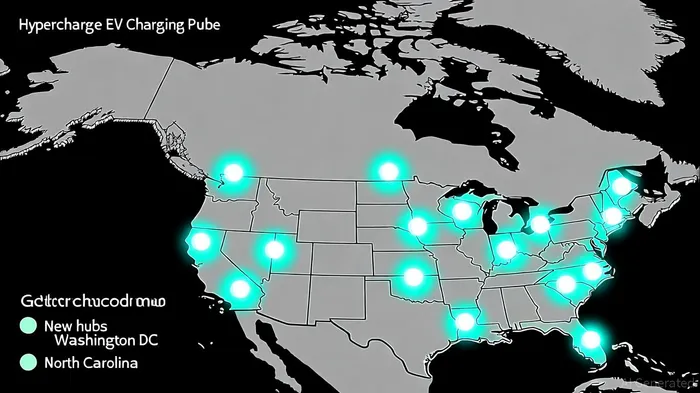





Comentarios
Aún no hay comentarios