
HYPE's Vulnerability to Whale-Driven Market Fragility
Hyperliquid's HYPE token has emerged as a cornerstone of the decentralized finance (DeFi) ecosystem, driven by its high-liquidity perpetual trading platform and aggressive tokenomics. However, beneath its meteoric growth lies a critical vulnerability: concentrated ownership among top holders. This article analyzes the risks posed by whale-driven market dynamics, liquidity pressures, and structural imbalances in Hyperliquid's token distribution, drawing on blockchain analytics and institutional insights.
Ownership Concentration: A Double-Edged Sword
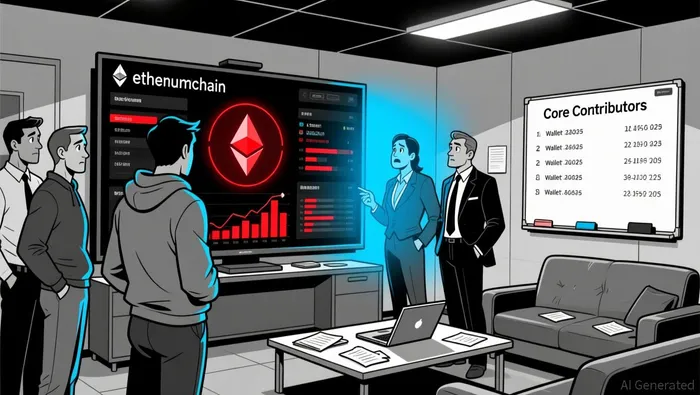
Hyperliquid's HYPE token supply is heavily concentrated among core contributors and institutional entities. Core contributors hold 23.8% of the total supply (237 million tokens), distributed under a multi-year vesting schedule. Additionally, 38% of the token supply (388 million HYPE) remains reserved for future growth incentives. While these allocations aim to align long-term incentives, they create a scenario where a relatively small group of actors could exert outsized influence over price stability.
Blockchain analytics reveal further concentration risks. A single non-team wallet holds 8.5 million HYPE tokens, representing a significant portion of the circulating supply. Meanwhile, institutional entities like Galaxy Digital Holdings Ltd and Lion Group Holding collectively own 2.5 million HYPE tokens (0.25% of total supply). Though individually modest, these holdings-combined with the platform's own treasury-highlight the potential for coordinated selling or liquidity withdrawal to destabilize the market.
Unlocking Events: A Recipe for Volatility
In late 2025, large wallets tied to HYPE staking activity began unlocking tokens in wavesWAVES--. Initial unlocks included $4.4 million, $5.4 million, and $11.7 million worth of HYPE, with another $6.3 million already withdrawn. While crypto intelligence firm Front Runners cautions against interpreting these moves as definitive sell signals, the sheer volume of tokens entering circulation raises concerns.
The Hyper Foundation's proposed burn of $1 billion in HYPE tokens (13% of circulating supply) aims to counteract this dilution. However, the timing of unlocks-particularly the $312 million allocation to Hyperliquid Labs in January 2026-could temporarily overwhelm market absorption capacity, especially if demand fails to keep pace.
Competition and Liquidity: A Fragile Equilibrium
Hyperliquid's dominance in perpetual trading-capturing 70% of the market-is under threat from platforms like AsterASTER--, Lighter, and edgeX, which leveraged aggressive incentive programs to amass $638 billion in combined volume by November 2025. While Cantor Fitzgerald argues much of this volume is reward-driven and not organic, the competition exacerbates liquidity fragility. If HYPE whales decide to liquidate holdings, the platform's ability to maintain depth in its order book could be compromised.
Institutional Participation: A Shield or a Sword?
Institutional adoption of HYPE has grown, with entities like Anchorage Digital and Circle's CCTP V2 integrating Hyperliquid's infrastructure. The platform's economic model-allocating 97% of trading fees to HYPE buybacks-has created a deflationary flywheel, with the Assistance Fund accumulating $1.3 billion in HYPE tokens. However, institutional ownership percentages remain opaque, and the lack of transparency in large holder identities (e.g., the Hyper Foundation itself holds $4.003 billion in HYPE) leaves room for speculation about potential conflicts of interest.
Conclusion: Balancing Innovation and Risk
Hyperliquid's HYPE token embodies the promise and peril of DeFi. Its buyback-and-burn strategy and institutional partnerships signal long-term value creation. Yet, the concentration of ownership among core contributors, the timing of unlocks, and competitive pressures create a fragile equilibrium. Investors must weigh these risks against the platform's innovation, recognizing that whale-driven volatility could undermine liquidity and price stability.
For HYPE to thrive, Hyperliquid must address these structural vulnerabilities-whether through further token burns, governance reforms, or diversifying its holder base. Until then, the token remains a high-risk, high-reward asset in a market where whales hold the reins.





Comentarios
Aún no hay comentarios