
Beyond the Hype: How Regulatory Shifts and Institutional Capital Secure Bitcoin's Future
The cryptocurrency market has seen its fair share of volatility in 2025, with meme coins like Dogecoin (DOGE) and Shiba Inu (SHIB) experiencing sharp declines. Yet beneath this surface turbulence lies a structural transformation: the confluence of U.S. regulatory reforms and institutional capital inflows is solidifying a bullish long-term outlook for foundational digital assets like Bitcoin. While meme tokens grab headlines, the real story is how President Trump's crypto-friendly policies and strategic investments—such as the UAE's $100 million stake in World Liberty Financial (WLF)—are building a resilient ecosystem. For investors, focusing on these macro shifts—not short-term speculation—offers clarity amid the noise.
The Regulatory Foundation: Bitcoin as a Strategic Asset
President Trump's Strategic Bitcoin Reserve (SBR), announced in early 2025, marks a watershed moment. By designating Bitcoin as a reserve asset and consolidating over 207,000 BTC ($17 billion at the time) from seized funds, the U.S. government has positioned Bitcoin as “digital gold.” This policy isn't just symbolic: it addresses a $17 billion loss from previous premature sales of seized crypto, while signaling geopolitical ambition.
The SBR's non-sale mandate ensures these holdings remain a store of value, akin to gold reserves. Meanwhile, regulatory rollbacks—such as repealing Biden's strict crypto enforcement framework and allowing banks to engage freely with crypto firms—are dismantling barriers to institutional adoption. The result? A clearer path for Bitcoin to integrate into traditional finance.
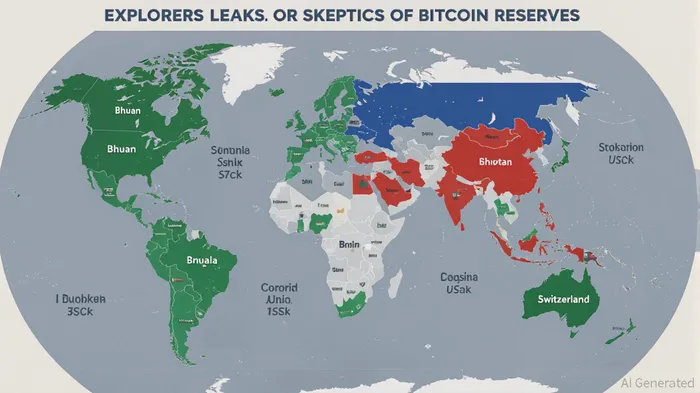
While critics like the EU reject Bitcoin's inclusion in reserves due to volatility, nations from Bhutan to Belarus are following the U.S. lead. This geopolitical race underscores Bitcoin's role as a strategic tool, not just a speculative play.
Institutional Inflows: The UAE's Stake in WLF and Beyond
The UAE's $100 million investment in WLF, led by the enigmatic Aqua 1 Foundation, highlights the shift toward institutional capital. Despite Aqua 1's opaque structure—no UAE regulatory registration and a founder with a sparse digital footprint—the deal itself is undeniable. The investment funneled into WLF's $WLFI governance tokens, granting influence over its USD1 stablecoin, which now ranks as the third-largest stablecoin by volume ($3.37 billion in 2025).
Critics have questioned whether Aqua 1 is a front for foreign influence, given WLF's ties to the Trump family (owning 60% of WLF and 75% of token revenue). Yet the transaction's scale—backed by Emirati fund MGX's $2 billion Binance investment using USD1—reflects a broader trend: sovereign wealth funds and institutional players are treating crypto as a legitimate asset class.
Why Meme Coins Don't Matter Long-Term
The decline of meme coins like DOGE and SHIB has fueled claims of a crypto “mania dying down.” But this misses the point. Meme tokens are speculative instruments, their prices tied to viral trends and liquidity pools. Their volatility is a feature, not a bug—but it's also fleeting.
In contrast, Bitcoin's intrinsic fundamentals—scarcity (21 million max supply), security (no major breaches in over a decade), and adoption by institutions—form the bedrock of a sustainable market. Regulatory clarity and reserve policies like the SBR are reducing Bitcoin's perceived risk, while institutional capital like the UAE's investment is scaling up adoption.
Investment Strategy: Focus on Blue Chips, Ignore the Noise
For investors, the path is clear: prioritize Bitcoin and other foundational assets over meme tokens.
- Bitcoin as a Portfolio Hedge: With the SBR ensuring U.S. government support and volatility metrics lower than meme coins, Bitcoin's risk-reward profile is unmatched.
- Monitor Regulatory Progress: Track the CLARITY Act (defining crypto jurisdiction) and GENIUS Act (stabilizing stablecoins). Their passage could accelerate adoption.
- Watch Institutional Flows: WLF's USD1 and similar projects are testing crypto's utility in traditional finance. Success here could validate Bitcoin's role as a reserve asset.
The data shows a clear shift: institutional capital is growing faster than retail speculation. This is the trend to bet on.
Final Verdict: Bitcoin's Bull Run Isn't Over—It's Just Maturing
The meme coin slump is a distraction. The real story is the U.S. government's strategic embrace of Bitcoin and the inflow of capital from sovereign funds and banks. These structural changes—regulatory, geopolitical, and financial—are creating a foundation that outlasts viral trends.
Investors who focus on Bitcoin's fundamentals and ignore the meme coin rollercoaster will position themselves to benefit from the next phase of crypto's evolution: a regulated, institutionalized asset class. The mania may fade, but the revolution is just beginning.
Risk Disclosure: Cryptocurrency investments carry significant risks, including volatility and regulatory uncertainty. Always conduct thorough research or consult a financial advisor before making investment decisions.







Comentarios
Aún no hay comentarios