
HYPE's Explosive Rally and Institutional Adoption: A Liquidity-Driven Tokenomics Revolution
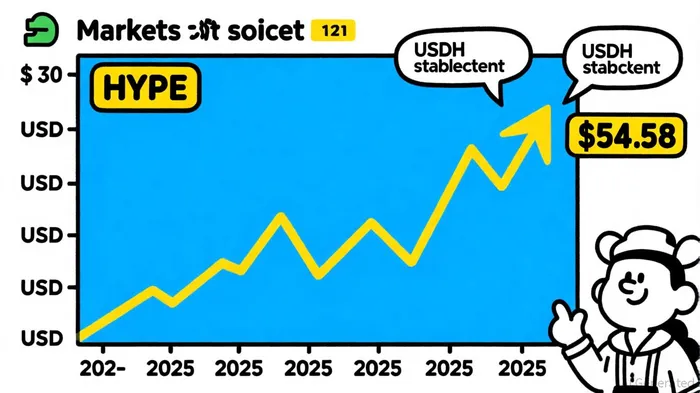
The HYPE token, native to decentralized perpetual exchange Hyperliquid, has experienced a meteoric rise in 2025, driven by a confluence of liquidity-driven tokenomics and a surge in institutional adoption. This analysis unpacks the mechanics behind the rally, the role of institutional reallocation, and the implications for HYPE's future trajectory.
Liquidity-Driven Tokenomics: A Deflationary Engine
Hyperliquid's tokenomics model is engineered to create scarcity and align incentives. The platform's Assistance Fund has allocated over 28.5 million HYPE tokens for buybacks, using 97% of trading fees to reduce circulating supply[5]. This has been amplified by a daily burn mechanism, which removed over 3,200 HYPE tokens in a single day, tightening supply further[4].
The deflationary pressure is compounded by institutional-driven buybacks. Paxos' proposal to allocate 95% of reserve interest from its USDH stablecoin to HYPE buybacks has created a bullish tailwind, directly correlating with a 12% price surge to over $50[1]. Such mechanisms not only reduce supply but also signal confidence in the token's utility, particularly as Hyperliquid prepares to launch USDH under the GENIUS Act and MiCA frameworks[1].
Hyperliquid's infrastructure—featuring a fully on-chain order book (CLOB) and dual execution layers (HyperCore and HyperEVM)—has enabled it to rival centralized exchanges in liquidity depth and speed[4]. The platform's $320 billion in perpetuals trading volume and $3.5 billion TVL in Q1 2025 underscore its dominance in the decentralized derivatives market[2]. These metrics are not just indicative of user adoption but also of a self-reinforcing liquidity flywheel: deeper liquidity attracts more traders, which in turn generates higher fees and accelerates buybacks.
Institutional Reallocation: From SolanaSOL-- to HYPE
Institutional investors have increasingly reallocated capital into HYPE, reflecting a strategic pivot toward high-growth DeFi assets. The Nasdaq-listed Lion GroupLGHL--, for instance, has shifted its holdings of 6,629 Solana (SOL) and 1 million SuiSUI-- (SUI) tokens into HYPE, citing Hyperliquid's on-chain order book and efficient trading infrastructure as key drivers[1]. This move mirrors broader trends, as entities like Eyenovia and SonnetSONN-- BioTherapeutics have also disclosed significant HYPE allocations[1].
The institutional shift is further supported by custody and compliance innovations. BitGo's institutional-grade custody solutions for HYPE have addressed security and regulatory concerns, while 21Shares' launch of the first regulated ETP for HYPE on the SIX Swiss Exchange has provided a compliant on-ramp for traditional investors[2]. These developments align with the token's growing utility: Hyperliquid's HyperEVM and partnerships with Phantom have expanded its ecosystem beyond trading, enabling app development and liquidity functions[2].
Macro-level data reinforces this trend. Institutional investors moved 3.8% of circulating ETH into staking and DeFi-optimized wallets in Q3 2025, a shift accelerated by the U.S. SEC's informal classification of EthereumETH-- as a commodity[3]. While this primarily boosted Ethereum's price, it also created a halo effect for DeFi platforms like Hyperliquid, which benefit from increased on-chain activity and capital inflows.
Market Dynamics: Hyperliquid's Dominance and Network Effects
Hyperliquid's market share in decentralized perpetuals has surged to 73% in Q3 2025, with Open Interest reaching $15 billion and daily trading volume exceeding $8 billion[4]. The platform's ability to handle high-volume trading with tight spreads—achieved through its CLOB design—has made it a preferred venue for both retail and institutional traders[2].
The network effects are self-reinforcing. Hyperliquid's early listings of tokens like PUMP and UNIT have attracted speculative capital, while its Rabby Perps Integration and HyperSwap launch have enhanced interoperability[3]. These upgrades are expected to drive further liquidity and developer activity, creating a virtuous cycle of growth.
Future Outlook: Regulatory Clarity and Scalability
The launch of USDH, Hyperliquid's stablecoin, represents a critical next step. By partnering with Paxos and CircleCRCL--, the platform aims to tap into institutional capital pools, potentially accelerating HYPE's adoption as a governance and utility token[1]. Regulatory clarity under MiCA and the GENIUS Act will be pivotal in attracting additional institutional participation.
Analysts project HYPE's price could test $60 as supply constraints tighten and institutional inflows continue[4]. However, risks remain, including regulatory shifts and competition from other DeFi platforms. For now, the combination of liquidity-driven tokenomics and institutional reallocation positions HYPE as a compelling case study in DeFi's evolution.





Comentarios
Aún no hay comentarios