
HyOrc's Locomotive Retrofit Strategy as a Scalable Pathway to Decarbonize U.S. Rail
The global push to decarbonize hard-to-abate sectors has intensified in 2025, with freight rail emerging as a critical frontier. Traditional diesel locomotives account for a significant share of transportation-related emissions, yet their replacement with zero-emission alternatives has been hindered by high costs, infrastructure constraints, and operational inertia. Enter HyOrc, a Finnish clean-tech innovator whose modular, multi-fuel retrofit technology is redefining the economics of rail decarbonization. By leveraging an external-combustion Rankine cycle engine capable of operating on hydrogen, natural gas, LPG, and e-methanol, HyOrc offers a scalable, cost-effective solution tailored to the U.S. rail sector's unique challenges.
A Technological Edge: Fuel Flexibility and Efficiency
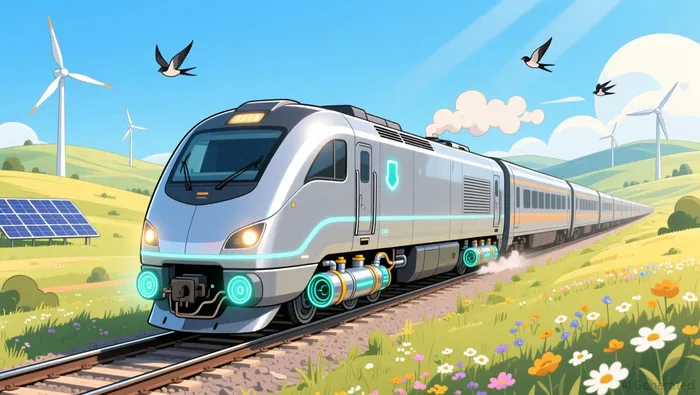
HyOrc's core innovation lies in its ability to convert existing diesel locomotives into zero-emission powertrains without scrapping their foundational infrastructure. The company's 2.8 MW engine, retrofitted onto a Class 66 locomotive as part of the Greener Railfreight Opportunity Project Phoenix, achieves over 45% efficiency on hydrogen and LPG-outperforming conventional internal-combustion engines and rivaling fuel cell systems in energy conversion according to technical specifications. This fuel flexibility is a strategic advantage, allowing operators to pivot between renewable sources like green methanol and hydrogen based on availability and cost. For instance, HyOrc's partnership with a Portuguese green methanol project-converting municipal waste into clean fuel-demonstrates its commitment to creating a circular economy for rail transport according to industry reports.
Strategic Expansion into the U.S. Market
The U.S. freight rail sector, valued at $71.8 billion in 2025, faces mounting regulatory and competitive pressure to reduce emissions according to market analysis. HyOrc's entry into this market, facilitated by a partnership with Zeltech (Zero Emissions Locomotive Technologies), underscores its potential to capitalize on these dynamics. A Memorandum of Understanding (MOU) signed in late 2025 outlines joint development of hydrogen-ready gas-engine locomotives, with a California-based pilot project set to demonstrate the technology's real-world viability. This initiative, supported by the California Energy Commission and other agencies, aims to secure grant funding to offset deployment costs-a critical enabler for widespread adoption according to official announcements.
The collaboration extends beyond pilots: Zeltech has also inked an MOU with Dreamstar Lines to explore hybrid configurations powered by HyOrc's multi-fuel engine for the Los Angeles to San Francisco corridor according to press releases. Such partnerships highlight HyOrc's ability to align with regional rail operators seeking to meet stringent environmental targets while maintaining operational flexibility.
Capital-Light Deployment and Cost Competitiveness
A key differentiator for HyOrc is its capital-light business model. Unlike full locomotive replacements, which require substantial upfront investment, retrofits preserve existing assets while enabling incremental upgrades. Annual operating expenses for HyOrc-equipped locomotives are estimated at less than €25,000-significantly lower than diesel counterparts-due to reduced maintenance and fuel costs according to company data. This cost advantage is amplified by the modular design, which allows operators to transition from natural gas to hydrogen as green hydrogen production scales and prices decline.
Moreover, HyOrc's strategy extends beyond the U.S. The company is preparing pilot deployments in the UK, EU, and India, with timelines contingent on customer agreements and regulatory approvals according to company updates. This global pipeline reinforces the scalability of its technology and mitigates regional market risks for investors.
Investment Implications: Hard-to-Abate Sectors as High-Conviction Opportunities
For investors targeting decarbonization in hard-to-abate sectors, HyOrc represents a compelling case study. The company's retrofit approach addresses three critical barriers to adoption: cost, infrastructure compatibility, and fuel availability. By offering a technology that works with existing rail networks and supports multiple low-carbon fuels, HyOrc positions itself at the intersection of regulatory tailwinds and market demand.
The U.S. rail sector's transition to zero-emission technologies is no longer a hypothetical scenario but a regulatory imperative. California's leadership in clean-energy policy, combined with federal incentives under the 2025 Infrastructure and Climate Act, creates a fertile ground for HyOrc's expansion. As noted by industry analysts, "The ability to retrofit rather than replace represents a paradigm shift in rail decarbonization-one that balances environmental goals with economic pragmatism" according to market commentary.
Conclusion
HyOrc's locomotive retrofit strategy exemplifies how innovation in hard-to-abate sectors can unlock both environmental and financial value. By combining technical ingenuity with strategic partnerships and a capital-efficient deployment model, the company is poised to capture a significant share of the $71.8 billion U.S. freight rail market. For investors, the alignment of regulatory momentum, scalable technology, and cost competitiveness makes HyOrc a standout opportunity in the race to decarbonize global transportation.







Comentarios
Aún no hay comentarios