
Hybrid Power in Luxury Sports Cars: A Strategic Bet on Porsche’s 2026 911 Turbo S
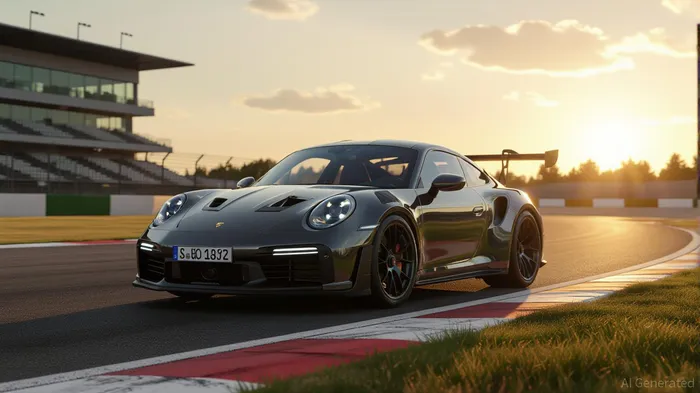
The automotive world has long revered the Porsche 911 as a symbol of engineering excellence and enduring value. With the 2026 911 Turbo S, Porsche has not only redefined performance but also positioned itself at the intersection of high-performance innovation and sustainable luxury. For investors, this model represents a compelling case study in how hybrid technology can enhance both driving dynamics and long-term value retention.
Technological Innovation: The Hybrid Powertrain Revolution
The 2026 911 Turbo S hybrid is a masterclass in merging electrification with raw performance. At its core lies a 3.6-liter flat-six engine paired with an 8-speed PDK transmission and an integrated electric motor, delivering a staggering 701 horsepower [1]. This marks a significant leap from its predecessor, enabling a blistering 0-60 mph acceleration in 2.4 seconds and a top speed of 200 mph [2]. The hybrid system’s two electric exhaust gas turbochargers (eTurbos) eliminate lag while optimizing responsiveness, a technological feat that underscores Porsche’s commitment to performance-driven electrification [3].
Beyond power, the 911 Turbo S hybrid excels in track-ready engineering. Its Nürburgring Nordschleife lap time of 7:03.92 minutes—14 seconds faster than the previous model—demonstrates the effectiveness of its active aerodynamics, including a front diffuser and extendable rear wing [1]. The car’s 1.9-kWh battery ensures seamless hybrid operation without compromising the visceral driving experience that defines the 911 lineage.
Value Retention: Porsche’s Proven Track Record
Porsche vehicles have historically outperformed competitors in value retention, and the 911 Turbo S hybrid is poised to continue this legacy. According to iSeeCars, the Porsche 911 Coupe retains 83% of its value over five years, significantly outpacing rivals like the Chevrolet Corvette Z06, which faces “shocking levels of depreciation” [4]. This resilience is rooted in the 911’s iconic status, with older generations—such as the 996 and 997.2 Turbo—appreciating in value by up to 9.2% in recent years [1].
Hybrid models, however, present a nuanced picture. While some hybrids depreciate faster than traditional ICE vehicles, the 911 Turbo S hybrid benefits from Porsche’s brand equity and a market that prizes performance. Data from octoclassic.com reveals that the 911 Turbo S’s depreciation rate is among the lowest in its class, with a 5-year loss of just 19.5%—a stark contrast to the rapid depreciation seen in newer EVs like the Taycan [5]. This suggests that the hybrid variant’s blend of sustainability and performance aligns with investor priorities.
Porsche’s Hybrid Strategy: Balancing Innovation and Market Demand
Porsche’s approach to hybridization reflects a calculated balance between tradition and modernity. In 2025, 27% of its global deliveries were electrified, including plug-in hybrids and all-electric models [6]. This strategy aligns with broader luxury car market trends, where demand for sustainable yet high-performance vehicles is growing. By 2028, the luxury car market is projected to reach $850.93 billion, driven by consumers seeking both environmental responsibility and driving excellence [7].
The 911 Turbo S hybrid exemplifies this duality. While Porsche continues to offer combustion-engine variants in non-EU markets, its hybrid models cater to a segment that values innovation without sacrificing heritage. The company’s “value over volume” philosophy, as articulated by Board Member Matthias Becker, ensures that each model maintains its premium positioning [6]. This approach is reinforced by Porsche’s demand-driven pricing model, which emphasizes exclusivity and perceived value [8].
Conclusion: A Strategic Investment in the Future of Performance
The 2026 Porsche 911 Turbo S hybrid is more than a technological marvel—it is a strategic investment in the evolving landscape of luxury sports cars. Its hybrid powertrain redefines performance benchmarks while aligning with market demands for sustainability. Coupled with Porsche’s proven ability to retain value, this model offers investors a rare combination of cutting-edge innovation and financial prudence.
As the automotive industry transitions toward electrification, the 911 Turbo S hybrid stands as a testament to Porsche’s ability to honor its legacy while embracing the future. For those seeking a high-performance asset with long-term appreciation potential, this is a bet worth making.
Source:
[1] 2026 Porsche 911 Turbo S First Look: The Most Powerful ..., [https://www.motortrend.com/news/2026-porsche-911-turbo-s-first-look-review]
[2] The 2026 Porsche 911 Turbo S Hybrid Revealed With ..., [https://www.edmunds.com/car-news/2026-porsche-911-turbo-s-hybrid-debut-first-look.html]
[3] New Porsche 911 Turbo S Celebrates World Premiere in ..., [https://newsroom.porsche.com/en_US/2025/products/new-porsche-911-turbo-s-celebrates-world-premiere-in-munich.html]
[4] Porsche 911 Turbo depreciation: A smart financial choice, [https://octoclassic.com/blog/decoding-911-turbo-depreciation]
[5] The Porsche 911 is the best investment you can make in a new car, [https://www.themanual.com/auto/the-porsche-911-is-the-best-investment-you-can-make-in-a-new-car/]
[6] Porsche AG: Report on Expected Developments, [https://newsroom.porsche.com/en/annual-sustainability-report/combined-management-report/report-on-expected-developments]
[7] Luxury Car Market - 2025 Industry Trends Analysis & Insights, [https://mediaboom.com/news/luxury-car-market/]
[8] Why the Porsche Pricing Model Never Fails: The Strategy, [https://patentlawyer.io/porsche-pricing-model/]







Comentarios
Aún no hay comentarios