
HUTCHMED's Strategic Expansion in China's Reimbursement Framework: Enhanced Market Access and Revenue Catalysts in a High-Growth Oncology Sector
China's oncology market, driven by an aging population and rising cancer incidence, has become a critical battleground for biopharmaceutical innovators. HUTCHMEDHCM--, a leader in precision oncology, has strategically positioned itself to capitalize on this growth by expanding access to its therapies through China's evolving reimbursement frameworks. Recent developments, including expanded National Reimbursement Drug List (NRDL) coverage, inclusion in commercial insurance programs, and regulatory advancements, underscore the company's ability to translate clinical innovation into scalable revenue streams.
Multi-Layered Reimbursement Access: A Catalyst for Patient Reach and Revenue
HUTCHMED's oncology portfolio has secured broad reimbursement coverage in 2025, combining the NRDL and the newly established National Commercial Health Insurance Innovative Drug List. For instance, ELUNATE® (fruquintinib) is now reimbursed for advanced endometrial cancer with mismatch repair-proficient (pMMR) tumors and metastatic colorectal cancer, while ORPATHYS® (savolitinib) is covered for non-small cell lung cancer (NSCLC) patients with MET exon 14 skipping alterations. Additionally, TAZVERIK® (tazemetostat) was added to the Commercial Insurance Drug List for relapsed or refractory follicular lymphoma patients with EZH2 mutations according to company announcements.
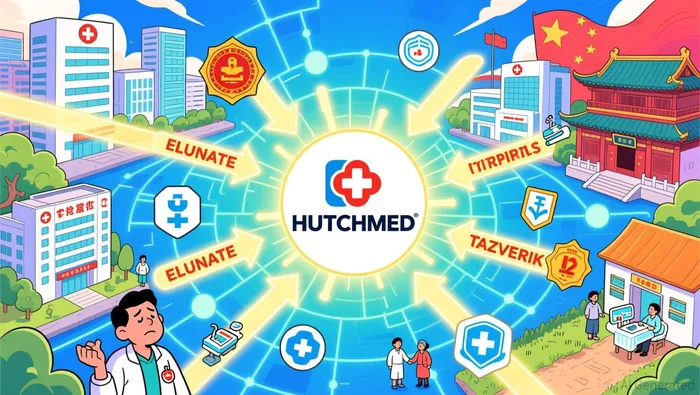 This dual-layered approach addresses a critical challenge in China's healthcare system: balancing access to high-cost, high-value therapies with affordability. By enabling reimbursement through both public and commercial insurance channels, HUTCHMED ensures broader patient access while mitigating out-of-pocket costs. For example, commercial insurance products such as high-limit medical insurance and inclusive health plans now cover therapies like TAZVERIK, which are otherwise prohibitively expensive for many patients. This expansion not only enhances patient outcomes but also creates a direct revenue uplift by reducing price sensitivity among prescribers and payers.
Regulatory Momentum and Pipeline Advancements: Fueling Long-Term Growth
HUTCHMED's engagement with the National Medical Products Administration (NMPA) has accelerated in 2025, with several key regulatory milestones. The NDA for the combination of ORPATHYS and TAGRISSO® (osimertinib) was accepted by the NMPA with priority review status, following a Breakthrough Therapy designation in December 2024. This combination therapy targets NSCLC patients with MET-driven resistance, a high-unmet-need population. Similarly, fanregratinib is nearing regulatory submission for advanced intrahepatic cholangiocarcinoma (IHCC), with Phase II data supporting its potential as a first-line treatment.
The company's ATTC (Antibody-Targeted Therapy Conjugate) platform further strengthens its long-term pipeline. The lead candidate, HMPL-A251, a PAM-HER2 ATTC, demonstrated superior preclinical efficacy in targeting the PI3K/AKT/mTOR pathway, with plans for clinical trials in late 2025. This platform's adaptability-allowing customizable payloads and antibodies-positions HUTCHMED to address diverse oncology indications, including those with complex resistance mechanisms.
Provincial Tenders and Localized Market Access: A Strategic Blind Spot?
While HUTCHMED's national reimbursement successes are well-documented, its participation in provincial tenders-a critical component of China's fragmented healthcare system-remains unclear. Provincial tenders directly influence drug pricing, distribution, and revenue scalability in regional markets. However, the provided sources do not explicitly mention HUTCHMED's involvement in 2025 tenders. This absence raises questions about localized market penetration, particularly for therapies like SULANDA® (surufatinib), which is renewed for pancreatic and neuroendocrine tumors but may face pricing pressures in provincial markets according to a press release.
That said, HUTCHMED's focus on securing national reimbursement eligibility-such as the potential negotiation for ORPATHYS in combination with TAGRISSO-suggests a strategic prioritization of high-impact, scalable access over localized tenders. This approach aligns with its goal of addressing rare or refractory cancers, where national coverage is more critical than regional price competition.
Financial and Strategic Implications: A High-Conviction Investment
HUTCHMED's 2025 interim financial results reflect the commercial and clinical progress underpinning its strategy. The approval of ORPATHYS in a new lung cancer indication triggered a milestone payment from AstraZeneca, while the ATTC platform's clinical readiness signals a pipeline of future revenue drivers. Meanwhile, the inclusion of therapies like ELUNATE in the NRDL and commercial insurance lists is expected to drive volume growth, particularly in high-prevalence indications such as colorectal and lung cancers.
For investors, the key catalysts lie in regulatory approvals, reimbursement expansions, and pipeline advancements. The pending NDA submissions for fanregratinib and sovleplenib, coupled with the ATTC platform's clinical trials, offer multiple inflection points in 2026. Additionally, the company's focus on high-value, precision oncology therapies aligns with China's broader healthcare policy goals, reducing reliance on price-driven competition and emphasizing value-based care.
Conclusion
HUTCHMED's strategic expansion in China's reimbursement framework exemplifies a forward-thinking approach to market access in a high-growth oncology sector. By leveraging both public and commercial insurance channels, advancing regulatory milestones, and innovating through platforms like ATTC, the company is well-positioned to scale its revenue while addressing critical unmet medical needs. While provincial tender participation remains a potential area for further scrutiny, the current trajectory suggests HUTCHMED is effectively navigating the complexities of China's healthcare ecosystem. For investors, this represents a compelling opportunity in a sector poised for sustained growth.





Comentarios
Aún no hay comentarios