
Hut 8's Strategic Transformation and AI Infrastructure Expansion: Assessing Long-Term Investment Potential
Hut 8 Corp. (HUT) has embarked on a bold strategic transformation, pivoting from a BitcoinBTC-- mining-focused entity to a vertically integrated energy infrastructure platform. This shift, anchored by a landmark $7.0 billion, 15-year AI data center lease with Fluidstack and supported by Google's financial backstop, positions the company to capitalize on the surging demand for AI and high-performance computing (HPC) infrastructure. As the global data center market braces for exponential growth, Hut 8's integration of power, digital infrastructure, and compute resources offers a compelling case for long-term investors.
Strategic Pivot to AI Infrastructure
Hut 8's recent $7.0 billion lease agreement for a 245-megawatt (MW) AI data center in Louisiana marks a pivotal moment in its evolution. The deal, which includes a financial backstop from Google, enables Hut 8HUT-- to secure favorable financing from institutions like JPMorgan and Goldman Sachs according to CEO statements. This partnership with Anthropic and Fluidstack is part of a broader initiative to scale AI-ready infrastructure to 2,295 MW across multiple phases as reported. The Louisiana project, supported by Entergy Louisiana's 330 MW utility capacity, represents a $10 billion investment in Phase I and is expected to create 268 jobs by 2027 according to Entergy.
Hut 8's "power-first" strategy-combining energy sourcing, data center design, and AI compute deployment-positions it to address the critical bottleneck of power availability for AI workloads. With a total energy development pipeline of 8.65 gigawatts, the company is uniquely positioned to meet the projected 165% increase in U.S. data center power demand by 2030.
Financial Strength and Balance Sheet
Hut 8's Q3 2025 financial results underscore its resilience and growth potential. The company reported revenue of $83.5 million and net income of $50.6 million, driven by its expanding energy and digital infrastructure portfolio. Its Total Energy Capacity Under Management now stands at 1,020 MW, with a strategic Bitcoin reserve of 13,696 Bitcoin (valued at $1.6 billion) further fortifying its balance sheet. Analysts have trimmed fair value estimates to $56.13 from $57.87 but maintain long-term revenue growth expectations of ~80%.
The company's dual revenue streams-Power, Digital Infrastructure, and Compute-highlight its diversification. Compute, the largest contributor at $70.0 million in Q3 2025, reflects the profitability of AI infrastructure compared to Bitcoin mining according to investment analysis. Hut 8's fortress liquidity position and manageable debt levels as noted in industry reports provide flexibility to fund its ambitious expansion while mitigating financial risk.
Industry Trends and Market Projections
The AI infrastructure sector is experiencing unprecedented demand. Global data center electricity consumption is projected to double to 980 terawatt-hours (TWh) by 2030, with AI-optimized servers accounting for 44% of power usage. In the U.S., data center power demand is expected to represent nearly half of the country's electricity growth through 2030. Goldman Sachs Research forecasts a 165% increase in global data center power demand by 2030, while the global data center infrastructure market is projected to exceed $1 trillion in annual spending by 2030.
Hut 8's vertically integrated model aligns with these trends. 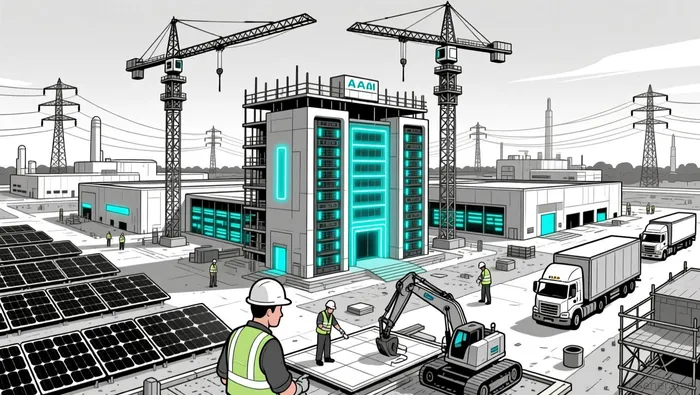 . By controlling power generation, infrastructure, and compute deployment, the company can deliver cost-competitive AI solutions at scale. Its Louisiana project, leveraging Louisiana's Quality Jobs incentives, exemplifies how strategic location choices can reduce costs and accelerate deployment.
Competitive Positioning and Challenges
While Hut 8's scale lags behind top-tier Bitcoin miners like Marathon Digital and Riot Platforms, its AI infrastructure pivot offers a path to higher-margin revenue. The company's 8.65 GW development pipeline provides a substantial growth runway, though execution risks-such as permitting delays and supply chain constraints-remain. Geographic concentration in Canada also poses operational risks, including political uncertainty and cold-weather challenges.
However, Hut 8's partnerships with Google and Anthropic mitigate these risks. Google's financial backstop ensures lease obligations are met, while Anthropic's AI expertise accelerates infrastructure deployment. The company's dual revenue streams and Bitcoin reserve further insulate it from short-term volatility.
Risks and Mitigation Strategies
Key risks include execution delays for its 8.65 GW pipeline, competition from larger Bitcoin miners, and regulatory headwinds in Canada. Hut 8's incremental scaling approach-phasically expanding the Louisiana project to 2.3 GW-reduces capital intensity and allows for agile adjustments. Its institutional-grade execution model and strategic Bitcoin reserve also provide financial flexibility.
Conclusion
Hut 8's transformation into an energy infrastructure platform positions it to benefit from the AI-driven data center boom. With a $7.0 billion lease secured, a $1.6 billion Bitcoin reserve, and a 8.65 GW development pipeline, the company is well-positioned to capitalize on the $1 trillion AI infrastructure market by 2030. While risks exist, its strategic partnerships, financial strength, and vertically integrated model offer a compelling long-term investment thesis. For investors seeking exposure to the AI infrastructure revolution, Hut 8 represents a high-conviction opportunity.





Comentarios
Aún no hay comentarios