
Hut 8's Strategic Pivot to AI Infrastructure: Capital Reallocation and Sector Transition as Catalysts for Long-Term Value Creation
Hut 8 Corp. (HUT), once a prominent player in the BitcoinBTC-- mining sector, has embarked on a transformative journey to reposition itself as a leader in AI infrastructure. This strategic pivot, announced in late 2025, marks a bold departure from its cryptocurrency roots and underscores a calculated reallocation of capital toward high-growth, institutional-grade energy and data center assets. For investors, the company's transition raises critical questions: Can HutHUT-- 8's shift from volatile crypto markets to the stable, capital-intensive world of AI infrastructure deliver sustainable value? And how does its recent financial performance and strategic partnerships position it to capitalize on this opportunity?
A Strategic Reorientation: From Bitcoin to AI
Hut 8's pivot began with a partnership with Anthropic and Fluidstack to develop hyperscale AI infrastructure in the United States. The collaboration, announced in December 2025, involves constructing up to 2,295 megawatts (MW) of AI data center capacity, with the initial 245 MW located at Hut 8's River Bend campus in Louisiana according to the company's press release. This move is not merely a diversification but a fundamental reclassification of the company's core business. By leveraging its existing energy infrastructure and geographic advantages, Hut 8HUT-- aims to transition from a speculative crypto miner to a provider of mission-critical infrastructure for the AI era.
The partnership is underpinned by a 15-year, 245 MW IT lease valued at $7.0 billion, backed by a financial guarantee from Google. This arrangement provides Hut 8 with long-term revenue visibility, a stark contrast to the cyclical nature of Bitcoin mining. The lease also aligns with broader industry trends, as tech giants and AI startups increasingly seek dedicated infrastructure to support their computational needs.
Capital Reallocation: Scaling with Precision
Hut 8's capital reallocation strategy is evident in its aggressive expansion of energy capacity. The River Bend campus, a $10 billion Phase I investment, is expected to generate 75 direct jobs and 268 total jobs, supported by Entergy Louisiana's utility capacity. This project exemplifies the company's focus on monetizing late-stage, high-utility projects-a shift from the speculative capital expenditures typical of Bitcoin mining.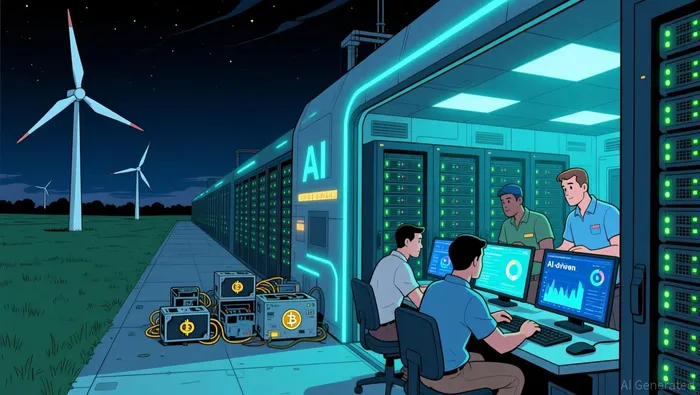
The company's Q3 2025 financial results further highlight its ability to fund this transition. Revenue surged 91% year-over-year to $83.5 million, driven by Bitcoin mining through its subsidiary, American Bitcoin. Net income jumped to $50.6 million from $0.9 million, while adjusted EBITDA reached $109 million, up from $5.6 million. These figures demonstrate Hut 8's current profitability, which it can now channel into AI infrastructure.
Notably, Hut 8 has reclassified 1,530 MW of capacity into the "Energy Capacity Under Development" category, signaling its intent to scale beyond Louisiana. This expansion, spanning four U.S. sites, aims to double the company's platform scale and diversify its market presence according to Gurufocus reporting. Such strategic capital deployment reduces geographic and sectoral risk while aligning with the growing demand for AI infrastructure.
Long-Term Value Creation: A Structural Advantage
The transition to AI infrastructure offers Hut 8 a structural advantage over its peers. Unlike Bitcoin mining, which is subject to price volatility and regulatory uncertainty, AI infrastructure is characterized by long-term, institutional-grade contracts. The 15-year lease with Fluidstack, for instance, provides a predictable revenue stream, supported by Google's financial backstop. This stability is critical for attracting institutional investors and securing debt financing.
Moreover, Hut 8's partnerships with energy providers like Entergy and technology firms like VertivVRT-- underscore its ability to execute complex projects. These collaborations mitigate execution risks and ensure that Hut 8's infrastructure meets the exacting standards of hyperscale AI operators. The company's geographic footprint in Louisiana-a region with abundant, low-cost energy-further enhances its competitive position.
For long-term value creation, Hut 8's focus on monetizing late-stage projects is equally significant. By prioritizing assets with clear utility and revenue potential, the company avoids the capital overhangs that plagued its Bitcoin mining operations. This disciplined approach, combined with its recent financial strength, positions Hut 8 to scale efficiently while maintaining profitability.
Conclusion: A Catalyst for Sustainable Growth
Hut 8's strategic pivot to AI infrastructure represents a masterclass in capital reallocation and sector transition. By leveraging its existing energy assets, securing institutional-grade partnerships, and reclassifying its capital expenditures, the company is transforming from a speculative crypto miner into a stable infrastructure provider. The Q3 2025 financial results validate its ability to fund this transition, while the River Bend campus and broader expansion plans highlight its long-term scalability.
For investors, the key takeaway is clear: Hut 8's pivot is not a reaction to market pressures but a proactive, well-capitalized strategy to capture the AI infrastructure boom. As the demand for computational power accelerates, Hut 8's ability to deliver reliable, high-capacity solutions will likely drive sustained value creation.





Comentarios
Aún no hay comentarios