
Hut 8's Resilience in 2025: A Glimpse into the Future of Bitcoin Mining Amid Sector Downturns
Bitcoin mining has long been a sector defined by volatility-price swings, regulatory uncertainty, and energy cost fluctuations. Yet, as the industry navigates a downturn in 2025, one player stands out for its operational discipline and strategic foresight: Hut 8. By combining hyper-efficient energy use, a robust BitcoinBTC-- reserve, and a diversified expansion pipeline, Hut 8HUT-- is positioning itself as a bellwether for resilience in a turbulent market.
Operational Efficiency: The Bedrock of Resilience
Hut 8's ability to thrive in 2025 hinges on its relentless focus on operational efficiency. As of September 30, 2025, the company's Bitcoin mining operations had expanded to a total hashrate of ~26.8 exahash-per-second (EH/s), with an average fleet efficiency of ~16.3 joules per terahash (J/TH). This efficiency is critical in a sector where energy costs often dictate profitability.
The company's energy cost per megawatt-hour (MWh) has plummeted to $31.63, a 30% decrease from Q4 2023. This reduction, driven by strategic partnerships with utilities like Entergy and a shift to lower-cost regions, has insulated Hut 8 from the broader industry's pain points. For context, the average Bitcoin miner in 2025 operates at energy costs exceeding $40/MWh, making Hut 8's cost structure a significant competitive advantage.
Strategic Positioning: A Bitcoin Reserve and Expansion Pipeline
Beyond operational metrics, Hut 8's strategic positioning is equally compelling. The company has built a strategic Bitcoin reserve of 13,696 Bitcoin, valued at $1.6 billion as of September 30, 2025. This reserve acts as a financial buffer, allowing Hut 8 to weather price downturns without resorting to asset sales or dilutive financing-a luxury most miners lack.
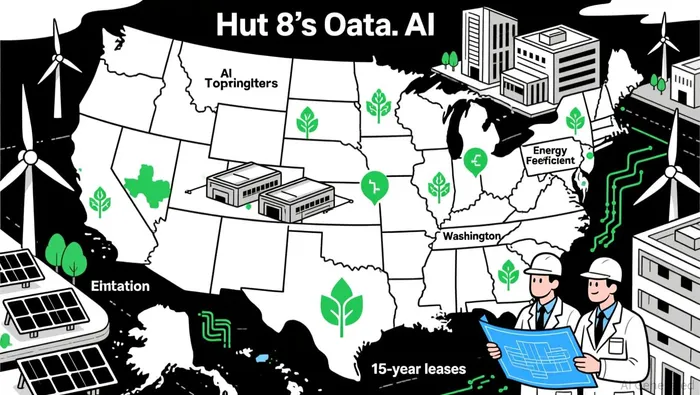
Simultaneously, Hut 8 is aggressively expanding its infrastructure. Its development pipeline now spans 8,650 MW of capacity, with 1,530 MW advanced from exclusivity into active development by Q3 2025. This includes four new U.S. sites, diversifying its geographic footprint and aligning with rising demand for energy-intensive applications like AI and high-performance computing (HPC).
A key pillar of this expansion is the 15-year, 245 MW AI data center lease at the River Bend Campus, valued at $7.0 billion. This long-term commitment underscores Hut 8's pivot toward AI infrastructure-a sector with more predictable demand than Bitcoin mining. By leveraging its energy expertise, Hut 8 is creating a dual-revenue model that reduces reliance on crypto volatility.
Capital Discipline and Execution Risk Mitigation
Hut 8's resilience is further bolstered by capital discipline. The company has launched a $500 million at-the-market (ATM) equity program and a $250 million stock repurchase program, signaling confidence in its balance sheet. These moves are particularly noteworthy in a sector where liquidity crises have forced many players into insolvency.
Execution risk-a perennial challenge in mining-has also been mitigated through partnerships with blue-chip firms like J.P. Morgan and Goldman Sachs. These collaborations ensure robust project delivery, reducing the likelihood of cost overruns or delays. As Hut 8's CEO noted in a recent earnings call, "We're not just building miners; we're building institutional-grade infrastructure."
Conclusion: A Model for the Future
Hut 8's 2025 performance demonstrates how a combination of operational efficiency, strategic reserves, and diversified infrastructure can create a moat in a volatile sector. While Bitcoin's price remains a wild card, Hut 8's energy cost discipline and AI-focused expansion pipeline position it to thrive regardless of crypto market conditions.
For investors, the lesson is clear: in a sector defined by chaos, the winners will be those who prioritize execution, efficiency, and long-term vision. Hut 8 is betting on all three-and the data suggests it's winning.





Comentarios
Aún no hay comentarios