
Huobi Founder's $1 Billion Ethereum Treasury Initiative: A Game Changer for Institutional Adoption?
The Huobi Founder's $1 billion EthereumETH-- (ETH) treasury initiative, spearheaded by Li Lin and supported by prominent Asian crypto investors, has ignited significant speculation about Ethereum's trajectory in institutional finance. This venture, structured as a regulated digital asset trust, aims to acquire and hold ETHETH-- as a core reserve asset, positioning itself as the fourth-largest public holder of the cryptocurrency, according to a FinancialContent report. With $200 million committed by Li's firm, Avenir Capital, and an additional $500 million from regional institutional investors, the initiative underscores a strategic shift toward Ethereum as a foundational asset in institutional portfolios, per BlockNews.
Ethereum's Institutional Infrastructure: A Catalyst for Growth
Ethereum's institutional adoption has been accelerating since the launch of U.S. spot Ether ETFs in July 2024, which formalized compliant access for institutions and aligned crypto with traditional asset classes, as reported by The Observer. Regulatory clarity, particularly the SEC's informal commodity classification of Ethereum under the CLARITY Act, has further enabled institutions to stake ETH without regulatory friction, generating yields comparable to fixed-income instruments, according to a Bitget article.
Technological upgrades have also played a pivotal role. The Dencun upgrade (EIP-4844) reduced Layer 2 fees by 90%, enabling scalable enterprise solutions and attracting $13 billion in tokenized real-world asset (RWA) growth, per a Mitosis analysis. Meanwhile, the rise of derivatives, RFQ networks, and custody solutions has created a compliance-friendly ecosystem, reducing counterparty risk and enhancing execution efficiency, The Observer also notes. These developments have positioned Ethereum as a programmable base layer for institutional-grade DeFi and tokenized finance.
Liquidity Dynamics and Market Implications
The Huobi initiative is expected to amplify Ethereum's liquidity dynamics by tightening circulating supply and boosting demand. By acquiring ETH as a reserve asset, the trust could reduce on-chain selling pressure, a trend observed in similar initiatives by BitMine and SharpLink, as reported by Coingape. This aligns with Q3 2025 data showing Ethereum ETFs attracting $33 billion in inflows, outpacing BitcoinBTC-- ETFs, while 9.2% of Ethereum's total supply is now controlled by corporate treasuries and ETFs, according to Crowdfund Insider.
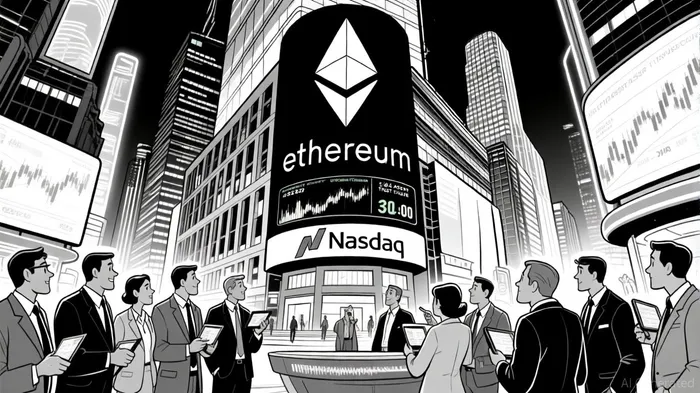
The initiative's potential to formalize through a Nasdaq-listed shell company also signals a broader trend of institutional capital seeking structured exposure to crypto. This mirrors the success of Bitcoin ETFs, where institutional-grade vehicles have driven price stability and artificial scarcity by reducing ETH on centralized exchanges, as Crowdfund Insider reported.
Institutional Strategies and Future Outlook
Ethereum's 4.8% staking yield, outpacing Bitcoin's 1.8%, has made it a preferred asset for yield generation and DeFi participation. The Huobi trust's focus on ETH aligns with this trend, as institutions increasingly prioritize assets with deflationary mechanics and utility in decentralized finance. With 36 million ETH staked and liquid staking services gaining traction, Ethereum's role as a reserve asset is further cemented, per Mitosis.
However, challenges remain. Regulatory shifts, such as the U.S. GENIUS Act of 2025, have transformed stablecoins like USDCUSDC-- into regulated instruments, but broader adoption hinges on cross-chain interoperability and custody solutions, The Observer reported. The Huobi initiative's success will depend on its ability to navigate these complexities while maintaining compliance.
Conclusion
The Huobi Founder's $1 billion Ethereum treasury initiative is a significant catalyst for institutional adoption, reflecting Ethereum's maturing infrastructure and liquidity dynamics. By aligning with regulatory clarity, technological upgrades, and institutional-grade DeFi, the initiative could accelerate Ethereum's transition from speculative asset to foundational financial layer. While risks persist, the venture underscores a broader reallocation of institutional capital toward Ethereum, positioning it as a cornerstone of the Web3 ecosystem.






Comentarios
Aún no hay comentarios