
Huntington Ingalls Industries and the Future of Unmanned Undersea Warfare: A Strategic Partnership with Babcock
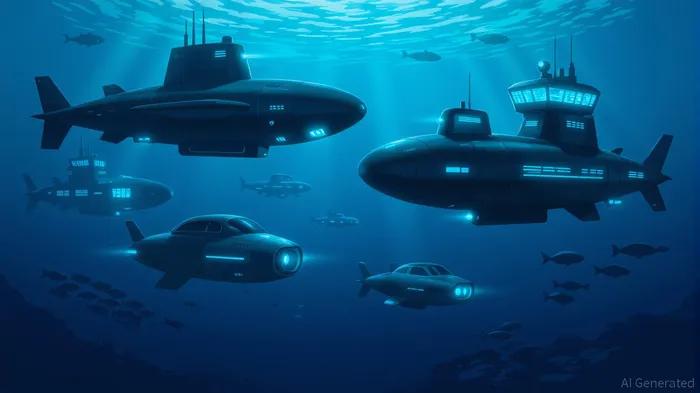
The defense sector is undergoing a seismic shift as nations prioritize autonomous systems to secure maritime dominance. At the forefront of this transformation is Huntington Ingalls IndustriesHII-- (HII), whose recent partnership with Babcock International Group has positioned it as a pivotal player in the next era of naval innovation. By aligning its nuclear shipbuilding prowess with Babcock's expertise in submarine support and decommissioning, HIIHII-- is not only expanding its technological footprint but also securing long-term growth in a high-stakes market.
Strategic Synergy: HII and Babcock's MoU
In July 2023, HII and Babcock signed a memorandum of understanding (MoU) to collaborate on unmanned undersea warfare and defense projects, leveraging their complementary strengths in naval nuclear capabilities and shipbuilding[3]. This partnership is deeply intertwined with the AUKUS trilateral agreement, which aims to equip Australia with nuclear-powered submarines while advancing joint technological development between the U.S., U.K., and Australia[3]. HII's leadership in constructing aircraft carriers and nuclear submarines—coupled with Babcock's experience in submarine maintenance and nuclear decommissioning—creates a robust framework for tackling complex defense challenges[1].
The collaboration extends beyond hardware. HII and Babcock are also partnering with academic institutions like the University of Adelaide and Curtin University through the AUKUS Workforce Alliance, ensuring a pipeline of skilled professionals to support future projects[1]. This strategic alignment underscores the companies' commitment to not just building systems, but fostering an ecosystem of innovation.
Financial Resilience and a $48 Billion Backlog
Despite a 2.5% year-over-year decline in Q1 2025 revenues to $2.7 billion, HII demonstrated operational resilience, with operating income rising to $161 million and a 5.9% operating margin—the highest in recent years[1]. The company's $48 billion backlog, bolstered by $2.1 billion in new contract awards during the quarter, provides a strong foundation for sustained revenue streams[1]. This financial stability is critical as HII invests in high-margin, technology-driven projects, including autonomous systems.
The backlog's composition further highlights HII's strategic focus. While traditional shipbuilding remains a cornerstone, the company is increasingly capitalizing on contracts tied to advanced technologies. For instance, HII's Mission Technologies division secured a $347 million contract for the Lionfish Small Unmanned Undersea Vehicle, a platform with potential for up to 200 units over five years[1]. Such projects align with the U.S. Navy's push for unmanned systems to conduct surveillance, mine countermeasures, and other high-risk missions.
Autonomous Systems as a Growth Catalyst
HII's foray into autonomous undersea systems is not merely a diversification play—it's a response to a $12.5 billion global market for unmanned underwater vehicles (UUVs), projected to grow at a 10% CAGR through 2030[4]. The Babcock partnership accelerates this trajectory by pooling resources to develop next-generation platforms. For example, the joint venture with Babcock Australasia and Bechtel Australia to support Australia's nuclear submarine program spans infrastructure development to end-of-life operations, creating a lifecycle revenue model[1].
Moreover, HII's investments in artificial intelligence, cyber warfare, and C5ISR systems position it to win contracts beyond traditional shipbuilding. These technologies are integral to autonomous systems, which require real-time data processing and secure communication networks[1]. By integrating these capabilities, HII is transforming from a shipbuilder into a comprehensive defense technology provider.
Risks and the Road Ahead
While HII's trajectory is promising, challenges remain. The development of autonomous systems is capital-intensive and subject to regulatory and technical hurdles. Additionally, geopolitical tensions could disrupt AUKUS-related projects if diplomatic relations sour. However, HII's $48 billion backlog and strategic partnerships mitigate these risks, providing a buffer to navigate uncertainties.
Conclusion: A Must-Watch for Defense Investors
Huntington Ingalls Industries is at an inflection pointIPCX--. The Babcock partnership, combined with a robust backlog and a $347 million Lionfish contract, signals a deliberate pivot toward autonomous undersea warfare—a sector poised for explosive growth. For investors, HII represents a unique opportunity to bet on the convergence of naval modernization and technological innovation. As the demand for unmanned systems intensifies, HII's ability to deliver cutting-edge solutions while maintaining financial discipline could redefine its role in the defense landscape.





Comentarios
Aún no hay comentarios