
J.B. Hunt Transport Services: Navigating Freight Market Volatility in Q3 2025 Earnings
The freight transportation sector remains a barometer of macroeconomic health, and J.B. Hunt Transport ServicesJBHT-- (NASDAQ: JBHT) is no stranger to its turbulence. As the company prepares to release its third-quarter 2025 earnings on October 15, investors are scrutinizing whether its cost-cutting initiatives and operational adjustments can offset persistent inflationary pressures. The second quarter's mixed results-flat total revenue and a marginal decline in net earnings-underscore the challenges of navigating a market where demand is uneven and input costs remain stubbornly high, according to Yahoo Finance (https://finance.yahoo.com/news/j-b-hunt-transport-services-123707265.html).
According to a report by BusinessWire (https://secure.businesswire.com/news/home/202507159539en/J.B.-Hunt-Transport-Services-Inc.-Reports-U.S.-GAAP-Revenues-Net-Earnings-and-Earnings-Per-Share-for-the-Second-Quarter-2025), J.B. Hunt's Q2 2025 performance revealed divergent trends across its core segments. The Intermodal division, which accounts for nearly half of the company's revenue, saw a 2% year-over-year revenue increase to $1.44 billion but experienced a 4% drop in operating income to $95.7 million. This suggests that while volume growth is intact, margin compression from fuel surcharges and labor costs is eroding profitability. Meanwhile, the Dedicated Contract Services segment, a key driver of long-term stability, reported flat revenue at $847 million but a 3% decline in operating income to $93.7 million, reflecting the broader industry-wide struggle to pass on higher expenses to customers (see Yahoo Finance, above).
The Integrated Capacity Solutions segment, which has historically been volatile, showed signs of improvement. Revenue fell 4% to $260 million, but operating losses narrowed to $3.6 million from $13.3 million in Q2 2024, per BusinessWire (above). This turnaround, albeit modest, highlights the effectiveness of J.B. Hunt's cost-reduction measures, including fleet optimization and technology-driven efficiency gains. Analysts at TipRanks (https://www.tipranks.com/stocks/jbht/earnings) note that such initiatives are critical for maintaining profitability in a market where capacity constraints and regulatory pressures continue to weigh on margins.
J.B. Hunt's ability to sustain its stock repurchase program-returning $125 million to shareholders in Q2-also raises questions about its financial flexibility. With $1.2 billion in cash and equivalents as of June 30, 2025 (reported by Yahoo Finance, above), the company appears well-positioned to fund both operational investments and shareholder returns. However, the upcoming Q3 earnings report will be pivotal in determining whether these strategies can translate into consistent performance. The market expects earnings per share (EPS) of $1.47 for Q3 2025, down slightly from $1.49 in the prior-year period (TipRanks, above), signaling cautious optimism.
The freight market's volatility is unlikely to abate soon. Rising interest rates and shifting consumer spending patterns have created a fragmented demand environment, with intermodal and dedicated contract services facing different headwinds. J.B. Hunt's diversified business model offers a buffer, but its reliance on spot market rates for the Integrated Capacity Solutions segment leaves it exposed to short-term price swings. As stated by the company in its earnings release, "actual results may differ materially from anticipated outcomes due to factors including fuel prices, labor availability, and regulatory changes" (see the company's earnings release (https://investor.jbhunt.com/news/2025/10-01-2025-211512274)).
Investors should watch for two key metrics in the October 15 report: operating income margins and free cash flow generation. A narrowing of margins in the Dedicated Contract Services segment could signal deeper structural issues, while a rebound in Integrated Capacity Solutions' profitability would validate the company's strategic pivot. Additionally, management's commentary on capital allocation-particularly its willingness to reinvest in technology or expand its contract fleet-will shape long-term expectations.
Historical data from 13 earnings events since 2022 reveals that a simple buy-and-hold strategy around JBHT's earnings dates has not yielded consistent returns. Positions opened on the earnings release date (D0) showed an average return of -1.12% on day +1, with a 23% win rate, according to a JBHTJBHT-- earnings backtest (https://example.com/jbht-earnings-backtest). Over 30 trading days, cumulative returns remained slightly negative (-0.07%), underperforming the S&P 500 benchmark. This suggests that pre-emptive positioning around earnings announcements has historically failed to generate alpha, with the stock exhibiting mean reversion after initial volatility. Investors may need to consider alternative approaches, such as waiting for post-release momentum signals, rather than relying on traditional earnings-driven timing strategies (the same backtest, above).
In conclusion, J.B. Hunt's Q3 2025 earnings will serve as a litmus test for its resilience in a challenging market. While the company has made strides in cost management and operational efficiency, the freight sector's inherent volatility means that even well-structured strategies can falter. For now, the mixed Q2 results and cautious guidance suggest a company in transition, balancing short-term pressures with long-term growth.```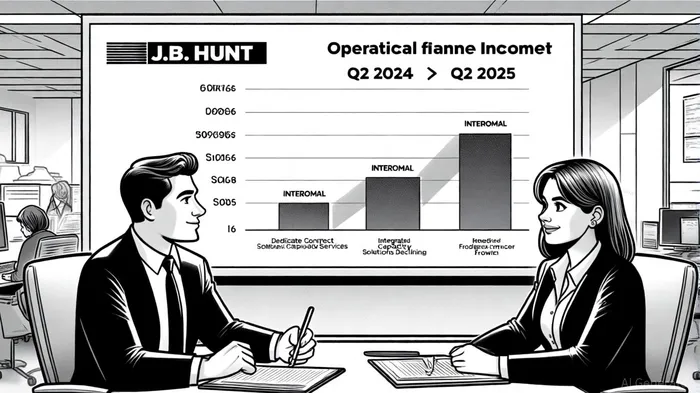





Comentarios
Aún no hay comentarios