
Hungary's Forint Under Pressure Amid Orban's Rate-Cut Demands
Hungary's forint, a currency long shaped by the interplay of political ambition and economic pragmatism, now faces renewed scrutiny as Prime Minister Viktor Orban pushes for aggressive rate cuts to stimulate growth ahead of the 2026 elections. The National Bank of Hungary (MNB) has steadfastly maintained its benchmark rate at 6.5%-among the highest in the EU-since September 2025, prioritizing inflation control and currency stability over political demands, according to the MNB press release. This standoff between Orban's government and the central bank underscores the fragility of Hungary's economic model, where political pressures and monetary policy collide in a high-stakes game of balancing growth, inflation, and regional volatility.
A Currency at a Crossroads
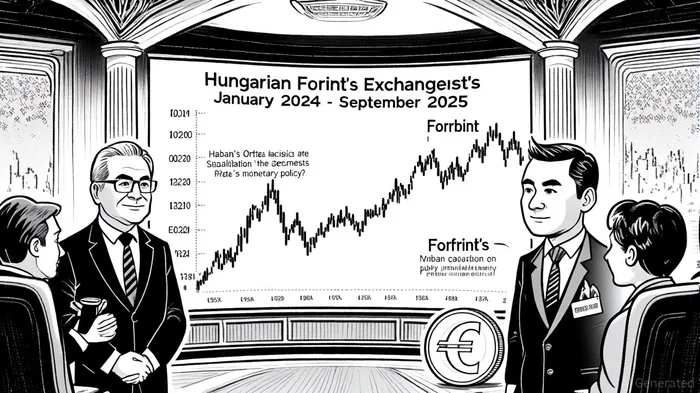
The forint's recent performance has been a mixed bag. While it has appreciated by 2.84% year-to-date against the U.S. dollar as of August 2025, according to Trading Economics, analysts warn that this strength masks deeper vulnerabilities. The MNB's decision to pause rate cuts-despite Orban's public criticism-has curbed capital outflows and bolstered investor confidence in the short term, as noted in the central bank's release. However, the central bank's caution is rooted in a grim reality: Hungary's economy is teetering on the edge of a technical recession, with GDP growth projected at a meager 1.8% in 2025, according to an Invezz forecast. Weak industrial output, declining exports to Germany, and a stubbornly high budget deficit (exceeding EU limits) have left the government reliant on fiscal stimulus, including tax cuts and public spending, to prop up growth, a trend highlighted in a Bloomberg analysis.
Orban's push for lower rates is driven by political calculus. With his Fidesz party facing a strong challenge from opposition leader Péter Magyar, who advocates for euro adoption and EU fund unfreezing, the prime minister seeks to inject liquidity into the economy to shore up public support; the MNB's September statement has repeatedly resisted those calls. Yet, as the MNB's September release emphasized, inflation risks remain "upside-biased" due to global supply chain fragmentation and high services prices. This divergence between political and monetary priorities creates a precarious environment for the forint, where any premature rate cut could trigger a depreciation spiral, eroding consumer confidence and inflating import costs, a risk also discussed in a recent FinancialContent article.
Central Europe's Volatility Amplifier
Hungary's currency risks are further compounded by broader regional dynamics. Central Europe's emerging markets are grappling with divergent monetary policies: the ECB's 2.00% rate contrasted with the Fed's 4.00%–4.25% cut in Q3 2025, according to a Reuters report. This divergence has fueled euro strength, complicating Hungary's export competitiveness and inflating debt servicing costs for foreign-currency borrowers. Meanwhile, the Bank of England's pause on easing due to 3.7% inflation adds to the uncertainty, creating a patchwork of policy responses that amplify cross-border volatility.
For Hungary, the stakes are particularly high. The forint's recent resilience-partly due to the MNB's intervention to curb capital outflows-hides a fragile undercurrent. If Orban's demands for rate cuts gain traction, the forint could face renewed depreciation pressures, mirroring its near-two-year low against the euro in October 2024, a scenario outlined in the FinancialContent analysis. Such a scenario would exacerbate inflation, strain public finances, and deepen the government's reliance on EU funds, which remain frozen due to governance disputes, as noted in the Invezz coverage.
Investment Implications and Strategic Risks
Investors navigating Hungary's market must weigh several critical factors. First, the forint's short-term strength may not be sustainable if the MNB relents to political pressure. A rate cut could trigger a sell-off in the currency, increasing hedging costs for foreign investors and inflating import-dependent sectors like manufacturing-a risk flagged in a China–CEE briefing. Second, the government's fiscal stimulus-while politically expedient-risks widening the budget deficit, potentially triggering a downgrade in Hungary's credit rating and raising borrowing costs, as previously discussed by Bloomberg.
Conversely, the MNB's current stance offers a degree of stability. By maintaining rates at 6.5%, the central bank has managed to anchor inflation expectations and prevent a full-blown currency crisis, according to the MNB's September statement. However, this strategy is a double-edged sword: prolonged high rates could stifle growth, fueling public discontent and strengthening Magyar's opposition, which promises a more EU-aligned economic agenda, as analysts have pointed out.
Conclusion: A Delicate Balancing Act
Hungary's forint stands at a crossroads, reflecting the broader tension between political expediency and economic fundamentals. Orban's rate-cut demands highlight the challenges of governing in an era where monetary policy is increasingly politicized. For investors, the key lies in monitoring the MNB's response to these pressures and the government's ability to balance growth with fiscal discipline. While the forint's near-term trajectory appears stable, the long-term outlook hinges on whether Hungary can reconcile its illiberal governance model with the structural reforms needed to attract sustainable investment and navigate Central Europe's volatile landscape.







Comentarios
Aún no hay comentarios