
Humanoid Robots and the Future of Work: Assessing Tesla's Optimus as a Strategic Investment in the Automation Revolution
The rise of humanoid robotics, spearheaded by Tesla's Optimus, marks a pivotal shift in global economic dynamics. Elon Musk's vision of a future where robots "eliminate poverty" and render traditional labor optional has moved from speculative hype to a tangible investment thesis. With Tesla's Gen 3 Optimus expected to enter mass production by 2026 and a projected annual output of 10 million units by 2027 according to market analysis, the company is positioning itself at the forefront of a $5 trillion humanoid robot market by 2050 as projections suggest. This article evaluates the investment case for Tesla's Optimus, balancing Musk's bold claims with economic analyses, production timelines, and competitive risks.
Technical Advancements and Production Timelines: A Foundation for Scalability
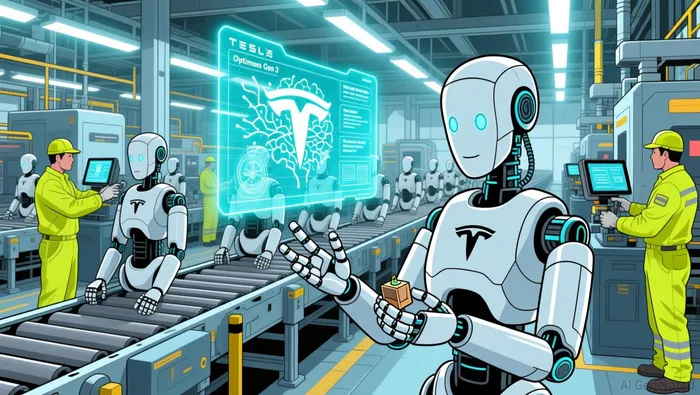
Tesla's Optimus has demonstrated rapid iteration, with recent milestones including the ability to run, showcasing improved balance and coordination according to Elon Musk. The Gen 3 version, set for full-scale production by early 2026 as reported, incorporates advanced features such as five-fingered hands for dexterity and onboard neural networks for autonomous decision-making according to technical specifications. Tesla's Gigafactory Texas is being retooled to produce 5,000–10,000 units in 2025, scaling to 50,000 by 2026 according to industry forecasts. These timelines suggest a deliberate push toward affordability, with unit costs projected to fall between $20,000 and $30,000 at scale according to market estimates.
However, production challenges persist. Robotics experts note that Tesla's reliance on classical control methods, rather than machine learning, may limit adaptability in real-world environments according to industry analysis. Additionally, manual dexterity-critical for tasks like object manipulation-remains a technical hurdle according to experts. These issues underscore the complexity of scaling humanoid robotics but also highlight Tesla's engineering prowess in fast-tracking solutions.
Economic Impact: Disruption, Productivity Gains, and Poverty Reduction
Musk's assertion that Optimus could "eliminate poverty" hinges on two key mechanisms: productivity amplification and labor cost reduction. By operating 24/7 with 5x the productivity of a human according to Musk, Optimus could drive exponential economic output, potentially increasing global GDP by factors of 10–100 according to projections. This aligns with IMF projections that AI and robotics could affect 40% of global employment, though with uneven impacts across skill levels and regions according to the IMF.
Academic studies corroborate the dual-edged nature of this disruption. A 2025 MIT analysis found that industrial robots reduce employment and wages for lower-income workers, displacing 0.2 percentage points of jobs per robot deployed according to research. Similarly, the World Bank warns that while productivity gains may create jobs for skilled workers, low-skilled laborers often migrate to informal sectors according to findings. Yet, Musk's vision of a "universal high income" assumes that surplus productivity will be redistributed, a claim critics argue lacks a clear funding mechanism according to analysis.
The IMF and World Bank have cautiously acknowledged the potential of AI and robotics to address labor shortages and aging populations according to reports, but emphasize the need for policies to mitigate inequality. For instance, the IMF advocates for social safety nets and retraining programs to manage displacement according to policy recommendations, while the World Bank highlights the importance of "small AI" solutions in developing economies according to their analysis. Tesla's Optimus, with its general-purpose design, could bridge this gap if deployed in sectors like healthcare and logistics, where labor shortages are acute according to industry experts.
Investment Case: Market Growth, Competitive Positioning, and Valuation
Tesla's Optimus is increasingly factored into Wall Street valuations. Stifel analysts allocate 6% of their $483 price target for Tesla's stock to Optimus, reflecting confidence in its long-term value according to analyst reports. The global humanoid robotics market, valued at $1.4 billion in 2024, is projected to grow to $11 billion by 2030 according to market research, with Asia-Pacific leading expansion according to regional analysis. Tesla's first-mover advantage in general-purpose robotics-compared to niche players like Figure 03 and 1X NEO-positions it to capture a significant share of this growth according to industry experts.
However, competition from China's state-backed robotics industry poses a critical risk. China installed 290,000 industrial robots in 2023 alone according to data, and its 15th Five-Year Plan prioritizes humanoids as strategic assets according to official documents. Tesla's success will depend on its ability to leverage China's manufacturing ecosystem while maintaining technological differentiation.
Risks and Challenges: From Production Bottlenecks to Ethical Concerns
Despite its potential, Optimus faces multifaceted risks. Production bottlenecks, such as hand dexterity issues according to technical reports, could delay timelines. Economically, the displacement of low-skilled workers may exacerbate inequality unless governments implement universal basic income or retraining programs according to economic analysis. Ethically, the integration of autonomous robots raises questions about job redefinition and human-centric innovation according to experts.
Moreover, Musk's vision of a post-scarcity economy-where money becomes obsolete-remains speculative. While AI-driven abundance could reduce the cost of goods, the transition period may see heightened social and political tensions. Investors must weigh these uncertainties against Tesla's track record of turning ambitious projects into commercial realities.
Conclusion: A High-Risk, High-Reward Bet on the Future
Tesla's Optimus represents a transformative play on the automation revolution, with the potential to redefine labor markets and poverty alleviation. Its production timelines, technical advancements, and Musk's bold economic claims create a compelling narrative for long-term investors. However, the path to mass adoption is fraught with technical, economic, and ethical challenges. For those willing to navigate these risks, Optimus could be the linchpin of Tesla's evolution into a $25 trillion enterprise according to market analysis, reshaping industries and societies in the process.





Comentarios
Aún no hay comentarios